Published: June 2026 | Last Updated: June 2026
Strength Training for Men Over 30: The Minimum Effective Training Week
The honest answer to “how much do I actually need to train?” is less than most fitness content suggests. Strength training for men over 30 does not require five days a week, a dedicated gym membership, or programming designed for professional athletes. Two full-body sessions a week, built around compound lifts, can help reverse muscle loss, drive measurable strength gains, and build a physical base that holds for decades.
The bigger risk is not under-training. After 30, men lose roughly 3–5% of muscle mass per decade without resistance training, according to Harvard Health. The physiology behind that decline – particularly the loss of fast-twitch muscle fibers – responds specifically and only to intentional strength work.
General activity, walking, and even cardio do not preserve what compound lifting protects. If you have read why your body is the most important asset you will ever own, you already know the cost of neglecting this. This article is the operational follow-up: exactly how much, how often, and what the minimum structure looks like in practice.
For the full evidence case before you commit to a program, the benefits of strength training for men covers it in depth.
Medical Disclaimer: The information in this article is for educational purposes only and does not constitute medical advice. It is not a substitute for diagnosis, treatment, or guidance from a qualified healthcare professional. If you have any existing health conditions, joint issues, or concerns about starting a resistance training program, consult your physician before beginning. Individual results vary.
Disclosure: This article contains affiliate links. If you click through and make a purchase, I may earn a small commission at no extra cost to you. I only recommend products I genuinely believe in. As an Amazon Associate I earn from qualifying purchases.
Strength Training for Men Over 30 – Defined
Strength training for men over 30 is a structured approach to resistance exercise designed to counteract age-related muscle loss, preserve fast-twitch fiber function, and build measurable strength through progressive overload on compound movements. It matters because the window between 30 and 50 is the best window to build a physical buffer before sarcopenia accelerates. This guide is for men who have limited time, want evidence-backed minimum doses, and are building a training habit from scratch or restarting after a break.
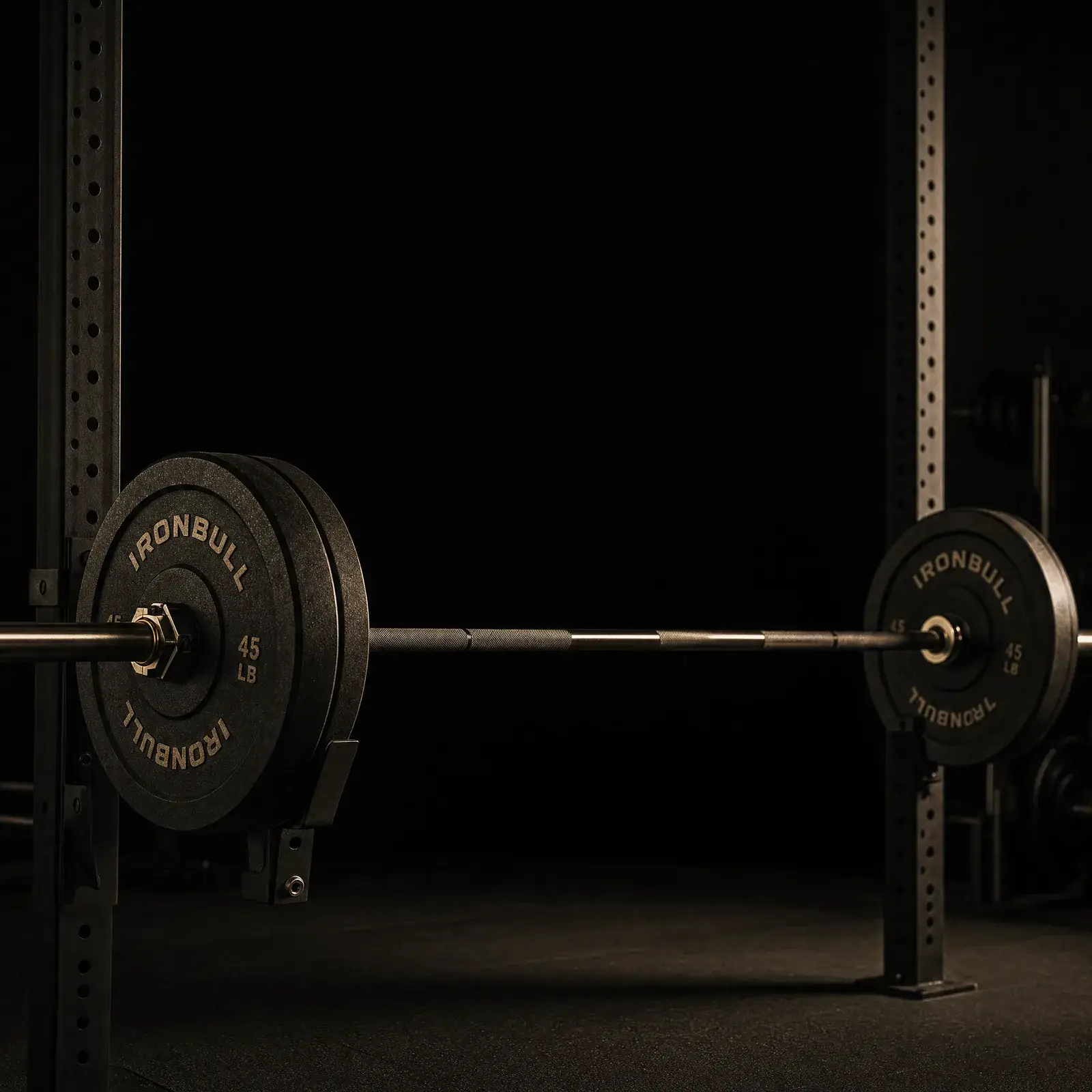
Here is the direct answer: two resistance training sessions per week, each covering the full body with compound lifts and 3 working sets per movement, is enough for real strength gains in men over 30. A 2024 overview published in Sports Medicine found that even a single session per week produces strength improvements of 6–57% compared to untrained controls. Two sessions with volume matched to higher-frequency programs produces comparable gains.
You do not need more to start – you need to start.
Quick Takeaways
- Two full-body sessions per week is the research-backed minimum for strength gains
- Muscle loss after 30 is real but largely reversible with consistent training
- Fast-twitch fibers require compound lifts – cardio alone cannot preserve them
- The 2-Day delivers ~6 sets/muscle/week (MV) – enough for real gains in untrained men
- Protein target: at least 1.6 g/kg/day for lower-body strength gains
- Early gains are neurological – visible muscle follows at weeks 8–12
What Is the Minimum Effective Training Week for Men Over 30?
The minimum effective training week is the smallest dose of structured resistance exercise that produces measurable improvements in strength and muscle mass. For men over 30, the research converges on two full-body sessions per week as the floor for progress. A 2024 overview published in Sports Medicine found that even minimal-dose strategies – as few as one session per week with four or more exercises – improved strength by 6–57% compared to untrained controls across multiple studies.
Two sessions per week, when volume is matched to higher-frequency programs, produces comparable gains to training three or more days a week, according to research published in Sports Medicine in 2021. The implication for time-constrained men is significant: you are not leaving most of the gains on the table by training twice a week. What drives results is not how many days you train, but how much quality work you accumulate per muscle group over the week.
Why Two Days Works
A full-body program on two non-consecutive days – Monday and Thursday, for example – allows each muscle group to recover fully before being trained again. Recovery is when muscle protein synthesis elevates and actual tissue remodeling occurs. For men who are also sleeping under seven hours, managing work stress, or carrying family responsibilities, under-recovery is a bigger threat than under-training.
Two sessions respects that constraint while still delivering a training stimulus at maintenance volume. The 2-Day template in this article produces approximately 6 sets per major muscle per week – which the RP Strength framework identifies as MV (maintenance volume). That level keeps the muscle you have and, for untrained or returning men, typically also produces real strength and size gains during the early adaptation window.
Adding a third session – or a fourth set per movement on the 2-Day – pushes volume toward the 10-sets-per-week growth zone that Dr. Andy Galpin identifies as the minimum hypertrophy target. Only the added-accessory or third-session option actually enters that zone.
Why Muscle Loss Accelerates After 30 – and What That Means for Your Training
Men begin losing muscle mass around age 25, with the rate running at roughly 3–5% per decade through the 30s, according to Harvard Health. By age 75, strength declines at approximately 3–4% per year, and most men without resistance training lose around 30% of their total muscle mass over their lifetime. The 30s are the most strategically important window: building a larger muscle base now creates a buffer against the accelerated losses that arrive in the 50s.
Testosterone declines approximately 1% per year after age 30, according to the Cleveland Clinic. At 30–35, that is a mild reduction of roughly 5–10% from peak – not yet clinically limiting for most men. The bigger physiological levers at this age are training consistency and protein intake.
The Fast-Twitch Fiber Problem
The muscle you lose fastest after 30 is not the slow-twitch fibers responsible for endurance activity. Type II fast-twitch fibers – responsible for explosive force, speed, and the dense functional strength that carries over to everything from carrying loads to protecting joints – decline with aging in a way that intentional high-force training can counter.
Dr. Andy Galpin’s framing is direct: fast-twitch fiber atrophy is almost exclusively the problem with aging muscle, and you cannot preserve those fibers through general activity. Cardio does not recruit them at high enough intensities.
Only intentional high-force efforts – compound lifts at moderate to heavy loads – maintain Type II fiber function. That is why strength training for men over 30 is not optional if you want to age with physical capability intact.
Anabolic Resistance – Not Your Problem at 30
Anabolic resistance – the blunted muscle protein synthesis response to protein and training stimulus – intensifies with aging, but primarily from the mid-40s onward. At 30, your anabolic response remains largely intact.
The fix for anabolic resistance when it does become relevant is higher protein per meal (closer to 40 grams rather than 20–25 grams) and higher training intensity. That is planning information for your 40s, not a constraint in your 30s.
Volume Landmarks: MV, MEV, and the Growth Zone
Three numbers clarify every programming decision. These are the volume landmarks from RP Strength (Dr. Mike Israetel), the most widely used applied framework in evidence-based training.
MV (Maintenance Volume) – ~6 sets per muscle per week. At this level, you keep the muscle you have without growing it. Useful during high-stress periods, travel weeks, or injury management. Below this, you begin to lose muscle.
MEV (Minimum Effective Volume) – ~10 sets per muscle per week. This is the floor for men who want to build, not merely maintain. A 2025 meta-regression by Dr. Brad Schoenfeld and Grgic across 67 studies and 2,058 participants confirmed a continuous dose-response relationship between training volume and both size and strength – approximately 0.24% additional size per extra weekly set at an average of 12.25 sets.
Optimal Range – 10–20 sets per muscle per week. This is the productive zone for most men over 30. Beyond 20 sets, recovery costs begin outweighing the marginal gains for drug-free trainees without elite recovery capacity.
What This Means Practically
The 2-Day template below delivers approximately 6 sets per major muscle per week – sitting at MV (maintenance volume). For untrained or returning men, that is enough to drive real strength gains during the early adaptation window. It is a solid, sustainable starting point.
The 3-Day template pushes most muscles to 9–15 sets per week – at or just inside the 10–20 set growth zone. Men who can recover from three sessions will see faster hypertrophy there. The upgrade path is also available on the 2-Day: adding a fourth set per compound movement or a second accessory exercise per muscle brings weekly totals closer to 10 sets without adding a full session.
The 2-Day Full-Body Template
Run this on any two non-consecutive days – Monday and Thursday, Tuesday and Friday, or any split with at least 48 hours between sessions. Each session takes approximately 45–55 minutes.
A1: Squat Pattern – Goblet Squat or Barbell Back Squat – 3 sets x 8–10 reps – RPE 7–8
A2: Hip Hinge – Romanian Deadlift or Trap Bar Deadlift – 3 sets x 8–10 reps – RPE 7–8
B1: Horizontal Push – Dumbbell or Barbell Bench Press – 3 sets x 8–12 reps – RPE 7–8
B2: Horizontal Pull – Dumbbell Row or Barbell Row – 3 sets x 8–12 reps – RPE 7–8
C1: Vertical Pull – Lat Pulldown or Assisted Pull-Up – 2 sets x 10–12 reps
C2: Core – Pallof Press or Plank Variation – 2 sets x 30–45 seconds
Weekly Volume Output (2-Day)
- Quads and Glutes: approximately 6 sets per week
- Hamstrings and Hips: approximately 6 sets per week
- Chest: approximately 6 sets per week
- Back: approximately 10 sets per week
- Core: approximately 4 sets per week
This volume sits at maintenance for most muscles – enough to preserve and strengthen what you have, with genuine strength gains during the early adaptation phase. To move toward the 10-set growth zone on the 2-Day, add a fourth set to each compound movement or add one accessory movement per muscle (e.g. a cable row alongside the barbell row for back).
Rest periods: 2–3 minutes between working sets for the compound movements (A and B pairings). Allow 60–90 seconds for the supplementary work (C pairings).
The 3-Day Full-Body Template
The 3-Day template adds one session per week on top of the 2-Day structure. Monday, Wednesday, and Friday is the classic arrangement – it preserves a rest day between every session. Add these movements to each session, or distribute them across the three days by feel.
Each 3-Day session runs approximately 55–65 minutes in total.
Overhead Press: 3 sets x 8–10 reps – adds shoulder volume and a vertical push pattern
Incline Dumbbell Press or Cable Fly: 2 sets x 12–15 reps – chest work at peak contraction
Face Pull or Band Pull-Apart: 2 sets x 15–20 reps – rear delt and rotator cuff health
Optional – Bicep Curl / Tricep Pushdown Superset: 2 sets each
Weekly Volume Output (3-Day)
- Quads and Glutes: approximately 9 sets per week
- Hamstrings and Hips: approximately 9 sets per week
- Chest: approximately 12 sets per week
- Back: approximately 15 sets per week
- Shoulders: approximately 9 sets per week
This puts most muscles at or just inside the 10–20 set growth zone – the evidence-backed range for consistent hypertrophy with adequate recovery between sessions. Testosterone optimization and sleep quality amplify everything in this range; see the BTO guides on how to naturally increase testosterone and how to improve sleep quality for the supporting framework.
Progressive Overload: The Only Rule That Actually Matters
Progressive overload means systematically increasing training demand over time. Without it, training maintains what you have but does not build. The simplest application: add 2.5–5 lbs when you reach the top of your rep range at RPE 7 or lower for two consecutive sessions.
RPE – Rate of Perceived Exertion – measures how hard a set felt on a 0–10 scale. RPE 7 means you had approximately three reps left in the tank; RPE 8 means two reps in reserve. The sustainable training zone for men over 30 is RPE 7–9 on the last working set of each movement.
Training consistently below RPE 7 does not generate enough stimulus for growth. Training consistently above RPE 9 accumulates systemic fatigue that impairs recovery – particularly relevant for men managing demanding professional schedules.
Tracking Progress Without Overcomplicating It
A simple training log – even a notes app on your phone – is enough. Record the weight, sets, and reps for every working set.
Most men stall not because their program is wrong but because they stop tracking and default to doing the same session on feel every week. The log is the entire system.
The Minimum Nutrition Stack
Training creates the stimulus. Protein provides the raw material. Without adequate protein intake, the training signal is real but the building blocks to act on it are not available.
Research published in Sports Medicine in 2022 found that at least 1.6 grams of protein per kilogram of bodyweight per day was the threshold for strength gains in the lower body. The International Society of Sports Nutrition recommends 1.4–2.0 grams per kilogram per day for exercising individuals seeking strength and body composition improvements. At 80 kilograms (176 lbs), that is 128–160 grams of protein per day.
Protein distribution across the day matters more than post-workout timing. Aim for three to four protein-containing meals rather than concentrating intake around training.
On Creatine
Creatine monohydrate is the most researched ergogenic supplement available. Five grams per day is the effective dose – no loading phase required. The evidence for creatine’s effect on strength, power output, and lean mass in men is strong and well-replicated.
BTO’s full breakdown of the evidence is in the creatine monohydrate guide. If you do only one thing nutritionally beyond hitting your protein target, creatine is it. Nutricost Creatine Monohydrate is a solid budget pick – unflavoured powder, 5 grams in water, done.
Recovery Is Not Optional
Sleep is where muscle protein synthesis peaks and testosterone production runs its highest volume. Consistently sleeping under seven hours blunts both. The training program above will produce far less than its theoretical output if sleep debt is chronic.
What to Expect: A Realistic Timeline
The first three weeks of training are primarily neurological. Your nervous system is learning motor patterns it has not used at high loads before. Strength goes up quickly – not because you built new tissue, but because your brain is getting more efficient at recruiting the muscle fibers you already have.
Do not confuse early strength gains with a license to add weight aggressively. Let form quality lead the load.
From weeks 4 through 8, the training stimulus begins producing structural changes. Muscles begin retaining more water and glycogen. Visible muscle changes are typically noticeable by week 8–12 for men who are consistent and eating enough protein.
Months 3–12: The Real Gains Window
The newbie gains window lasts approximately 6–12 months for men starting resistance training for the first time or returning after a long break. Fitbod’s data suggests a lifter starting with a 110 lb squat one-rep maximum can realistically reach approximately 140 lbs within 20 weeks – a gain of roughly 27%.
Muscle tissue accrual in year one runs approximately 1–2 lbs of lean mass per month for men who are eating, sleeping, and training consistently, according to BodySpec.
Mistakes to Avoid
Chasing soreness. Delayed-onset muscle soreness does not correlate with hypertrophy. A session that leaves you functional tomorrow is better than one that leaves you unable to sit down.
Avoiding compound lifts because of injury fear. The most common response to joint discomfort in men over 30 is to default to machine-based isolation work. The problem: Type II fiber retention requires high-force multi-joint efforts. The fix is better warm-up sequences, more conservative load progression, and form quality ahead of load.
Training every day. Muscle tissue is built in the 48–72 hours after the session, not during it. Two to three sessions per week with full recovery between sessions will outperform daily training with chronic under-recovery.
Undereating protein. Most men eating without tracking consume 60–90 grams of protein per day – roughly half the research-backed threshold for strength gains. Hitting 1.6 grams per kilogram requires intention. If you are consistently short, a quality whey is the simplest fix – Optimum Nutrition Gold Standard Whey delivers 24 grams per serving and has been the category benchmark for years.
2-Day vs. 3-Day: Which Is Right for You?
2-Day Full-Body Program
- Best for: Men returning to training, very limited schedules, high-stress periods
- Weekly sets: ~6 sets per muscle group (MV – real gains for beginners)
- Session length: 45–55 minutes
- Recovery demand: Low – 5 full rest days per week
- Results: Meaningful strength gains, early-phase muscle growth
- Upgrade path: Add a 4th set or one accessory movement to move toward the 10-set growth zone
3-Day Full-Body Program
- Best for: Men with 3 available days, ready for higher volume, already building habit
- Weekly sets: ~9–15 sets per muscle group (at or just inside the 10–20 set growth zone)
- Session length: 55–65 minutes
- Recovery demand: Moderate – 4 rest days per week (alternating structure)
- Results: Faster hypertrophy, more direct shoulder and chest development
- Upgrade signal: When strength plateaus on 3-Day and sleep and protein are dialed in

Source: RP Strength – Volume Landmarks for Muscle Groups (Dr. Mike Israetel)
Frequently Asked Questions
Can you still build muscle after 30?
Yes – strength training for men over 30 produces the same fundamental adaptations as training in your 20s. The physiology changes gradually, but the muscle-building response remains largely intact through the 30s. Anabolic resistance becomes more clinically significant in the mid-40s and beyond, not at 30.
How many days a week should a man over 30 lift weights?
Two days per week is the research-backed minimum for strength and muscle gains. Three days is the evidence-backed sweet spot for men who want faster hypertrophy and can manage the recovery demand. More than three days per week is not necessary for men at the beginner-to-intermediate level.
How many sets per muscle group per week should men over 30 do?
The minimum effective volume for growth is approximately 10 sets per muscle group per week, based on the RP Strength framework. Six sets per week maintains existing muscle – and produces real gains for untrained men in the early adaptation phase. The optimal growth range for most men over 30 is 10–20 sets per muscle per week.
What are the best exercises for men over 30?
Compound movements produce the highest return per set: squat patterns, hip hinges (Romanian deadlift, trap bar deadlift), horizontal push (bench press), horizontal pull (row), and vertical pull (lat pulldown, pull-up). The 2021 Sports Medicine time-efficient training review confirms compound-focused training produces greater systemic strength development than isolation-only approaches. These movements also train Type II fast-twitch fibers – the primary fiber type lost with aging.
Does testosterone decline affect muscle building after 30?
Testosterone declines approximately 1% per year after 30, according to the Cleveland Clinic. At age 30–35, that represents a mild reduction that is not clinically limiting for most men. The primary performance levers at this stage are training consistency, protein intake above 1.6 g/kg/day, and sleep quality.
How long does it take to see results from strength training after 30?
Strength increases are noticeable within the first three weeks – these are primarily neurological adaptations. Visible muscle fullness typically appears by weeks 8–12 for men who are consistent and eating adequate protein. Over 20 weeks of structured training, beginners can expect meaningful strength gains; data from Fitbod suggests approximately a 27% squat strength increase over that period as a reasonable benchmark.
Is cardio bad for muscle building after 30?
No – concurrent training does not meaningfully interfere with muscle building at moderate cardio volumes. Zone 2 cardio at 2–3 sessions per week supports cardiovascular health without impairing recovery from strength training. The BTO guide on how much cardio you actually need covers the evidence-based approach to combining both.
How I Know This
I spent three years training six days a week alongside my best friend, a marine veteran, who had the kind of structured approach to physical training that most gym-goers never encounter. We tracked sets and reps on paper. We ran the same compound movements week after week and measured the incremental weight added.
What I learned from that period is that the compound lift principle is not complicated. The squat, the deadlift, the row, the press – when you run those movements with honest progressive overload and eat enough protein, the results follow a predictable curve. The result comes from repeating high-quality work over months, not from variety.
After that training block, I went years with minimal gym access. The strength I had built took years to fully erode, but the fast-twitch quality, the explosive capacity, the dense functional strength – that faded faster than anything else.
When I returned to structured training, the difference between “moving around and staying active” and “actually loading the compound patterns with intent” was immediately obvious. That gap is exactly what this article is designed to close for men in their 30s who are not yet fully committed to a program.
Closing: The Minimum Viable Physical Life
Strength training for men over 30 builds the physical infrastructure for a life that does not become increasingly constrained by declining capacity. The aesthetics follow on their own. The men who build this habit now – two sessions, compound lifts, 10 sets per muscle where possible, 1.6 grams of protein per kilogram – are making a compounding investment in everything else they want to do over the next 40 years.
Break The Ordinary is built on the conviction that independence is physical as well as financial. You cannot build anything for long on a body that is quietly losing its capability. The minimum effective training week is not the ceiling – it is the floor you build your life on.
Start with two sessions. Track the weight. Add protein, stay consistent for 12 weeks, and reassess from evidence.
What to Read Next
About the Author
Randal is the founder of Break The Ordinary, a content platform for men building financial independence and a life on their own terms. He spent three years training six days a week under the mentorship of a marine veteran, developing practical knowledge of strength training and nutrition from real practice. Randal built Break The Ordinary as a systematic platform – not theory-first – and every article goes through research, fact-checking, and structured review before publication.