Published: June 2, 2026 · Last updated: June 2, 2026
Anthropic Files for an AI IPO: What a Draft S-1 Means for Your Money
On June 1, 2026, Anthropic confirmed it has confidentially submitted a draft S-1 to the SEC for a proposed initial public offering. So yes, an Anthropic AI IPO is now one of the year’s most watched market events. But for anyone trying to build wealth, the question that matters is narrower: can you actually buy in, and should you?
Plenty of headlines will call this the AI IPO of the decade. The harder, more useful job is turning that noise into a plan, the same way our guide on how to build an investment portfolio turns market events into decisions, and our piece on why most people never build wealth explains why chasing hype tends to be the expensive habit.
This article is for informational purposes only and does not constitute financial advice. Always consult a qualified financial advisor before making investment decisions.
What This Article Covers
- What a confidential draft S-1 actually is
- What Anthropic confirmed, and what it did not
- Whether retail investors can buy an AI IPO
- The disciplined move instead of chasing the pop
- Mistakes to avoid reading this news
- Chasing the open versus disciplined exposure
- Frequently asked questions
A confidential draft S-1 is an early, private version of the registration document a company files with the SEC before going public, submitted for staff review without disclosing share count, price, or valuation. It signals that a company is serious about listing while still committing it to nothing. For the company it is a paperwork milestone. For you it is not a buy signal.

The short answer: a confidential draft S-1 is a private first step, not an open door. Anthropic has signaled it wants to list, but it set no price, no share count, and no firm date. For most retail investors, there is nothing to buy today. The disciplined move is patience, not a chased first-day pop.
Quick Takeaways
- Anthropic confidentially submitted a draft S-1 to the SEC on June 1, 2026.
- A confidential S-1 sets no price, share count, or valuation.
- The full prospectus only becomes public closer to any listing.
- Retail rarely buys an AI IPO at the offer price.
- First-day pops are not guaranteed and can reverse.
- Broad, low-cost index exposure beats chasing one hyped name.
What Is a Confidential Draft S-1?
A confidential draft S-1 is the early, non-public version of the document a company must file before selling shares to the public. The company submits it to the SEC for private staff review under a process created by the JOBS Act. Crucially, it does not set a price, a share count, or a valuation.
Why the confidential part matters
Under Securities Act Section 6(e), a company can submit a draft registration statement for confidential, non-public review before any public filing. The detailed terms stay private during that review. According to the SEC JOBS Act guidance, this lets a company test the waters with regulators while keeping its financials out of competitors’ hands.
There is also a built-in deadline that protects investors. The company has to publicly file its submission and all amendments no later than 15 days before it runs its roadshow. That public S-1 is the document you can actually read, with real numbers, before any shares trade.
What Did Anthropic Actually Confirm?
Anthropic confirmed it confidentially submitted a draft registration statement on Form S-1 for a proposed IPO of its common stock. In its own words, the number of shares and the price have not yet been set, and any offering will depend on market conditions. The notice was issued under Rule 135 and is not an offer to sell securities.
What the filing does not disclose
This is where careful reading separates signal from hype. A confidential draft S-1 discloses no terms publicly, so any valuation figure attached to this news is reported, not filed. Per Fortune on June 2, 2026, Anthropic was reportedly valued near $965 billion after a $65 billion round in May 2026, with a reported revenue run-rate around $47 billion. Big numbers. None of them came out of the filing.
Treat those numbers as press reporting, not facts from the filing itself. The company set no price, so no valuation is official yet. As CNBC noted on June 1, 2026, the timing is also open, with a possible fall listing floated but nothing confirmed.
A confidential S-1 commits the company to nothing and gives you nothing to buy. It is a signal of intent, read it that way.
Break The Ordinary
Can Retail Investors Actually Buy an AI IPO?
Usually not at the price that makes headlines. Most of the first-day gains in a hot AI IPO go to the institutions that got allocations at the offer price. By the time an individual can place an order, the price has often already swallowed the hype.
How IPO access really works
Some brokerages do offer IPO participation, including Fidelity, Schwab, and Robinhood. Access typically requires an account that meets minimum balance or trading-activity thresholds, and priority tends to go to premium or long-standing clients. Even then, allocations are small and not guaranteed.
And the first-day pop cuts both ways. The opening trade can come in below the offer price, and early trading is volatile with almost no price history to anchor it. Buying into that first hour on emotion is closer to gambling than investing.
What Is the Disciplined Move Instead?
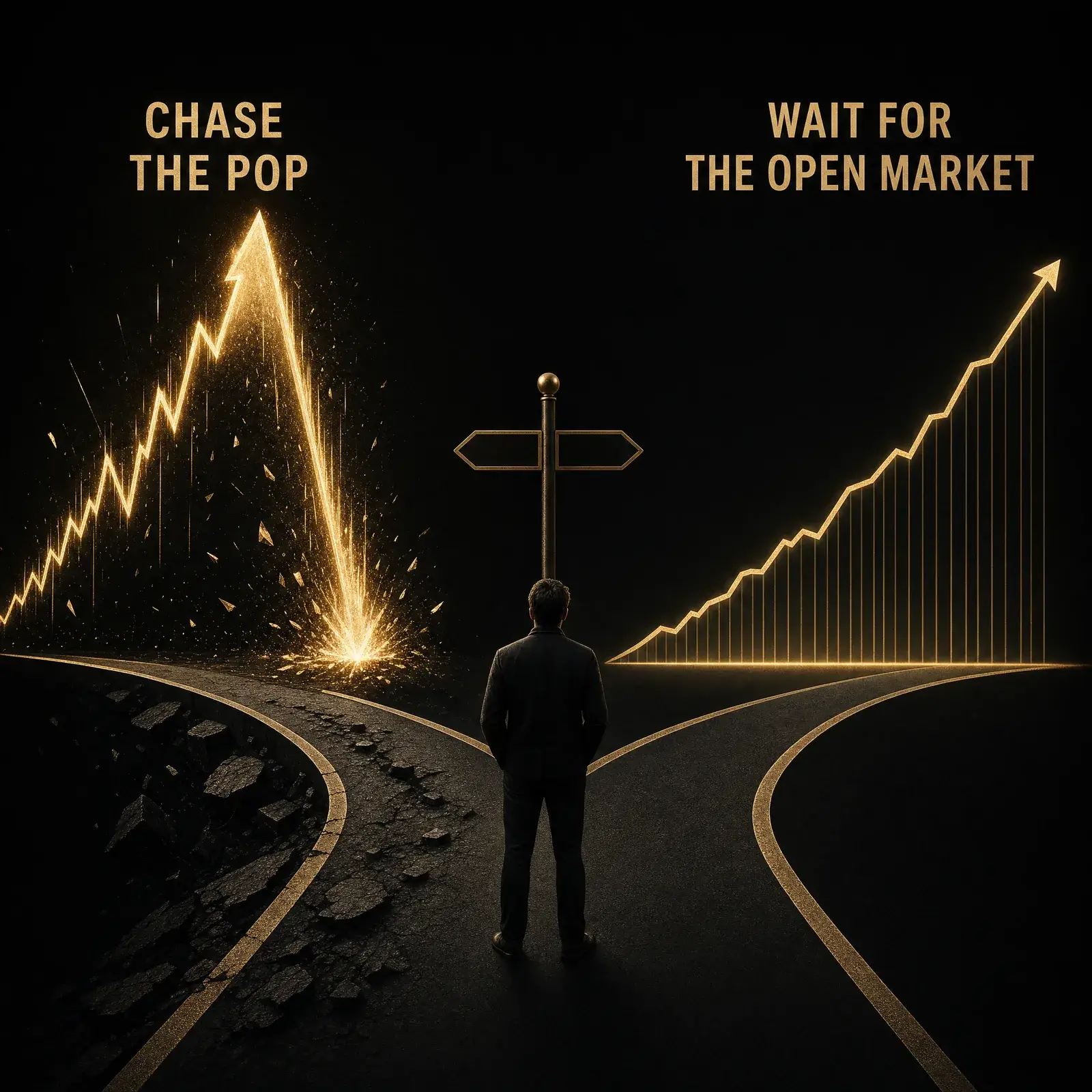
Slow down and let the company become readable. When the public S-1 drops, you get real financials, real risk disclosures, and an actual price range to judge against. That is the moment to form a view, not the day a draft is confidentially submitted.
Index exposure beats single-name bets
You may already own AI exposure without a single risky ticket. Broad, low-cost index funds hold the companies that supply chips, cloud, and capital to the AI buildout, including the kind of compute deals we covered in our piece on the Anthropic and SpaceX compute deal. That diversified exposure spreads the bet across the whole trend.
Pouring your savings into one hyped name does the opposite. It ties your outcome to a single company at its most uncertain, least-priced moment. The rule I keep coming back to is simple: read the public S-1 when it lands, and skip the first-day spike. And if you are still building the base, our guide to the financial order of operations comes first.
Mistakes to Avoid Reading This News
The biggest mistake is treating a confidential draft S-1 as a green light to buy. There is nothing to buy yet, and acting on the headline only sets you up to overpay later. The filing is intent, not availability.
Another is anchoring on the reported $965 billion figure as if the filing confirmed it. It did not, because the draft sets no price. And going all-in on one name is a mistake when broad index exposure already captures much of the same growth with far less single-company risk.
Chasing the Open Versus Disciplined Exposure
Chasing the First-Day Pop
- Entry: Buying in the volatile first hour of trading
- Price: Often already inflated by hype
- Information: Little price history to judge value
- Risk: Concentrated in one unproven public name
Disciplined AI Exposure
- Entry: Wait for the public S-1 and real financials
- Price: Judged against a disclosed range
- Information: Read risk factors before committing
- Risk: Spread across the trend via low-cost index funds
Frequently Asked Questions
What is a confidential draft S-1 in simple terms?
It is an early, private version of the document a company files before going public, submitted to the SEC for staff review. It sets no price, share count, or valuation, and the full terms only become public closer to a listing.
Can I buy Anthropic stock right now?
No. A confidential draft S-1 is a paperwork step, not a share offering, so there is nothing for retail investors to buy today. You could only buy once shares actually begin trading after a public filing.
Is the $965 billion valuation official?
No. That figure is reported by outlets like Fortune and CNBC, not disclosed in the confidential filing, which sets no price. Treat any valuation tied to this news as press reporting until a public S-1 says otherwise.
Will retail investors get shares at the AI IPO price?
Rarely. Most offer-price allocations go to institutions, and individual access through brokers is limited and often requires minimum balances. Many retail buyers end up purchasing after the first-day move, not at the offer price.
What is the smarter way to get AI exposure?
For most people, broad low-cost index funds already hold the major companies driving the AI buildout. That spreads the bet across the whole trend instead of pinning it to one hyped name at its least-priced moment.
How I Know This
When I started investing, the temptation was always the exciting story, the name everyone was talking about that week. The accounts that actually grew were the boring, diversified ones I more or less left alone.
An AI IPO is the loudest version of that temptation. I read news like this the way I read every money decision now: what can I actually buy, at what price, and is the hype already baked in? Usually the honest answer is to wait, and waiting is the part nobody wants to hear.
The Bottom Line
Anthropic filing a confidential draft S-1 is a real milestone, and an Anthropic AI IPO would be a major public listing. But it is intent, not availability, with no price, no share count, and no firm date on the table.
That is the kind of clarity Break The Ordinary tries to give you. Real independence comes from understanding how a deal actually reaches you, not from chasing the first headline. To keep building that foundation, our guide to financial literacy basics is a grounded next read.
Randal is the founder of Break The Ordinary, where he documents what actually works for building independence. He reads IPO headlines the way he makes every financial decision, as an immigrant who built from scratch and learned to value mechanics over hype. He writes from real experience, not theory.