Published: June 9, 2026 · Last updated: June 9, 2026
The Company That Buys “Dead” Apps Just Filed for a $20 Billion IPO: The Playbook Every Builder Should Study
You have probably used at least one of its products this year without knowing the owner. AOL, Evernote, Vimeo, Eventbrite, WeTransfer, Meetup. They all belong to one Italian company called Bending Spoons, and on June 8 it filed to go public on the Nasdaq at a target valuation near $20 billion. The remarkable part is not the size. It is how they got there: they did not invent a single one of those products. They bought them.
This article is for informational and educational purposes only and does not constitute financial or investment advice. Always do your own research before making investment decisions.
What This Article Covers
- What Bending Spoons actually filed
- The buy-and-revive playbook in plain English
- Why subscriptions are the real engine
- The uncomfortable part of the model
- What a normal builder can actually use
- Invent vs. acquire, side by side
- Frequently asked questions
Bending Spoons, an Italian holding company founded in 2013 with about $40,000, filed a Form F-1 to list on the Nasdaq under ticker BSP, targeting roughly a $20 billion valuation and a $1.5 billion raise. It reported $1.31 billion in revenue and a Q1 jump to $601 million, up 132% year over year, with 84% of revenue from subscriptions. Its strategy is not invention. It buys proven apps with existing users (AOL, Evernote, Vimeo, Eventbrite, WeTransfer), cuts costs hard, and converts users to recurring subscriptions. That is the playbook worth studying, trade-offs and all.

Quick Takeaways
- Bending Spoons filed for a Nasdaq IPO under ticker BSP at a ~$20B target valuation.
- It grew from a ~$40,000 seed in 2013 into a software empire through 50+ acquisitions.
- Revenue hit $1.31B, with Q1 up 132% year over year and 84% from subscriptions.
- The model: buy products with existing users, cut costs, convert to recurring revenue.
- The trade-off is real: aggressive layoffs and price hikes follow most acquisitions.
- The lesson for builders: distribution and recurring revenue beat a clever new idea.
What Bending Spoons Actually Filed
On June 8, 2026, Bending Spoons filed a Form F-1 with the SEC to list on the Nasdaq under the ticker BSP, seeking roughly a $1.5 billion raise at about a $20 billion valuation, with Goldman Sachs, J.P. Morgan and Allen & Company leading the deal, according to TechCrunch. The numbers behind the filing are what make it serious: $1.31 billion in revenue, a first quarter of $601 million that was up 132% year over year, and 84% of revenue coming from subscriptions, per Tech Startups.
It arrives in the middle of a busy IPO season that we have been tracking through the Anthropic IPO and the giant SpaceX listing. But Bending Spoons is a different animal from those frontier-tech stories, and that is exactly why it is more useful to study.
The Buy-and-Revive Playbook in Plain English
Bending Spoons was founded in Milan in 2013 with about $40,000 by five entrepreneurs led by CEO Luca Ferrari (Wikipedia). Early on they made a decision most founders never seriously consider: stop trying to invent the next big thing, and instead buy products that already work. The company now owns more than 50 acquired brands, including AOL, Evernote, Vimeo, Eventbrite, WeTransfer, Komoot, Meetup and Brightcove, as TechCrunch has documented.
The logic is simple once you see it. A product with millions of existing users has already solved the hardest problem in business, which is getting people to show up and care. Building that audience from zero can take years and usually fails. Buying it skips the line. The acquirer inherits the distribution, the brand recognition and the user habits, then goes to work on the part most original founders neglect: the economics.
The hardest thing in business is an audience that already shows up. Bending Spoons decided it was cheaper to buy that than to build it.
Break The Ordinary
Why Subscriptions Are the Real Engine
Look again at one number: 84% of revenue is subscriptions. That is the whole story compressed into a stat. A one-time download or an ad-supported free tool produces lumpy, unpredictable income. A subscription produces the same dollar every month, from the same user, with compounding effect as the base grows. Investors pay far higher multiples for recurring revenue because it is predictable, and predictability is what a $20 billion valuation is really buying.
So the playbook is not “buy old apps” in isolation. It is buy a product with loyal users, then convert as much of that loyalty as possible into a recurring subscription. The acquisition gets the audience. The subscription turns the audience into an asset that grows on its own. This is the same gravity pulling on software businesses everywhere, the kind of margin math we covered in how AI is reshaping SaaS margins.
The Uncomfortable Part of the Model
Honesty matters here, because the playbook has a sharp edge. Bending Spoons is known for aggressive cost-cutting after it buys. When it acquired Evernote, it laid off effectively the entire existing staff. After agreeing to buy WeTransfer, it announced layoffs of roughly 75% of the workforce, and Vimeo saw sweeping cuts too (Outlook Business). Prices tend to rise sharply as well: Evernote’s personal plan went up 63%, from $80 to $130 a year, and StreamYard’s jumped 80%, from $25 to $45 a month (Follow the Money).
Ferrari’s defense is that the acquired user bases stay “stable or growing,” and that “with a smaller, more talent-dense team, we will be able to do more, faster and better.” The market clearly rewards the discipline. But a builder copying this model should be clear-eyed: the efficiency that produces the valuation is the same efficiency that burns goodwill. Where you draw that line is a values decision, not just a spreadsheet one.
What a Normal Builder Can Actually Use
You are not about to raise $1.5 billion. That is not the point. The point is that the same logic runs at every scale, and the micro-version is more accessible than ever. Solo operators and small funds now buy tiny SaaS tools, newsletters, content sites and communities for a few thousand to a few hundred thousand dollars, then apply the same three moves: trim the cost base, fix the pricing, and convert casual users to recurring plans.
If you want to try it, you evaluate a target the way Bending Spoons does. Is there existing revenue, or at least a real, active user base? How sticky are those users, and how high is churn? Is the current price clearly below what the product is worth? You are not buying potential. You are buying proof, then improving it. If you would rather build than buy, the same discipline applies to your own product, and our guide to the one-person business system and how to validate a business idea are the place to start.
Invent vs. Acquire, Side by Side
Inventing From Scratch
- Hardest part: Finding any users at all
- Timeline: Years, with a high failure rate
- Upside: You own something truly new
- Risk: No proof it will ever work
Buying and Reviving
- Hardest part: Paying a fair price up front
- Timeline: Cash flow on day one
- Upside: Existing users and revenue to improve
- Risk: Cutting too hard and losing the base
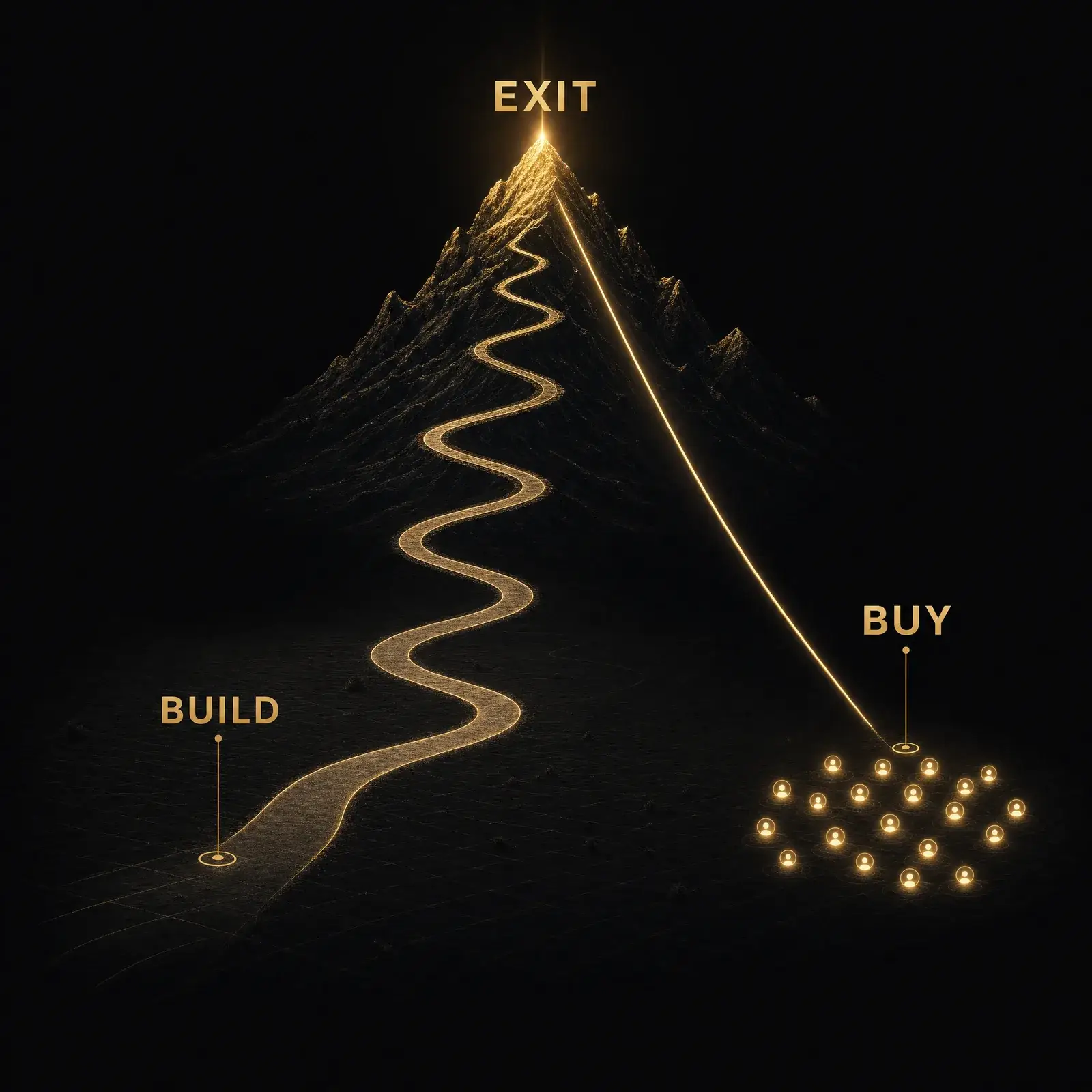
Frequently Asked Questions
What is Bending Spoons?
Bending Spoons is an Italian technology holding company founded in 2013. Instead of inventing new products, it buys established apps with existing users, including AOL, Evernote, Vimeo, Eventbrite and WeTransfer, then runs them for cost efficiency and recurring subscription revenue.
What are the details of the IPO?
Bending Spoons filed a Form F-1 to list on the Nasdaq under ticker BSP, targeting roughly a $20 billion valuation and about a $1.5 billion raise, with Goldman Sachs, J.P. Morgan and Allen & Company leading the deal.
How does Bending Spoons make money?
Primarily through subscriptions, which make up 84% of its revenue. It buys products with loyal users and converts as much of that usage as possible into recurring monthly or annual plans, which is what drives its predictable revenue and high valuation.
Why is the company controversial?
After acquisitions it tends to cut staff sharply and raise prices. It laid off most of Evernote’s staff, announced roughly 75% cuts at WeTransfer, and raised Evernote’s personal plan by 63%. Supporters call it discipline; critics call it harsh on employees and users.
Can a regular entrepreneur copy this playbook?
At a smaller scale, yes. Solo operators and small funds buy tiny SaaS apps, newsletters and communities, then apply the same moves: cut costs, fix pricing, and convert users to subscriptions. The key is buying proven revenue or an active user base, not unproven potential.
Is buying a business better than starting one?
Neither is universally better. Buying skips the hardest part, which is finding users, and can produce cash flow immediately, but it requires capital and the risk of overcutting. Building gives you full ownership of something new but has a high failure rate. The right choice depends on your capital, skills and risk tolerance.
How I Know This
I came to this country as an immigrant and built what I have one decision at a time, so I have a soft spot for the underdog founder grinding on a brand-new idea. For a long time I assumed that was the only honest way to build. Bending Spoons annoyed me at first for exactly that reason. It felt like cheating to skip the hard part and just buy the audience.
Then I actually thought about it. There is nothing dishonest about recognizing that distribution is the scarce thing and going to get it directly. What I do hold onto is the human cost. The version of this playbook I would run keeps more of the team and raises prices more gently, even if it leaves money on the table. That is a choice, and I would rather sleep well than squeeze the last point of margin.
The Bottom Line
Bending Spoons is heading for a $20 billion IPO because it understood something most builders learn too late: an existing audience and recurring revenue are worth more than a brilliant new idea with neither. The buy, fix, and subscribe loop is repeatable, and at a small scale it is within reach of ordinary operators. The trade-offs around people and pricing are real, and worth taking seriously.
That is the kind of clarity Break The Ordinary exists to give you. Study the playbook, take the parts that fit your values, and remember that the goal is not to invent something nobody has seen. It is to own something that people already pay for, and to run it well. Start by learning to validate an idea before you build or buy anything.
Randal is the founder of Break The Ordinary, where he documents what actually works for building independence. As an immigrant who built from scratch, he studies business models like Bending Spoons’ for the parts a normal builder can use, without losing sight of the human cost behind the spreadsheet. He writes from real experience, not hype.