Published: June 10, 2026 · Last updated: June 10, 2026
VCs Stopped Chasing Startups and Started Buying Boring Businesses. Here’s the AI Rollup Playbook.
For decades the venture capital game was simple to describe: write checks into risky young startups, accept that most will die, and pray one becomes the next giant. Lately some of the biggest names in the business have started doing something that sounds almost heretical. Instead of funding a shiny new app, they are buying old, unglamorous companies outright. Accounting firms. Call centers. Property managers. Then they rebuild those businesses around AI from the inside. The strategy has a name now, the “AI rollup,” and where the smartest money goes is usually worth understanding.
This article is for informational and educational purposes only and does not constitute financial or investment advice. Always do your own research before making business or investment decisions.
What This Article Covers
- What an AI rollup actually is
- Who is doing it, with real examples
- Why this is different from old-school private equity
- The signal it sends about where AI value lives
- The version a normal operator can actually run
- Traditional PE vs. the AI rollup
- Frequently asked questions
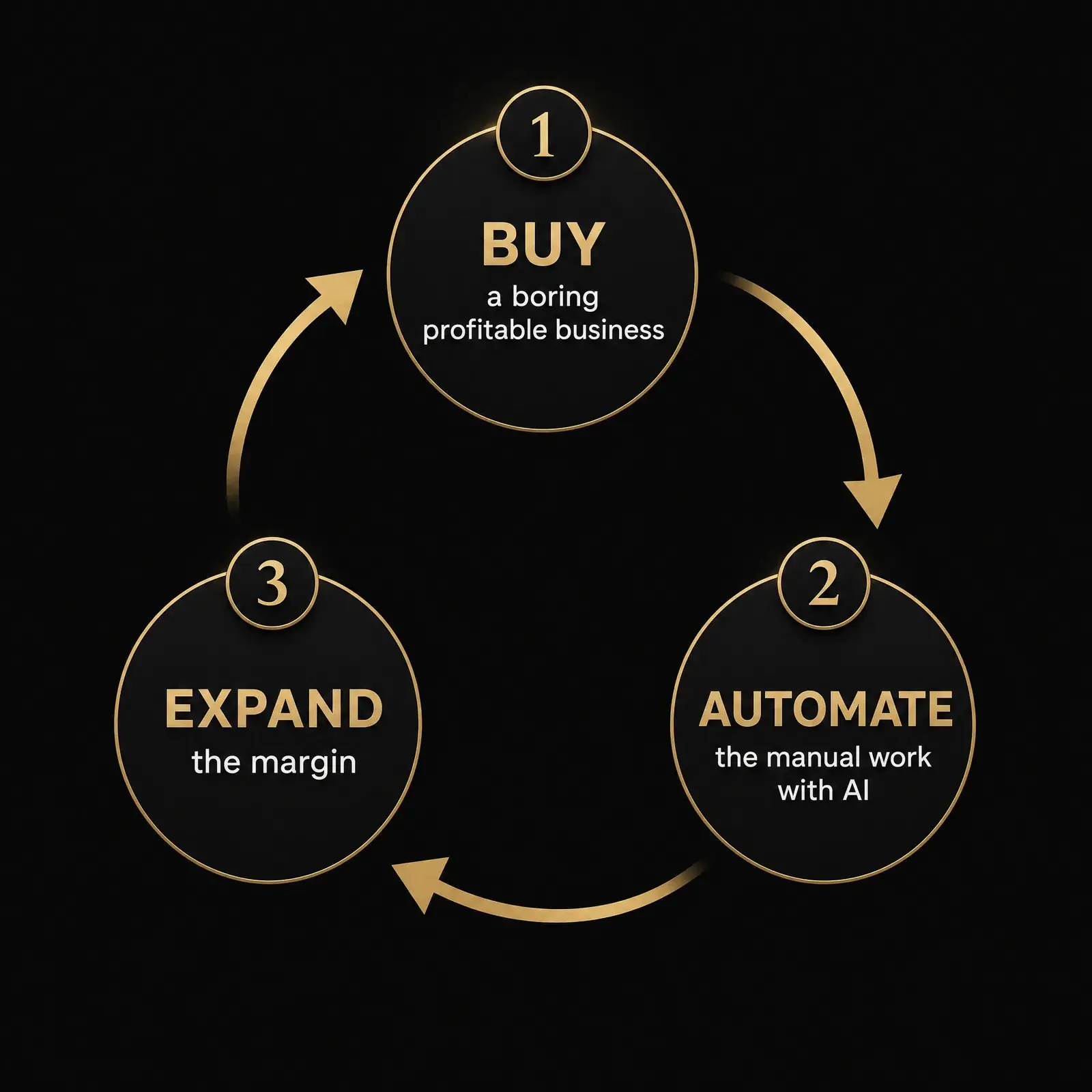
An AI rollup is when an investor buys established, software-starved businesses (accounting firms, call centers, property managers, insurance brokers) and uses AI to automate the manual work and expand margins, rather than just flipping them with debt. Top firms are doing it: General Catalyst has earmarked about $750 million for roll-ups, and its company Dwelly already manages 2,000+ UK properties after buying three lettings agencies. Thrive Capital (Joshua Kushner) runs the same model and even drew OpenAI to take a stake in its portfolio. The lesson for everyone else: the durable AI money may be in fixing boring businesses, not building another chatbot, and a solo operator can run the same play at a tiny scale.

Quick Takeaways
- Major VCs are buying legacy businesses outright instead of only funding startups.
- The targets are unglamorous, software-starved sectors: accounting, call centers, property, insurance, healthcare.
- General Catalyst earmarked about $750M for roll-ups; its firm Dwelly manages 2,000+ properties after buying three agencies.
- Thrive Capital runs the same model and reportedly drew OpenAI to take an equity stake in its portfolio.
- Unlike old-school PE (debt plus layoffs), the value comes from AI-driven efficiency.
- The micro-version is real: own or buy a small “boring” business and apply cheap AI to expand margins.
What an AI Rollup Actually Is
A “rollup” is an old idea: buy a bunch of small companies in the same industry and combine them into one bigger, more efficient operation. Private equity has done it for generations with dentist offices, car washes, and HVAC firms. The new twist is the engine. Instead of squeezing efficiency out of scale and cost-cutting alone, the AI rollup buys these businesses to automate their manual, repetitive work with software and AI, the paperwork, the scheduling, the customer calls, the data entry that eats most of a small firm’s payroll.
The targets are chosen on purpose. They are industries where software adoption has lagged badly: accounting, insurance, customer service, property management, healthcare back offices, construction admin. These are not failing businesses. They are profitable, boring, and stuffed with exactly the kind of manual tasks that modern AI is now good enough to handle.
Who Is Doing It, With Real Examples
This is not a thought experiment. According to Private Equity Insights, General Catalyst, one of the largest venture firms in the world, has earmarked roughly $750 million for roll-up strategies aimed at sectors like call centers and property lettings. One of its portfolio companies, Dwelly, has already bought three UK lettings agencies and now manages more than 2,000 properties, leaning on automation to grow.
Joshua Kushner’s Thrive Capital is running the same play through Thrive Holdings, and as a backer of OpenAI and Stripe it sits unusually close to the technology. Reporting around the trend, summarized by CNBC, notes Thrive has backed a rollup of regional accounting firms and even pulled OpenAI in to take an equity stake and embed engineers inside the businesses. It is not just these two, either: TechCrunch reported that Khosla Ventures has been experimenting with the same idea.
The hot move in venture used to be funding the company that might replace the accountant. Now it is buying the accounting firm and giving it AI.
Break The Ordinary
Why This Is Different From Old-School Private Equity
It is fair to be skeptical, because this can look like private equity wearing an AI costume. The difference is in how the returns are supposed to come. Traditional PE typically loads a company with debt and cuts costs hard, classic financial engineering, where the math works even if the business does not fundamentally change. The AI rollup thesis, as Private Equity Insights frames it, is the opposite: margin expansion is supposed to come from AI and digital efficiency, not from leverage and layoffs.
In plain terms, the bet is that a 60-person accounting firm can do the work of a much larger one once AI handles the repetitive tasks, so you grow profit by transforming how the work gets done rather than by stripping the company for parts. Whether every fund actually lives up to that distinction is an open question, and worth watching closely. But it is a genuinely different theory of value, and it rhymes with the margin story we covered in how AI is reshaping software margins.
The Signal It Sends About Where AI Value Lives
Here is the part that matters even if you never buy a company. When the most sophisticated investors in the world quietly shift from “fund the next AI app” to “buy a boring business and run it with AI,” they are placing a bet about where the durable money actually is. And that bet is not on another chatbot. It is on applying AI to real, profitable operations that have barely been touched by software.
That is a useful corrective to the hype. The headline value of AI may not be the flashy new product. It may be the unglamorous work of taking something that already makes money and making it dramatically more efficient. That reframes the opportunity for everyone, including people who will never raise a fund, the same way our piece on entrepreneurship in 2026 argues that the best opportunities are usually hiding in plain, boring sight.
The Version a Normal Operator Can Actually Run
You are not General Catalyst. You do not have $750 million. That is not the point, because the logic scales down with a few zeroes removed. The micro-version looks like this: own (or buy cheaply) a small, unglamorous business with real customers and a lot of manual busywork, then use today’s cheap, off-the-shelf AI tools to automate that busywork and widen the margin.
It might be a bookkeeping service where AI drafts the first pass of every client’s reconciliation. A small property-management side business where AI handles tenant messages and scheduling. A local service company where an AI assistant answers calls and books jobs after hours. You are doing exactly what the funds are doing, taking proven revenue and making it cheaper to deliver, just at a scale you can actually reach. If you would rather build than buy, the same instinct applies to your own operation, and our guides to the one-person business system and the AI stack that pays for itself are the place to start.
Traditional PE vs. the AI Rollup
Traditional Private Equity
- Engine: Debt plus aggressive cost-cutting
- Goal: Financial engineering, then a flip
- Change to the business: Often minimal
- Main risk: Cutting into the bone
The AI Rollup
- Engine: AI automating manual work
- Goal: Transform operations, expand margin
- Change to the business: Deep, by design
- Main risk: AI not delivering the promised gains
Frequently Asked Questions
What is an AI rollup?
An AI rollup is an investment strategy where a firm buys established businesses in software-starved industries (such as accounting, call centers, or property management) and uses AI to automate their manual work and increase profit margins, rather than building a new startup from scratch.
Which firms are doing AI rollups?
Major venture firms including General Catalyst and Joshua Kushner’s Thrive Capital are leading the trend, with Khosla Ventures among others experimenting. General Catalyst has earmarked around $750 million for roll-ups, and its portfolio company Dwelly manages over 2,000 UK properties.
How is this different from traditional private equity?
Traditional private equity usually relies on debt and cost-cutting to generate returns. The AI rollup thesis is to expand margins through AI-driven efficiency, transforming how the business operates rather than just engineering its finances and flipping it.
Why are investors buying “boring” companies instead of funding startups?
Because they are betting the durable value of AI lies in improving real, profitable operations that have barely adopted software, not in another consumer app. Boring businesses with steady revenue and lots of manual work are ideal candidates for AI-driven efficiency gains.
Can a small operator do a version of this?
Yes, at a smaller scale. You can own or cheaply acquire a small, unglamorous business with manual busywork and apply affordable AI tools to automate that work and widen your margins. The capital requirements are tiny compared with a venture fund, but the underlying logic is the same.
How I Know This
I will admit my first reaction to this story was a little cynical. “Smart money buys boring companies and bolts on AI” can sound like a press release designed to make ordinary cost-cutting feel visionary. I have watched enough hype cycles to keep one eyebrow raised.
But the more I sat with it, the more it lined up with something I actually believe: the boring businesses are where the real money usually hides. I have always been drawn to the unglamorous, steady operation over the lottery-ticket startup, and this trend is basically the biggest investors in the world admitting the same thing out loud. What I would hold onto, if I ran the micro-version, is that the people inside these businesses are not line items. The whole appeal of the AI version over the old debt-and-layoffs version is that you can grow by making the work easier, not by gutting the team. That is the version worth copying.
The Bottom Line
The biggest names in venture capital are telling you something with their money: the next wave of AI value may not be a new app at all, but ordinary, profitable businesses made far more efficient with AI. You do not need a billion-dollar fund to act on that insight. You need a boring business with real customers and too much manual work, plus the willingness to automate it.
That is the kind of unfashionable, durable opportunity Break The Ordinary keeps pointing you toward, because it is usually where the real independence is built. Start small: look at any business you run or could buy, list the repetitive tasks that eat the most hours, and ask what a cheap AI tool could take off the plate this month. Then, the same way you would validate any business idea, test it before you scale it.
Randal is the founder of Break The Ordinary, where he documents what actually works for building independence. He is drawn to unglamorous, durable businesses over hype, and he reads moves like the AI rollup for the part a normal operator can copy without losing sight of the people involved. He writes from real experience, not hype.