Published: June 12, 2026 · Last updated: June 12, 2026
AI Is Quietly Making Your Next Laptop, Phone, and SSD More Expensive. Here’s What’s Happening to Memory Prices, and Who Profits.
Most of the AI story you hear is about what the models can do. This is a story about what they eat. The companies building AI data centers need a specific kind of memory chip, and they need it so badly that they are buying up the world’s supply and bidding the price through the roof. That bidding war does not stay in the data center. It runs straight down the supply chain to the memory inside your phone, your laptop, and your next SSD. If you have wondered why hardware deals feel worse lately, this is a big part of the answer, and it is worth understanding both as someone who buys electronics and as someone with money to invest.
This article is for informational and educational purposes only and does not constitute financial advice. Always do your own research before making financial decisions.
What This Article Covers
- What is actually happening
- How high prices are going
- What it means for your wallet
- The investing angle, without the hype
- What to actually do about it
- Frequently asked questions
The AI boom runs on a stacked memory chip called HBM (high-bandwidth memory), and making it pulls factory capacity away from the ordinary DRAM and NAND flash that go into phones, laptops, and SSDs. The result, per TrendForce, is the worst memory shortage since 2011, with general DRAM contract prices projected up roughly 58–63% and NAND up 70–75% in Q2 2026 alone, on top of about 90–95% DRAM increases in Q1. PC makers including Dell, HP, and Lenovo have warned of 15–20% contract resets, and analysts at IDC and Gartner forecast consumer phone and PC prices rising into the double digits in 2026. The squeeze is expected to last through 2026, with real relief not arriving until late 2027 or 2028.
Quick Takeaways
- AI accelerators use HBM, a premium stacked memory, and making it eats the same factory capacity as consumer DRAM and NAND.
- TrendForce calls it the worst memory shortage since 2011.
- DRAM contract prices are projected up about 58–63% and NAND about 70–75% in Q2 2026, after roughly 90–95% DRAM jumps in Q1.
- PC makers (Dell, HP, Lenovo, ASUS) have warned of 15–20% contract price resets.
- IDC and Gartner forecast double-digit rises in average phone and PC prices in 2026; these are forecasts, not confirmed retail prices.
- Memory makers Micron, SK Hynix, and Samsung are the clear winners; each crossed roughly $1 trillion in market value in 2026.
What Is Actually Happening
Start with the chip nobody outside tech talks about: HBM, or high-bandwidth memory. It is the stacked, ultra-fast memory bolted next to the chips that train and run AI models, and demand for it is close to unlimited right now. The catch is that the same handful of companies, Micron, SK Hynix, and Samsung, make both HBM and the everyday memory in your devices, using overlapping factory capacity. Every wafer they redirect to high-margin AI memory is a wafer not making the DRAM in a laptop or the NAND flash in an SSD. Some makers are even converting flash production lines over to DRAM to chase the better margins.
The result, according to TrendForce, is a supply shortage across DRAM, NAND, and HBM that is the worst the industry has seen since 2011. This is not a glitch or a temporary blip from one bad quarter. It is a structural mismatch: AI demand is enormous and growing, new factories take years to build, and the makers are rationally sending their chips to the highest bidder. Right now the highest bidder is the AI industry, not you.
How High Prices Are Going
The numbers are stark. TrendForce projects general-purpose DRAM contract prices rising roughly 58 to 63 percent quarter-over-quarter in the second quarter of 2026, with NAND flash up about 70 to 75 percent, and that is on top of DRAM contract increases of around 90 to 95 percent in the first quarter. Contract prices are what device makers pay, and they have been signing long-term deals and accepting the higher cost just to lock in supply, which tells you how worried they are about getting enough.
This is not your laptop getting fancier. It is the same laptop costing more, because the cheapest part inside it suddenly is not cheap.
Break The Ordinary
When the raw component doubles in price, that cost has to land somewhere. It lands on the company building the device, and eventually on you.
What It Means for Your Wallet
Here is where I want to be careful, because the honest version is more useful than the scary one. The contract-price increases are real and confirmed. The consumer prices are, so far, forecasts. PC makers like Dell, HP, Lenovo, and ASUS have already warned of contract resets in the 15 to 20 percent range. On top of that, IDC projects average smartphone prices climbing around 14 percent in 2026, and Gartner forecasts PC prices up roughly 17 percent and phone prices up about 13 percent versus 2025. Those last figures are analyst projections, not prices ringing up at checkout, so treat them as the direction of travel rather than a guarantee.
There is also a sneakier effect than a bigger sticker price. Some device makers will not raise the price at all; they will quietly give you less. The same money buys a laptop with 16 gigabytes of memory instead of 32, or a phone with less base storage. The shrinkflation you already know from the grocery aisle is coming to the spec sheet. The practical takeaway is simple: for the next year or so, do not assume electronics keep getting cheaper and roomier by default the way they have for most of your life.
The Investing Angle, Without the Hype
Every shortage has a winner, and here it is the companies that make the scarce thing. Micron, SK Hynix, and Samsung sit at the center of this, selling a product whose price is spiking into demand they cannot fully meet. SK Hynix posted record results on the back of AI memory, and all three crossed roughly a trillion dollars in market value during 2026. This is the classic “picks and shovels” idea: in a gold rush, the steady money is often in selling the tools, not panning for gold.
But notice what I am not saying. I am not telling you to buy memory stocks. Memory is one of the most brutally cyclical businesses on earth; the same names that soar in a shortage have a long history of cratering when supply catches up and prices collapse. By the time a trend is obvious enough to read about in an article like this one, a lot of it is already priced in. The useful lesson is not a ticker, it is a way of thinking: when you see a real-world shortage, ask who sells the scarce thing, then ask what is already baked into their price before you ever act. That habit is worth more than any single trade, and it is the same disciplined mindset behind building a real investment portfolio instead of chasing headlines.
What to Actually Do About It
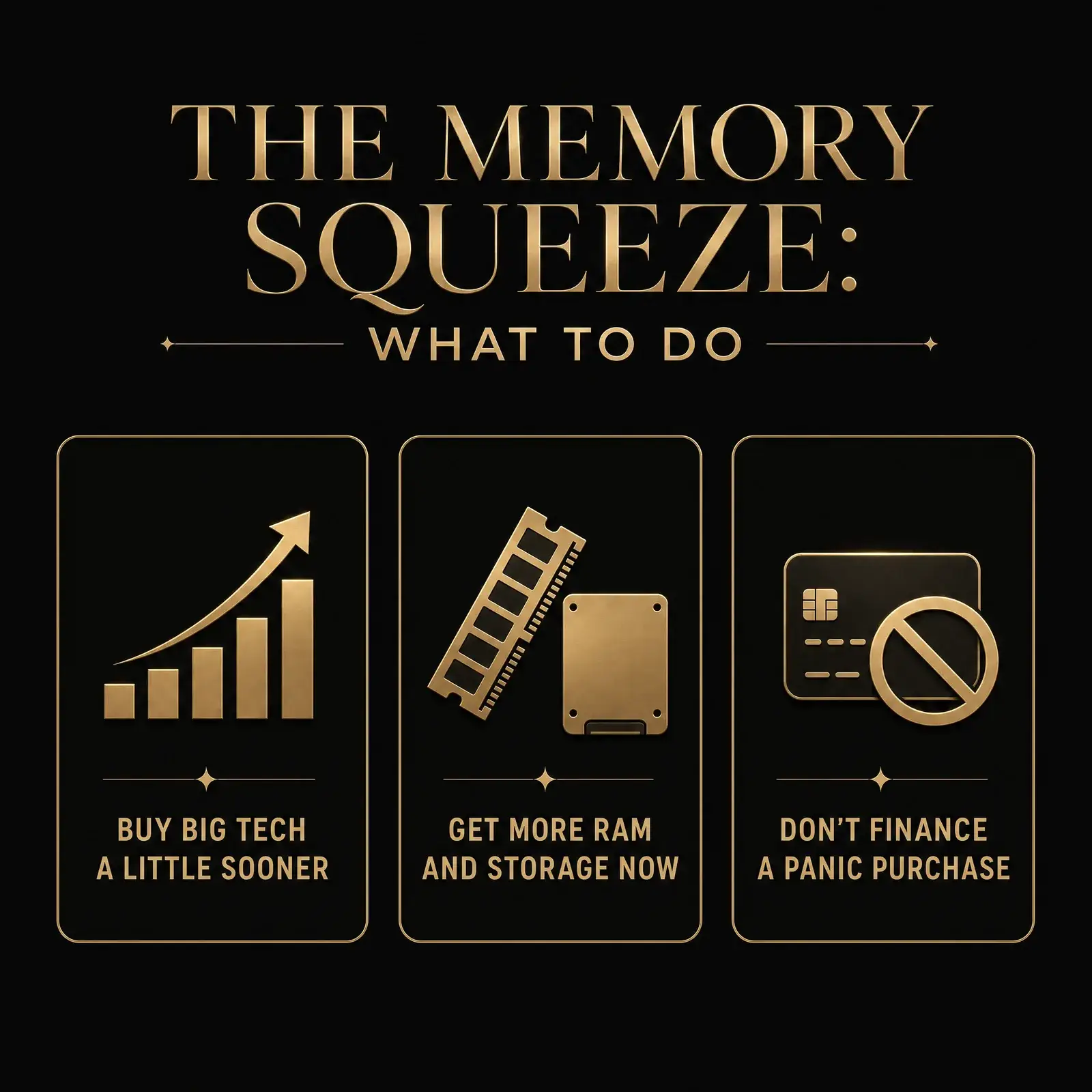
For most people this calls for small, sensible adjustments, not panic. If you were planning to buy a laptop, phone, or a big SSD in the next year, it is reasonable to buy a little sooner rather than waiting for a “better deal” that may not come, and to buy slightly more memory and storage than you think you need, since that is the part getting expensive. Do not, however, panic-buy a device you do not need just because prices might rise; a gadget you did not need is not a bargain at any price, and financing one on a credit card to “beat the increase” only swaps a higher sticker for higher interest. If you do find yourself reaching for credit to time a purchase, that is usually a sign to wait, the same logic that underpins getting out of consumer debt in the first place.
Frequently Asked Questions
Why is AI making memory more expensive?
AI accelerators rely on a premium stacked memory called HBM (high-bandwidth memory). The same companies that make HBM, Micron, SK Hynix, and Samsung, also make the standard DRAM and NAND flash in consumer devices, using shared factory capacity. As they shift production toward high-margin AI memory, the supply of everyday memory tightens and its price rises. TrendForce calls it the worst memory shortage since 2011.
How much are memory prices rising?
TrendForce projects general-purpose DRAM contract prices up roughly 58–63% and NAND flash up about 70–75% in the second quarter of 2026, following roughly 90–95% DRAM increases in the first quarter. Those are contract prices paid by device makers; consumer-device price increases are expected to follow but are currently analyst forecasts.
Will my next phone or laptop actually cost more?
Probably, though the exact amount is a forecast, not a guarantee. PC makers have warned of 15–20% contract price resets, and IDC and Gartner forecast double-digit increases in average phone and PC prices in 2026. Watch also for the quieter version: the same price buying a device with less memory or storage than before.
How long will the shortage last?
TrendForce expects a pronounced shortage through 2026, with meaningful new factory capacity unlikely to arrive in volume before late 2027 or 2028. Building new memory fabrication plants takes years, so relief is not quick.
Should I buy memory-maker stocks?
This article does not make investment recommendations. It is worth understanding that memory is a highly cyclical industry: the makers benefiting now have historically seen prices and profits fall hard when supply catches up. By the time a trend is widely reported, much of it is often already reflected in the stock price. Do your own research and consider the full cycle, not just the current spike.
How I Know This
I will be straight with you: I started looking into this because my own next laptop upgrade quote came in higher than I expected, and I wanted to know whether I was imagining it. I was not. Once I started pulling the supply data, the pattern was obvious, and a little unsettling. There is something strange about an abstract AI boom reaching into my pocket through the price of a memory chip I never think about.
What keeps me calm about it is that the response is boring and within my control. I am not going to panic-buy a machine I do not need, and I am not going to chase a memory stock that has already tripled. I will time the purchase I was already going to make a bit more deliberately, spec it with a little more headroom, and otherwise get on with my life. The technology is dramatic. The smart reaction to it usually is not, which is a theme in most of why most people never build wealth.
The Bottom Line
The AI buildout has quietly turned ordinary computer memory into a scarce, expensive thing, and that cost is working its way toward the devices in your hands. Contract prices have already jumped by double and triple digits, the squeeze is expected to run through 2026, and the makers of memory are the clear financial winners. None of that requires panic. It requires a little awareness: buy the big tech you actually need a touch sooner, spec it with room to spare, do not finance a purchase just to beat a price increase, and treat the investing side as a lesson in cycles rather than a hot tip. Understand what is happening, and a confusing price increase becomes just another thing you saw coming.
Randal is the founder of Break The Ordinary, where he documents what actually works for building independence. He reads supply-chain data so you do not have to, and is allergic to both panic-buying and hot stock tips. He writes from real experience, not hype.