Published: June 28, 2026 | Last Updated: June 28, 2026
Morning Sunlight and Cortisol: The 10-Minute Habit That Rewires Your Day
Morning sunlight and cortisol are linked by one of the most direct and well-documented pathways in human biology – and almost nobody is using it. Within the first hour of waking, your body runs a precise hormonal sequence that sets your alertness, your energy arc, and the timing of your sleep the following night. Whether that sequence fires cleanly depends almost entirely on whether light hits your retinas at the right moment.
If you are building the kind of output-driven mornings that compound into real results, the sunlight habit belongs alongside the fundamentals. It connects directly to how to build a morning routine that sticks, pairs naturally with how to improve sleep quality through its effect on melatonin timing, and sits inside the same physiology covered in BTO’s guide to sleep and recovery for men. For anyone working on the physical side, the sunlight-testosterone relationship connects to the full picture in the testosterone optimization guide for men in their 20s and 30s.
Medical Disclaimer: This article is educational and informational only. It is not medical advice and is not a substitute for diagnosis or treatment by a qualified healthcare professional. If you have a medical condition, sleep disorder, mood disorder, or hormonal concern, consult a clinician before making changes to your routine.
Morning sunlight cortisol refers to the relationship between early morning light exposure and the cortisol awakening response (CAR) – a natural 38 to 75% surge in cortisol during the first 30 to 45 minutes after waking. It matters because this surge drives alertness, immune readiness, and metabolic preparedness for the day, and morning light is one of the clearest external inputs that sharpens its timing. It is most relevant for people who want to maximize morning performance and improve sleep quality without relying on stimulants or supplements.
Featured answer: Getting 5 to 10 minutes of outdoor sunlight within 30 to 60 minutes of waking sharpens the cortisol awakening response, signals the brain’s master clock to anchor the day’s hormonal rhythm, and sets a melatonin timer that improves sleep onset 12 to 14 hours later. The habit is free, requires no equipment, and takes less time than a cup of coffee.
Quick Takeaways
- Cortisol peaks 30 to 45 minutes after waking – that morning spike is healthy and useful.
- Morning light through a window is approximately 50 times less effective than going outside.
- On sunny days, 5 to 10 minutes of outdoor light is sufficient; overcast days require 15 to 20 minutes.
- No sunglasses. Contacts and prescription glasses are fine.
- The morning light sets a melatonin timer – sleep improves that night, not just the morning.
- A 10,000-lux light therapy lamp is a validated clinical substitute when outdoor light is unavailable.
What Is the Cortisol Awakening Response?
The cortisol awakening response is a predictable, biology-driven surge in cortisol that occurs in the first 30 to 45 minutes after waking. According to research published in Endocrine Reviews in 2026, cortisol rises approximately 38 to 75% above baseline during this window – a natural signal from your body’s master clock, not a stress response.
Why the CAR Is Not a Problem to Solve
The wellness world has spent years telling people to “lower their cortisol.” That advice makes sense in the context of chronic stress. In the context of morning biology, it is backwards.
A strong CAR is associated with alertness, healthy immune function, and metabolic readiness. A blunted CAR – a flat, weak morning cortisol spike – is linked to fatigue, impaired cognition, and poor immune response. The goal is not to suppress morning cortisol; the goal is to sharpen it at the right time.
Importantly, the CAR is driven primarily by the internal circadian clock – the suprachiasmatic nucleus (SCN) in the hypothalamus. As a 2022 forced-desynchrony study published in Frontiers in Neuroscience confirmed, there is “virtually no CAR when awakening occurs in the afternoon or evening.” The CAR’s circadian peak falls around 3:40 to 3:45 AM internal biological time.
Waking during biological morning is a prerequisite. Morning light is the input that keeps your internal clock anchored to actual sunrise – and without that anchor, the whole timing sequence drifts.
What the CAR Actually Does for You
Think of the CAR as your body’s daily ignition sequence. It mobilizes glucose, activates the immune system, and shifts the brain toward the alertness states needed for focused work.
In contrast, an exaggerated or persistent CAR across multiple hours is associated with chronic stress. The distinction matters: a sharp, well-timed morning spike followed by a natural decline through the day is the healthy pattern. Light helps produce that pattern.
How Morning Light Talks to Your Brain
The pathway from morning sunlight to cortisol runs through a specific set of photoreceptors that most people have never heard of. These are melanopsin-containing intrinsically photosensitive retinal ganglion cells – ipRGCs for short.
The ipRGC Pathway Explained
Melanopsin-expressing ipRGCs make up only approximately 0.4 to 1.5% of all retinal ganglion cells in the human eye, according to a 2016 study published in PLOS ONE. Yet they are responsible for essentially all non-image-forming light detection used by the circadian system.
These cells are maximally sensitive to short-wavelength light around 480 nm – the blue-shifted frequencies most abundant in natural outdoor morning light. When they receive that signal, they transmit it directly to the SCN via the retinohypothalamic tract. The SCN then cascades that timing signal to every clock gene in every organ in the body.
A 2023 study in Communications Biology (Nature) confirmed that melanopsin-mediated optical entrainment is the primary mechanism by which vertebrates regulate circadian rhythms – not temperature, not food timing, not social cues. Light is the dominant synchronizer, and outdoor morning light delivers the strongest dose of the frequencies that matter.
What a Controlled Study Found
A peer-reviewed controlled study by Leproult et al. (2001), published in the Journal of Clinical Endocrinology and Metabolism, examined eight healthy males during a 36-hour wakefulness protocol. Transitioning from dim to bright light between 5:00 and 8:00 AM produced an immediate, greater-than-50% elevation in cortisol levels and limited the deterioration in alertness that normally follows sleep deprivation.
Critically, the same bright light applied in the afternoon at identical intensity produced no hormonal effect. The circadian system is highly time-gated. Light in the morning works; light in the afternoon does not replicate those effects.
Why the Window Doesn’t Count
One of the most common misconceptions about morning sunlight is that sitting near a sunny window is an adequate substitute for going outside. It is not – and the difference is quantifiable.
Standard window glass filters UV and short-wavelength visible light, which are the frequencies that activate melanopsin most effectively. According to photobiology research cited by the Huberman Lab, sunlight through a window is approximately 50 times less effective for circadian signaling than being outdoors without a barrier.
The Lux Numbers
Outdoor bright sunlight delivers 10,000 to 100,000 lux at eye level. A fully overcast sky still delivers 1,000 to 10,000 lux. Typical indoor artificial lighting – even in a well-lit office or kitchen – delivers 100 to 500 lux.
For context, a 2022 study in PLOS Biology recommends a minimum melanopic equivalent daylight illuminance (EDI) of 250 lux at the eye for daytime wakefulness. Even overcast outdoor conditions clear that threshold easily. The window does not.
Five minutes outside on a cloudy morning delivers more circadian signal than an hour seated next to the brightest window in your home. That is the practical upshot of the lux gap.
The 10-Minute Morning Sunlight Protocol
The protocol Andrew Huberman, PhD (Stanford University, Department of Neurobiology) recommends – and which aligns with the primary research above – is straightforward. No equipment is required. The steps are listed below in the exact order they matter.
Step 1 – Wake Consistently
Consistent wake time is a prerequisite. The CAR’s circadian peak depends on a stable internal clock. Irregular wake times drift the clock and blunt the response before you even get outside. Aim for the same wake time seven days a week, within 30 minutes.
Step 2 – Get Outside Within 30 to 60 Minutes of Waking
The timing window matters. The first 30 to 60 minutes after waking is when the circadian system is most responsive to light input. Going outside at 10:00 AM instead of 7:00 AM delivers far less of the hormonal benefit.
On a clear day, 5 to 10 minutes of outdoor exposure is sufficient. On overcast days, extend to 15 to 20 minutes to compensate for the reduced lux delivered by cloud cover.
Step 3 – No Sunglasses. Eyes Open and Facing the Sky
Sunglasses block the very frequencies that trigger melanopsin activation. Remove them for this portion of your morning. Never stare directly at the sun – face toward the general direction of the sky or horizon, eyes open, blinking naturally.
Contact lenses and prescription glasses are fine. They do not meaningfully filter the relevant wavelengths in the way sunglasses do.
Step 4 – Walk, Stretch, or Stand. Movement Is Optional but Useful
You do not need to do anything in particular. Standing on a balcony, walking to get coffee, or doing a short walk around the block all qualify. Movement adds its own morning benefit, but the light is the mechanism – not the activity level.
Step 5 – If You Wake Before Sunrise
Turn on bright overhead lights immediately upon waking. Use the maximum available artificial light indoors while waiting for sunrise. As soon as the sun is up, go outside – the natural signal always beats artificial.
Winter and Low-Light Workarounds
For people living above approximately 45 degrees north or south latitude during winter months, outdoor sunrise may come long after a workday has started. There are practical substitutes.
Light Therapy Lamps
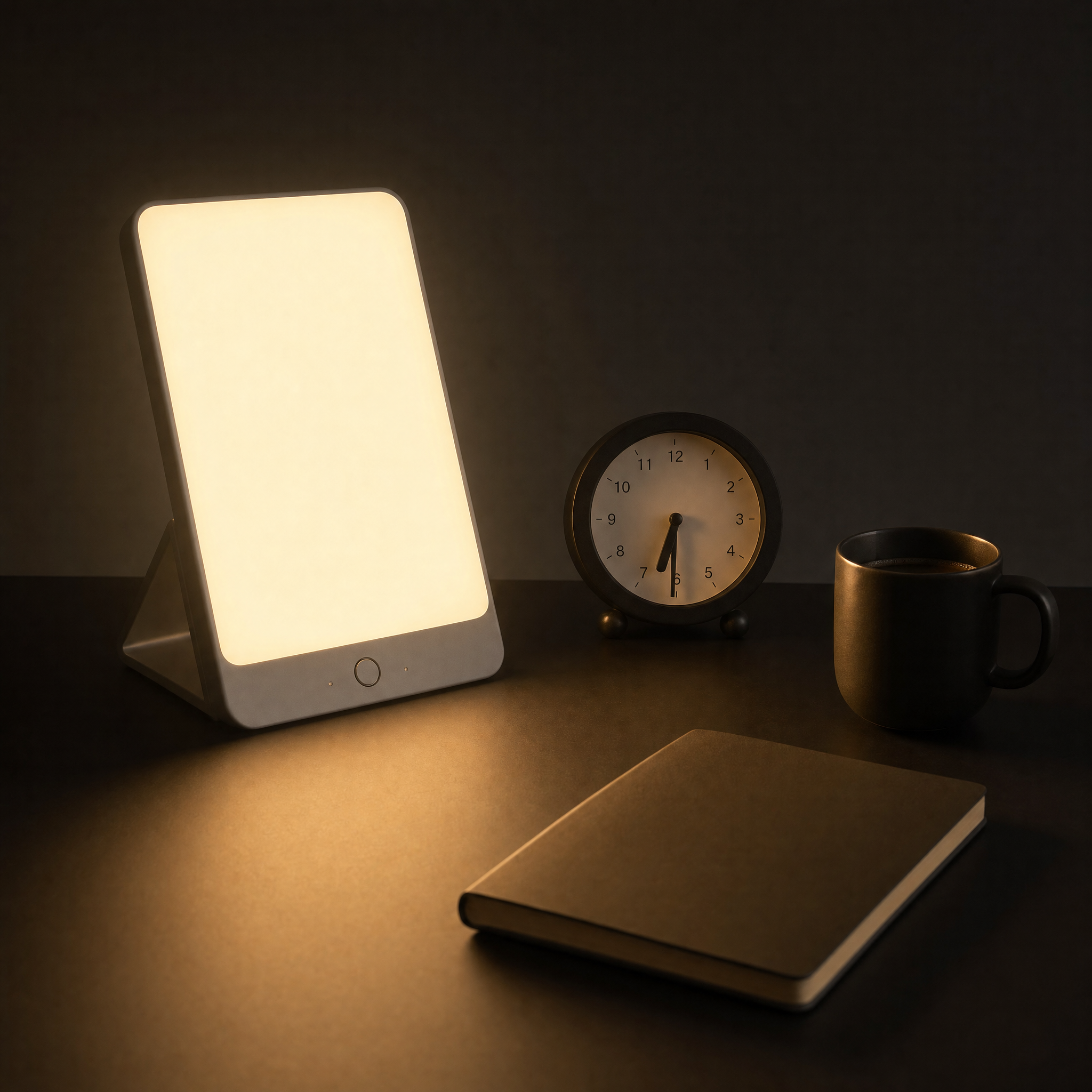
A 10,000-lux light therapy lamp used at approximately 20 cm distance for 20 to 30 minutes in the morning is an established clinical protocol for circadian entrainment, with research support going back decades. A 2004 study in the Journal of Psychiatry and Neuroscience found that bright light therapy improves remission rates in seasonal affective disorder when combined with medication – evidence that the mechanism is real and clinically meaningful.
The key is positioning. The lamp must be in your line of sight – not pointed directly at your eyes, but within the peripheral visual field so your ipRGCs receive adequate lux. Use it during breakfast or while working at your desk in the first 30 to 60 minutes after waking.
Dawn Simulators
Dawn simulators are alarm clocks that gradually increase light intensity in the minutes before your scheduled wake time, mimicking sunrise. Controlled dawn-simulator studies associate their use with a 12.8% greater CAR magnitude compared to waking in darkness.
They are not a replacement for outdoor light but are a useful supplement – especially in winter when the sun rises after the work alarm sounds.
Shift Workers and Night Owls
If you work rotating shifts or your schedule makes morning outdoor light impossible, prioritize bright light exposure at whatever time you wake relative to your sleep cycle. The principle is biological morning, not clock morning. Consult a sleep specialist or chronobiologist if your schedule creates persistent misalignment – this is one case where the general protocol genuinely needs professional tailoring.
The Caffeine Timing Connection
Here is a connection most morning-routine advice skips: morning sunlight and caffeine timing work together, and getting the sequence wrong blunts both levers.
Why Delaying Coffee Matters
Cortisol peaks 30 to 45 minutes after waking and remains elevated for approximately 90 minutes. During this window, your body is producing its own alertness chemistry. Caffeine works primarily by blocking adenosine receptors – the receptors that make you feel tired as adenosine accumulates.
Drinking coffee immediately upon waking does not clear adenosine from your system. It only masks the signal. When the caffeine wears off, the accumulated adenosine rebounds – which is why the mid-afternoon energy crash often correlates with how early the first coffee was consumed.
Huberman recommends delaying caffeine intake 90 to 120 minutes after waking. This means the morning sunlight protocol and the natural cortisol spike do the heavy lifting first – and the caffeine, when it arrives, stacks on top of an already-elevated baseline rather than competing with it.
The practical result: sharper morning performance for a longer window, fewer rebounds, and lower total caffeine consumption over time.
Morning Light and Testosterone: What the Evidence Actually Says
This is where the internet gets the framing wrong, and where being honest about the evidence matters more than sounding impressive.
Two Distinct Mechanisms, Commonly Conflated
There is a real, documented relationship between sunlight and testosterone. But it does not operate through the morning-eye-level-light-to-cortisol pathway. It operates through a separate UVB-skin pathway.
A 2021 study published in Cell Reports (PMC8411113) identified a skin-brain-gonadal axis: UVB exposure activates p53 signaling in skin keratinocytes, which in turn is associated with elevated testosterone in observational human data and controlled animal studies. A large 2023 database study (n=13,086 men aged 21 to 25) found a significant seasonal testosterone peak in July, consistent with peak UV exposure months.
However, the human causal sample is very small – n=9 for signaling-pathway activation – and this mechanism applies to skin exposure during midday sun conditions, not 5 to 10 minutes of eye-level morning light. Researchers including those involved in the Huberman Lab newsletter note that 20 to 30 minutes of bare skin exposure in the afternoon sun (shorts and short sleeves, 2 to 3 times per week) is the protocol associated with this pathway.
Honest Framing of the Evidence
Morning eye-level sunlight does not directly raise testosterone through the cortisol-melatonin pathway. The circadian and hormonal benefits described in this article are well-supported by controlled research. The testosterone-skin-UVB connection is real but applies to a different protocol, a different time of day, and remains insufficiently powered in humans to support outcome claims.
For the full picture on naturally supporting testosterone through training, sleep, and lifestyle, the BTO guide on how to naturally increase testosterone covers the evidence-ranked levers in detail.
Myths to Drop Right Now
The morning sunlight space has accumulated a specific set of myths worth addressing directly.
Myth: Cortisol Is Bad and You Want Less of It
Chronic stress cortisol and morning awakening cortisol are not the same physiological event. The wellness narrative to “lower cortisol” conflates these two contexts. Morning cortisol is a controlled, adaptive signal – a blunted spike is linked to fatigue and poor immune function, not to anything you want more of.
Myth: A Window Is Just as Good as Going Outside
Standard glass filters the short-wavelength light that activates melanopsin. The circadian signal delivered through a window is approximately 50 times weaker than outdoor exposure, based on photobiology research referenced by the Huberman Lab. This is not a small difference – it is the difference between a sufficient and an insufficient dose.
Myth: You Need to Stare at the Sun for Maximum Effect
Never stare directly at the sun. The mechanism requires photons to reach the ipRGCs – cells distributed throughout the retina – and facing toward the general sky or horizon with eyes open is sufficient. Staring harder adds no benefit and risks retinal damage.
Myth: Morning Sunlight Cures Insomnia or Depression
Morning light supports circadian rhythm – it is not a treatment for clinical insomnia disorder, major depressive disorder, circadian phase disorder, or clinically low testosterone. These are medical conditions that require clinical evaluation. This habit is a lifestyle lever, not a medical intervention.
Mistakes That Kill the Benefit
Getting outside in the morning is the right direction. These specific errors undercut the mechanism even when the intention is correct.
Mistake 1 – Wearing Sunglasses the Whole Time
This is the most common error. Sunglasses block the exact frequencies that trigger melanopsin activation – remove them for the duration of the protocol and put them back on after. Five to ten minutes without them is all it takes.
Mistake 2 – Getting Light Through the Car Windshield During the Commute
Car windshields, like window glass, filter the short-wavelength light needed for circadian signaling. A 30-minute commute in a car does not substitute for 5 minutes standing outside. The light must reach your retinas without a glass barrier.
Mistake 3 – Going Outside at the Wrong Time of Day
The circadian benefit of morning light is time-gated. The Leproult et al. 2001 study found no hormonal effect from afternoon bright light at identical intensity – the same lux, different clock position, zero cortisol response. The relevant window is the first 30 to 60 minutes after waking, not midday or later.
Mistake 4 – Irregular Wake Times That Drift the Clock
The cortisol awakening response is largest when waking aligns with biological morning. Sleeping in by two hours on weekends or shifting your wake time across the week disrupts internal clock timing and blunts the CAR before the light habit has a chance to work. Consistent wake time is the prerequisite, not an optional enhancement.
Mistake 5 – Treating This as an Isolated Habit
Morning sunlight is one input in a larger circadian system. Evening bright light exposure – especially blue-light-emitting screens between 10:00 PM and 4:00 AM – suppresses melatonin and disrupts the sleep onset that morning light worked to advance. Pairing the morning light habit with evening light reduction is where the full benefit compounds.
Natural Light vs. Artificial Light vs. Window Light
Outdoor Morning Sunlight
- Lux delivered: 10,000 to 100,000 lux (bright sun); 1,000 to 10,000 lux (overcast)
- Circadian signal strength: Maximum – full melanopsin activation
- Protocol duration: 5 to 10 minutes (clear); 15 to 20 minutes (overcast)
- Cost: Free
- Best for: Everyone with access to outdoor space at or near wake time
- Limitations: Weather-dependent; requires going outside before normal habits kick in
10,000-Lux Light Therapy Lamp
- Lux delivered: 10,000 lux at 20 cm distance
- Circadian signal strength: High – clinically validated substitute
- Protocol duration: 20 to 30 minutes in the first hour after waking
- Cost: One-time purchase (lamps range from $30 to $100)
- Best for: Winter months, high latitudes, early wake times before sunrise
- Limitations: Requires equipment; less effective than outdoor light for melanopsin wavelengths
Window Light (Indoor)
- Lux delivered: Typically under 500 lux through standard glass
- Circadian signal strength: Approximately 50 times weaker than outdoor exposure
- Protocol duration: Cannot compensate for the lux deficit regardless of duration
- Cost: Free
- Best for: Not recommended as a substitute for outdoor light
- Limitations: Glass filters the short-wavelength frequencies that activate melanopsin
Source: Leproult et al. (2001) – Journal of Clinical Endocrinology and Metabolism
Frequently Asked Questions
How long does morning sunlight take to affect cortisol?
The effect is essentially immediate. The Leproult et al. 2001 controlled study found a greater-than-50% cortisol elevation within the transition from dim to bright light during the 5:00 to 8:00 AM window. Morning light does not need days of accumulation to produce a cortisol response – the signal pathway from ipRGCs to SCN to HPA axis is fast-acting.
Does morning sunlight work on cloudy days?
Yes. A fully overcast sky delivers 1,000 to 10,000 lux outdoors – far above the 100 to 500 lux of indoor artificial light. Extend your exposure to 15 to 20 minutes on overcast days, and go outside rather than sitting by a window.
Can I wear sunglasses during my morning sunlight walk?
No – not during the protocol portion. Sunglasses filter the short-wavelength frequencies that activate melanopsin, so remove them for the duration of your outdoor exposure. Contacts and prescription glasses are fine; they do not meaningfully block the wavelengths that matter.
What time do I need to go outside for morning sunlight to work?
Within 30 to 60 minutes of waking is the optimal window. The 2001 Leproult study identified a 5:00 to 8:00 AM window as maximally responsive, but the key variable is biological morning – the first hour after your consistent wake time – not the specific clock hour. Earlier exposure within that window is better than later.
Is morning sunlight cortisol the same as stress cortisol?
No. The cortisol awakening response is a timed, circadian-driven surge – distinct from the chronic, stress-induced HPA activation that the wellness world warns about. Conflating the two is the source of most bad morning cortisol advice.
Does morning sunlight improve sleep quality?
Yes. Morning light anchors the circadian clock, which advances the dim light melatonin onset (DLMO) – the point in the evening when melatonin begins rising. A 2013 clinical study (n=27, PMC3841985) found statistically significant DLMO advancement following morning bright light, which translates directly to earlier, easier sleep onset.
Will morning sunlight raise my testosterone?
Morning eye-level light does not directly raise testosterone through the cortisol pathway. A separate UVB-skin mechanism is associated with testosterone in observational data – but it applies to afternoon skin exposure, not 5 to 10 minutes of eye-level morning light. For the evidence-ranked testosterone levers, see BTO’s guide on testosterone optimization for men in their 20s and 30s.
What if I wake before sunrise?
Turn on the brightest available artificial light immediately upon waking – a 10,000-lux lamp is ideal for the pre-sunrise period. As soon as the sun rises, go outside for full outdoor exposure. Artificial light is better than darkness, but natural morning light at sunrise is always the stronger signal.
How does morning sunlight interact with caffeine?
They are synergistic when timed correctly. Cortisol peaks 30 to 45 minutes after waking and stays elevated for roughly 90 minutes – delaying caffeine until that window closes lets the natural alertness mechanism do its work first. Coffee on top of an existing cortisol surge produces a longer, cleaner energy window with fewer afternoon rebounds.
Is a light therapy lamp as effective as natural sunlight?
A 10,000-lux lamp at 20 cm is a clinically validated substitute, particularly for seasonal affective disorder and circadian entrainment when natural light is unavailable. It is not identical to outdoor sunlight – outdoor light contains a broader spectral range and higher peak lux – but it is meaningfully more effective than window light or standard indoor lighting. Use it in the first 30 to 60 minutes after waking, positioned in your peripheral visual field.
Does morning sunlight need to be direct sun on the skin?
No. The circadian mechanism operates through the eyes – specifically the retinal ipRGCs – so skin exposure is not required for the morning cortisol and melatonin timing benefits. The UVB-skin-testosterone pathway is a separate mechanism that operates through afternoon bare-skin exposure, not morning eye-level light.
How quickly will I notice a difference from morning sunlight?
The cortisol response is immediate – you may notice sharper alertness within the first few days of consistent practice. The melatonin timing effect – falling asleep more easily at night – can take one to two weeks of consistent morning light to stabilize, as the circadian clock shifts gradually rather than all at once.
How I Know This
I trained six days a week for three years with a close friend who spent years in the Marine Corps – a man who operated at a high physical and cognitive standard every day and had very clear views on what actually moved the needle in the mornings versus what was noise.
In that period, I learned that the gap between a flat morning and a sharp one is almost never about motivation. It is about the body’s readiness signals – and whether you are feeding those signals correctly or working against them. Morning light was one of the first things that showed up in that conversation as a real lever, not a wellness trend.
For this article, I went further than protocol summaries. I read the primary research – Leproult et al. 2001, the 2022 forced-desynchrony study, the PLOS ONE ipRGC work, the Communications Biology melanopsin entrainment paper – to understand the mechanism well enough to know where the evidence is solid and where it is being overstated. The testosterone framing here reflects that honest read: the human causal evidence for morning-eye-light-to-testosterone is weak, and saying so is more useful than a claim that sounds compelling but does not hold up.
The goal here is the same as everywhere at Break The Ordinary: give you what actually works, explain why, and be clear about the limits of the evidence so you can make decisions without being misled.
The Real Case for This Habit
Morning sunlight is not a wellness trend. It is a biology lever – free, with no side effects, backed by controlled research, and ignored by most people who spend money on supplements, smart alarms, and productivity tools trying to solve a problem that starts with whether they went outside in the first hour of the day.
The cortisol awakening response already happens every morning. You are either sharpening it or blunting it – and five to ten minutes outside is the difference between those two outcomes. That is an unusually good return on a free habit.
For men building output-driven lives, alertness, hormonal health, sleep quality, and immune function all run through the same circadian architecture. Getting light right in the morning is not one isolated habit – it is the anchor for every other lever you are already pulling. The BTO guide on how to build habits that actually stick covers how to layer these systems into a durable daily structure.
Build the simple things first. Get outside.
Sources
- Leproult et al. (2001) – Transition from Dim to Bright Light in the Morning Induces an Immediate Elevation of Cortisol Levels – Journal of Clinical Endocrinology and Metabolism
- The circadian system modulates the cortisol awakening response in humans – Frontiers in Neuroscience (2022)
- Recommendations for daytime, evening, and nighttime indoor light exposure – PLOS Biology (2022)
Randal | Break The Ordinary
I’m Randal, the founder of Break The Ordinary – a multi-niche media brand covering business, tech, health, and finance for people who want to build wealth, freedom, and a life worth living. I trained six days a week for three years alongside a marine veteran, and that experience gave me a direct education in what morning physiology actually feels like when you get it right. I share what actually works, what doesn’t, and what most people get wrong – my approach is direct, research-backed, and built on real experience, not theory.