Published July 21, 2026 · Last updated July 21, 2026
Sales Calls for Introverts: A 20-Minute Framework
Sales calls for introverts don’t have to feel like a performance you’re bad at. The problem was never your personality – it was that nobody handed you an actual structure to run instead of improvising in the moment. This article gives you one: a literal, time-boxed, 20-minute call you can prepare almost word-for-word before you ever pick up the phone.
Before the call matters, the groundwork does. If you’re still finding your first buyers, start with how to get your first customers without paid ads, which covers warm outreach and founder-led acquisition. Once people are actually saying yes to a first conversation, how to validate a business idea in 30 days is worth revisiting so the call isn’t doing work your positioning should already be doing.
The other half of readiness is systems, not scripts. A one-person business system built for solo founders keeps call prep from eating the rest of your day. And because depth builds trust faster than charm, how to build a personal brand from scratch explains why the quieter, more consistent version of you compounds better than the louder one.
Sales calls for introverts are structured, time-boxed conversations built around a fixed agenda instead of improvised charm. This matters because sales performance is driven by preparation and listening, not personality – the data on ambiverts and top-performing reps backs that up directly. This approach is built for solo founders, freelancers, and consultants who dread live selling but need a repeatable system they can run without winging it.
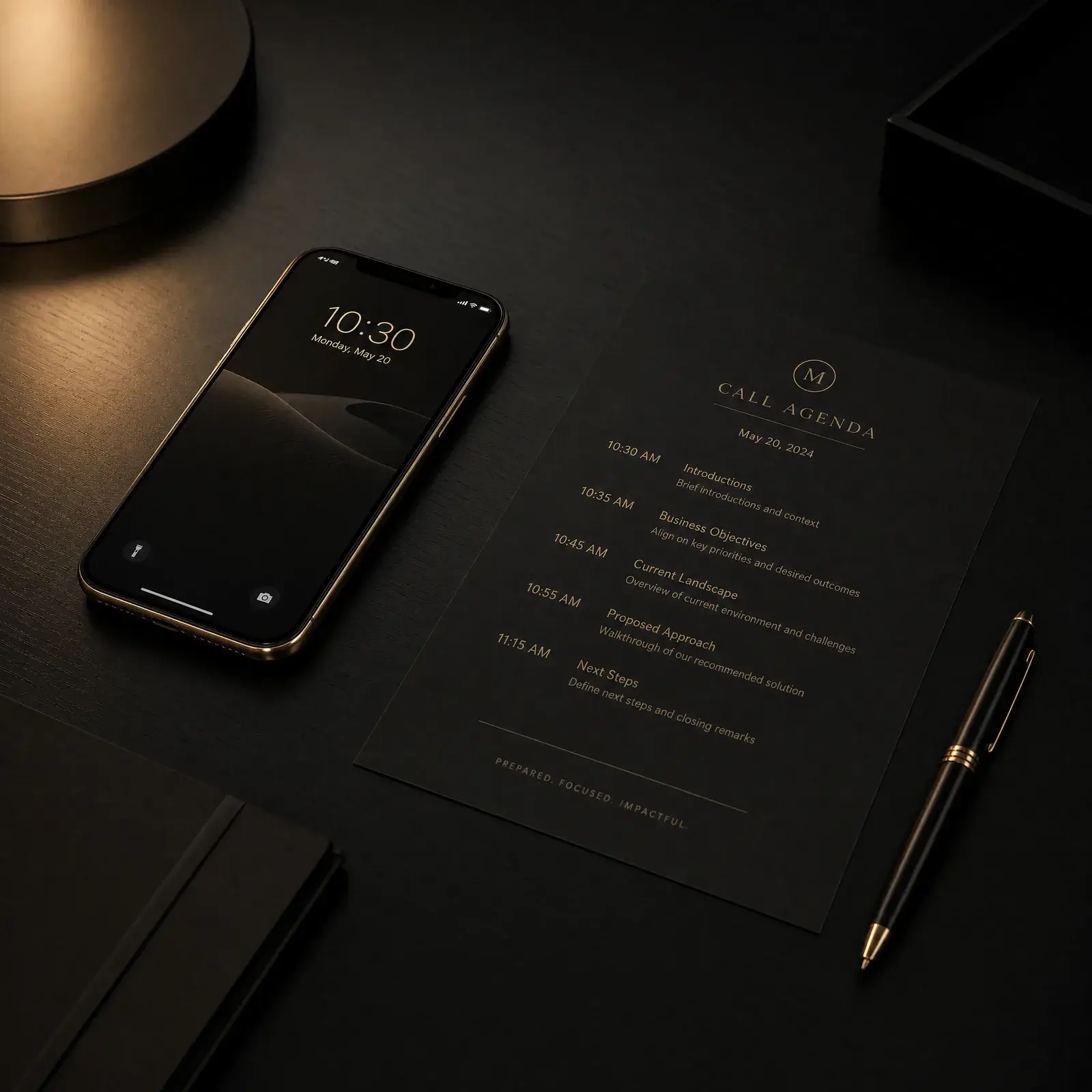
The best sales calls for introverts run on a fixed 20-minute structure: 2 minutes to open the agenda, 8 minutes of discovery questions, 3 minutes reflecting back, 4 minutes proposing next steps, and 3 minutes to handle price and lock a calendared follow-up. Preparation replaces improvisation at every stage.
Quick Takeaways
Here’s what matters most about sales calls for introverts before you read the full framework:
- The framework: open (2m), discovery (8m), reflect (3m), propose (4m), close (3m).
- Ambiverts outsell both introverts and extraverts on outbound calls, per Adam Grant’s study.
- Winning reps talk less on discovery calls – about 46 percent, not more.
- Fewer, sharper questions beat more questions – losing reps ask more, not fewer.
- Pre-write your price answer before the call – never improvise it live.
- Recovery time after calls prevents burnout – block it like a real meeting.
This content is for general informational purposes only and should not be taken as legal or professional business advice.
Can Introverts Be Good at Sales?
Yes – and the research is more specific than reassuring. Extraversion barely predicts sales performance, and the sellers who consistently outperform everyone else are not extraverts at all.
The Ambivert Advantage, Not the Extravert Ideal
Wharton psychologist Adam Grant tracked more than 300 outbound call-center reps over three months and found that ambiverts – the flexible middle of the personality spectrum – generated roughly 24% more revenue than introverts and 32% more than extraverts, according to his 2013 study in Psychological Science. Per HubSpot’s sales research roundup, the raw correlation between extraversion and sales performance sits close to r = 0.07 – functionally noise. As a result, a prepared introvert who knows exactly when to hold back and when to push ends up closer to the ambivert profile that wins than either stereotype suggests.
This is the real foundation for sales calls for introverts. You are not trying to become someone louder – you are building the structure that lets your existing traits, like preparation and real listening, do the work that charisma used to get credit for.
How Long Should a Sales Call Be?
Twenty minutes is the right length for most early-stage discovery and sales conversations run by a solo founder or freelancer. It’s long enough to actually diagnose a problem and short enough that neither side has to guess how much time is left. In other words, that balance is what makes sales calls for introverts sustainable across a full week of calls, not just survivable for one.
Consultative selling for introverts works best inside a fixed container, not an open-ended chat. As of July 2026, the standard consultative call structure – agenda, discovery, solution framing, next step – still holds up against Gong’s own call-phase data, which is exactly what the framework below is built on.
The 20-Minute Sales Call Framework for Introverts
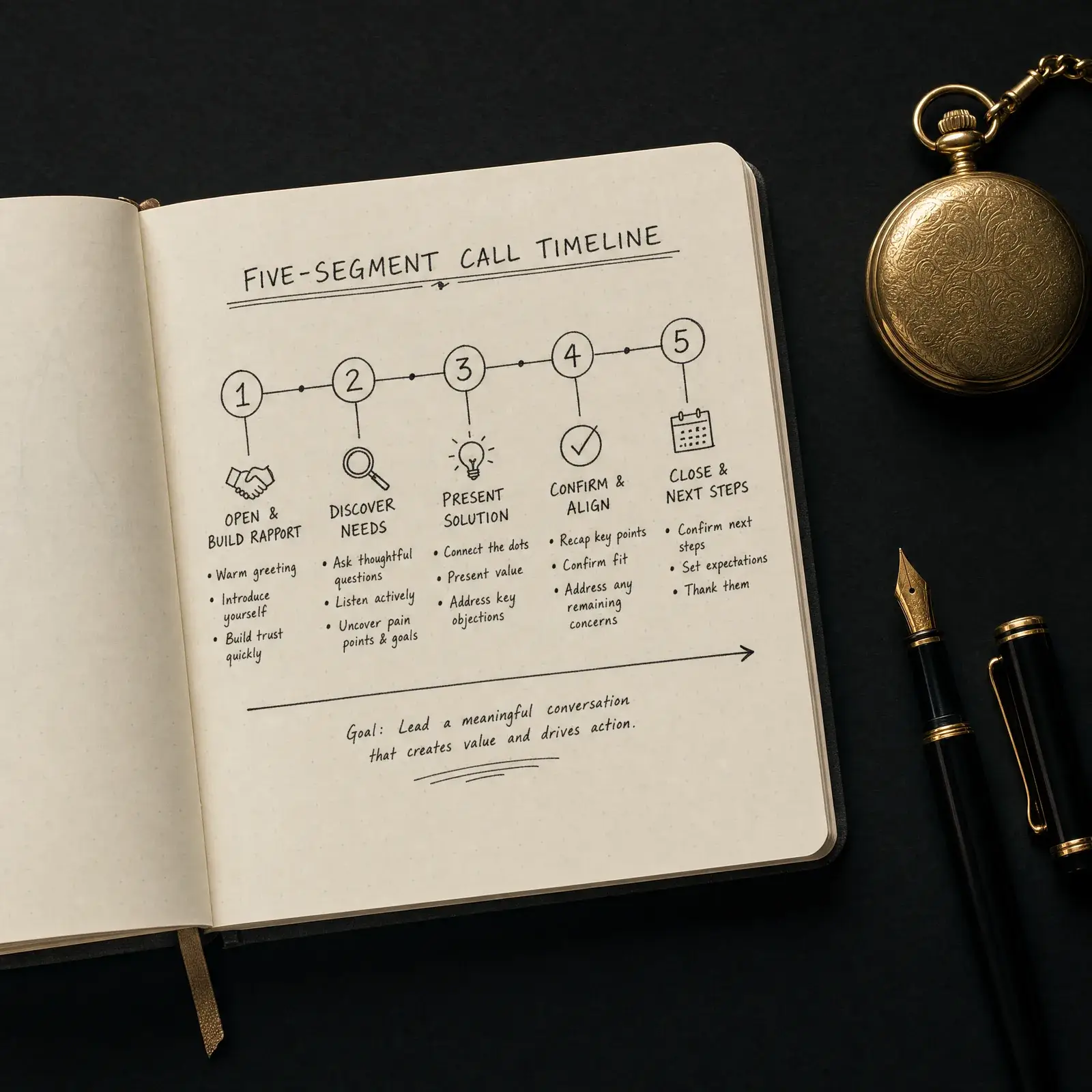
This is the discovery call framework at the center of this guide: five fixed segments, prepared in advance, that total exactly 20 minutes. Each one is short enough to script and rehearse before the call ever starts.
Source: Break The Ordinary – based on Gong call-phase research and Rackham’s SPIN Selling methodology.
Segment 1: Open (2 Minutes)
State the agenda out loud: “Here’s what I’d like to cover in the next 20 minutes.” Confirm the time box, then hand control back: “Anything you want to make sure we cover?”
This single move removes the improvisation pressure for the rest of the call. Both sides now know the shape of the conversation before it starts.
Segment 2: Discovery (8 Minutes)
This is the longest segment, deliberately. Ask Situation and Problem questions first, then two or three Implication questions – the type Neil Rackham’s research on 35,000+ recorded sales calls found top performers use roughly four times more often than average performers, according to HubSpot’s summary of the SPIN Selling method.
Target a talk ratio where the prospect is speaking noticeably more than you. Gong’s analysis of discovery calls specifically found top performers hold close to a 46:54 seller-to-buyer ratio, and performance drops once a seller crosses roughly 65% talk-time, per Gong’s discovery call research.
Source: Gong discovery call research, 326,000+ recorded sales calls
Segment 3: Diagnose (3 Minutes)
Summarize what you heard, in the prospect’s own words, before proposing anything: “What I’m hearing is…” Harvard Business Review’s research on the top 5% of listeners – a study of 3,492 professionals – found this exact behavior separates great listeners from average ones. They ask questions that add insight, per Zenger and Folkman’s HBR research, instead of just nodding along.
This is not passive listening. It’s an active demonstration of the depth an introvert already brings to a conversation.
Segment 4: Propose (4 Minutes)
State one specific recommendation tied directly to what you just reflected back. Never open with a generic pitch you rehearsed before the call started.
This is the one segment where Grant’s ambivert-flexibility research applies most directly. Specifically, a prepared introvert can be assertive here precisely because the previous 13 minutes already removed the guesswork.
Segment 5: Price and Close (3 Minutes)
Handle the price question here if it comes up, using the script in the next section. Then end with one explicit, calendared next step – never a vague “I’ll follow up.”
What Questions to Ask on a Discovery Call
The right discovery questions are fewer and sharper, not more numerous. A sales call structure template only works if the questions inside it are pre-written for the specific prospect, not generic.
The SPIN Question Bank for Solo Founders
This bank is built directly from Rackham’s SPIN framework, phrased for a founder-to-founder conversation:
- Situation: “Walk me through how you’re handling [X] today.”
- Problem: “What part of that process is costing you the most time or money?”
- Implication: “If that stays unsolved for another six months, what does that actually cost you?”
- Need-payoff: “If this were solved, what would that let you do that you can’t do now?”
Pre-draft the Implication question specifically for each prospect before the call. That single question is the one Rackham’s data ties most closely to closed deals.
Why Fewer Questions Win
More questions is not more thorough. Gong’s data on 326,000+ recorded calls shows reps who eventually lost the deal asked more questions per call (around 20) than reps who won (around 15 to 16), according to Gong’s talk-to-listen research.
That plays directly to an introvert’s preference for depth over volume. Ask fewer things, and mean every one of them.
How to Handle the Price Objection
Never answer “so, what’s your price” with a bare number. Reconnect it to the cost the prospect already named in Discovery, then state the number plainly and stop talking. This one moment defines more sales calls for introverts than any other segment.
The Script for “So, What’s Your Price?”
Say something close to: “Given what you told me this is costing you, here’s what it looks like.” Then say the number once, clearly, and go quiet.
This script only works because the Implication and Need-payoff answers were already surfaced in Discovery. Without that groundwork, the number lands as a cold ask, not a fair trade.
For the underlying methodology behind that number, how to price your first offer covers the five-step method this script assumes you’ve already done.
Why Silence After the Number Works
Gong’s over-talking data shows sellers who keep speaking right after stating a number tend to talk their way into a worse outcome. Say the number, then let the prospect respond first.
This is arguably the single hardest moment for an introvert to sit inside – and the one where the structure carries you.
How to End a Sales Call With a Clear Next Step
End every call with a specific date, a specific time, and a specific artifact – a proposal, a written recap, or a second call on the calendar. Never close with “I’ll be in touch.”
This is where introverts most often freeze, because asking for a commitment feels like an imposition. In fact, it’s the one thing the prospect is waiting for you to do.
Right after the call, send a short written recap restating the diagnosis from Segment 3 and the agreed next step. Composed, edited follow-up plays to an introvert’s strength far more than another live conversation would.
Mistakes to Avoid on Sales Calls for Introverts
These are the six failure modes that show up most often when introverts run calls without a fixed structure.
- Over-preparing the pitch, under-preparing the questions. Flip the ratio – spend more time drafting Implication questions than rehearsing what you’ll say.
- Going quiet and letting silence read as disengagement. Follow silence with a reflective question or summary, not just a nod.
- Avoiding the price question until it’s asked, then freezing. Pre-write the price line before the call so it’s retrieval, not improvisation.
- Ending vaguely to avoid discomfort. Use the calendared next step from Segment 5 every single time.
- Booking calls back-to-back with no recovery buffer. This is the fastest route to dreading your own calendar.
- Performing energy you don’t feel. It reads as inauthentic – let the structure carry the confidence instead.
How to Recover Energy After Sales Calls
Book a real recovery buffer after every call, not just after a bad one. Acting focused and assertive for 20 minutes is sustainable, but only with a genuine gap afterward.
The Recovery Protocol Between Calls
Personality psychologist Dr. Brian Little’s Free Trait Theory explains why: introverts can perform focused, “pseudo-extraverted” behavior for a defined task without it being fake, provided they get a real restorative period afterward, per Little’s research on acting out of character. Without that recovery, the performance isn’t sustainable.
In practice, never book two calls with zero buffer between them. Use the buffer for something low-stimulation, not admin work, which is still a form of performing.
Cap how many calls you take in a single day at a number you set on purpose, not whatever your calendar auto-fills. Above all, this one habit does more for sustainable sales for introverts than any script.
Structured vs. Improvised vs. Performed Calls
Three approaches show up most often in sales calls for introverts run without a system. Only one of them holds up over a full week of calls.
The Structured Introvert Call
- Approach: Fixed 20-minute agenda, prepared in advance.
- Talk Ratio: Close to 46:54, seller listening more.
- Best For: Solo founders and freelancers running their own calls.
- Failure Mode: Rare – the structure prevents most improvisation errors.
The Improvised “Natural” Call
- Approach: No fixed agenda, reacting in the moment.
- Talk Ratio: Inconsistent, often drifts over 60% seller talk-time.
- Best For: Experienced reps with years of pattern-matching.
- Failure Mode: High – no repeatable diagnosis, weak close.
The Performed Extravert Call
- Approach: Forcing energy and enthusiasm that isn’t genuine.
- Talk Ratio: Frequently over 60%, per Gong’s lost-deal data.
- Best For: Almost no one, long-term.
- Failure Mode: High – reads as inauthentic, burns out fast.
Frequently Asked Questions
Can introverts really be good at sales?
Yes. Extraversion has almost no measurable relationship to performance in sales calls for introverts, and the strongest performers are ambiverts, not extraverts, according to Adam Grant’s 2013 research in Psychological Science.
Are introverts or extroverts better at sales?
Neither, strictly. Grant’s study found ambiverts outsold both groups by a wide margin, which suggests flexibility and preparation matter more than where someone sits on the personality spectrum.
How long should a sales call be?
Twenty minutes works well for most early-stage discovery and sales conversations. It’s enough time to properly diagnose a problem without letting the conversation drift into small talk.
What questions should I ask on a discovery call?
Use SPIN-style questions: one Situation question, one Problem question, two or three Implication questions, and one Need-payoff question. Fewer, sharper questions consistently outperform a long generic list, per Gong’s call data.
How do I overcome sales call anxiety?
Preparation removes most of the anxiety, because the call stops requiring improvisation. Write out your agenda line, your Implication questions, and your price answer before you ever dial.
How should I end a sales call?
End with one specific, calendared next step – a date, a time, and an artifact like a proposal or a follow-up call. Avoid vague closers like “I’ll follow up,” which rarely convert.
How do I handle the price question when a prospect asks?
Reconnect the number to the cost they already described in Discovery, then state it plainly and stop talking. Answering in isolation, without that context, is what makes the price question feel harder than it is.
How do I recover energy after back-to-back sales calls?
Block a real buffer after every call, not just the difficult ones. Dr. Brian Little’s Free Trait Theory research shows sustained “pseudo-extraverted” performance requires genuine recovery time to avoid burnout.
How I Know This
I spent about five years in digital marketing before I ever had to run a sales call myself. Reading a dashboard and pitching a stranger on the phone are not the same skill, and I found that out the hard way.
When I helped launch and manage an acai shop and, separately, a furniture and home decor shop, there was no sales team to hand the hard conversations to. I was the one calling suppliers, negotiating terms, and talking prospective partners into a first meeting – usually without a script, which is exactly the mistake this article tells you not to make.
What changed things was treating the call like a system instead of a performance: know your questions before you dial, know your price line before it’s asked, and stop trying to sound like someone you’re not. It’s the same lesson at the center of every one of these sales calls for introverts.
Building the Kind of Independence That Doesn’t Depend on Charisma
Break The Ordinary exists because real independence is built on systems, not on personality traits you were never going to change anyway. A 20-minute call framework is a small example of a much bigger idea: the people who build lasting freedom are the ones who replace willpower and charm with structure they can repeat.
Sales calls for introverts are not about faking anything. You don’t need to become an extravert to close deals – you need a call you’ve already rehearsed, questions you’ve already written, and a price line you’re not afraid of anymore.
If call prep is eating time you don’t have, one-person business systems for solo founders is the natural next read – it’s built for exactly this kind of decision fatigue.
About the Author
Randal | Break The Ordinary
I’m Randal, the founder of Break The Ordinary – a multi-niche media brand covering business, tech, health, and finance for people who want to build wealth, freedom, and a life worth living. I’ve run founder-led sales calls myself, without a sales team to hide behind, while helping launch and manage a physical retail business from day one. I share what actually works and what most people get wrong – my approach is direct, research-backed, and built on real experience, not theory.