Published: June 3, 2026 · Last updated: June 3, 2026
The AI Spending Reckoning: Why Most AI Budgets Show No ROI
The numbers on AI spending ROI in 2026 are brutal, and they are finally public. An MIT analysis found that roughly 95% of corporate generative AI pilots produced no measurable impact on profit. Companies poured an estimated $30 to $40 billion into these projects and got close to nothing back.
This is not another “AI is overhyped” take. It is a playbook hiding inside bad headlines. The same trend shows up in rising AI subscription costs and in how AI is squeezing SaaS margins. If you run a small business, this is your cheat sheet for not wasting money.
What This Article Covers
- What the AI spending ROI problem actually is
- What the 2026 data shows
- Why most AI spending produces no ROI
- What the few winners do differently
- Mistakes to avoid with your AI budget
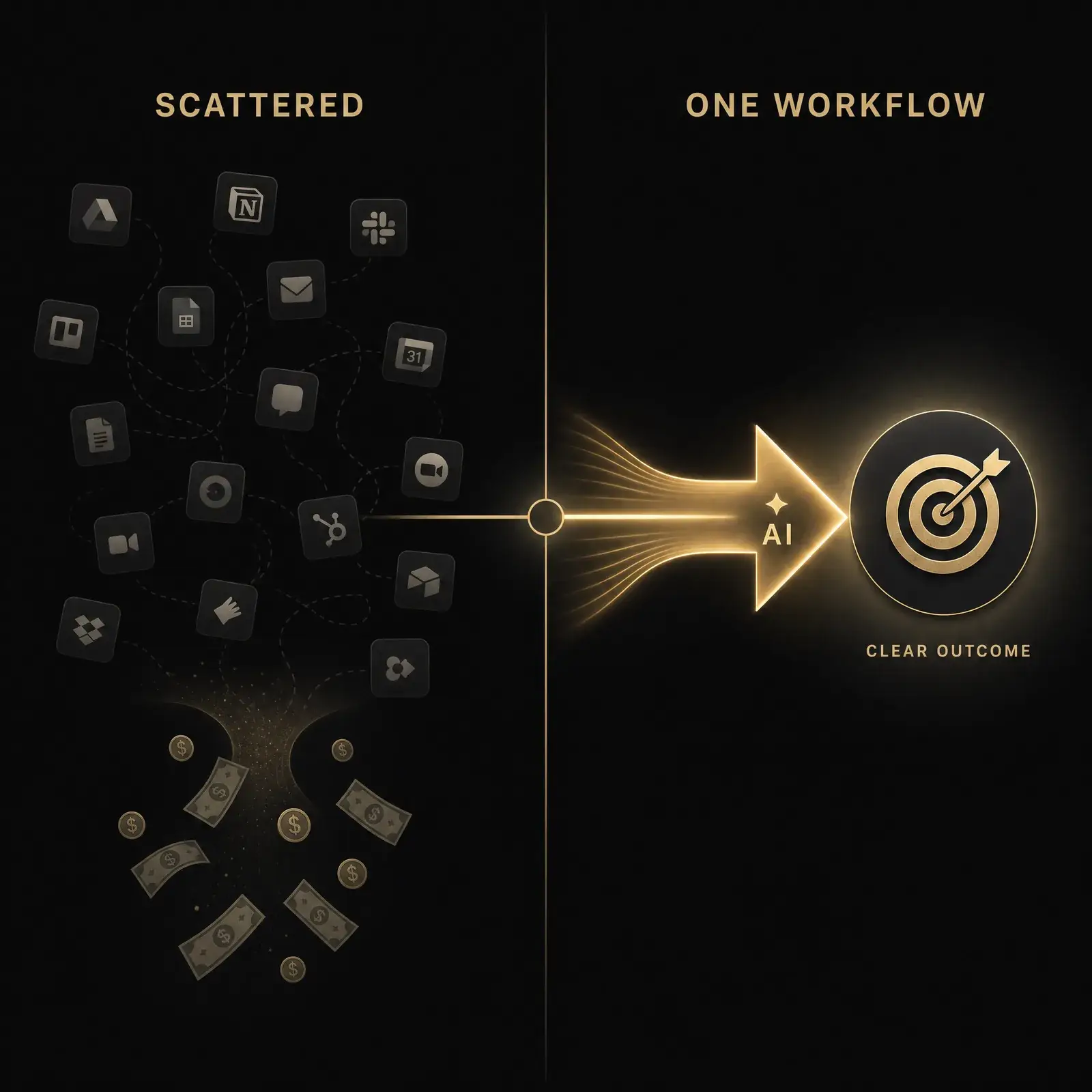
- Spray-and-pray versus one-workflow AI
- Frequently asked questions
AI spending ROI is the measurable return a business gets from the money it puts into AI tools, pilots, and infrastructure. It matters because 2026 data shows the large majority of that spending returns little or nothing, even as costs climb. It is most relevant to operators and small business owners who cannot afford to burn budget on tools that never pay off.

The short answer: most AI spending shows no ROI because companies buy tools before defining the outcome they want. The 2026 data from MIT, S&P Global, and IBM all point the same way. The small group that does get returns shares one habit, and it is one a solo operator can copy this week.
Quick Takeaways
- MIT found ~95% of AI pilots produced no measurable profit.
- S&P Global says 42% of firms abandoned most AI projects in 2025.
- IBM found only about 25% of AI initiatives hit expected ROI.
- The failure is rarely the model, it is the workflow.
- Winners pick one task and define success before building.
- Small operators can out-execute enterprises on this.
What Is the AI Spending ROI Problem?
AI spending ROI is simply whether the money you put into AI comes back as profit, saved hours, or growth. In 2026 the honest answer for most companies is that it does not. They are spending more while measuring less.
Spending up, returns flat
The gap is widening because AI is not free to run. As Axios reported in May 2026, rising token and compute costs are giving companies sticker shock and pushing some to cancel projects. The bills arrive monthly, while the promised returns keep slipping.
That pressure is why this matters now. When budgets were loose, nobody checked the math on AI spending ROI. In 2026, with costs climbing, the math is finally being checked, and it looks bad.
What Does the 2026 Data Actually Show?
The 2026 picture on AI spending ROI is consistent across independent sources. MIT found roughly 95% of generative AI pilots delivered no measurable profit impact. That is not a rounding error, it is the rule.
The same story from four directions
S&P Global Market Intelligence found that 42% of companies abandoned most of their AI initiatives in 2025, up from just 17% the year before. IBM put the share of AI initiatives hitting expected ROI at roughly 25%. Morgan Stanley found only about 21% of S&P 500 companies could point to a measurable AI benefit at all.
Layoffs justified by AI are not paying off either. Fortune reported in May 2026 that automation-driven job cuts are often failing to generate the returns leaders expected. The savings looked good on a slide and worse in reality.
The failure is almost never the model. It is buying a tool before you have decided what you actually want it to do.
Break The Ordinary
Why Does Most AI Spending Produce No ROI?
The reason is not that the technology is weak. MIT traced the failures to a learning gap, where teams did not know how to design a workflow that captured AI’s upside. The model worked, but the process around it did not.
Data, workflow, and undefined outcomes
Three things sink most projects. The data is not ready, the tool is never integrated into how people actually work, and no one defined the outcome before the build started. A funnel from MIT shows the drop-off plainly, since only about 5% of evaluated tools ever reach production.
This is the same discipline gap behind the broader cost story we covered in AI replacing workers. Spending without a defined target is how budgets vanish, with or without AI.
What Do the Few Winners Do Differently?
The minority that gets real AI spending ROI follows a pattern you can copy. They pick one painful, repetitive task and point AI at that single thing. They do not spread budget across ten tools nobody fully adopts.
Define the metric before you pay
Winners decide what success looks like before they buy. They name the metric, whether it is hours saved on inbox triage or faster first drafts, and they kill the tool fast if it does not move that number. Some small teams have gone from zero to serious revenue by solving one narrow problem well.
That is also the practical message in our guide to Claude for small business. One well-integrated workflow beats a drawer full of subscriptions every time.
Mistakes to Avoid With Your AI Budget
The first mistake is subscription stacking, paying for many AI tools and adopting none of them deeply. The second is buying before you have defined the outcome you want to move. Both guarantee weak AI spending ROI.
The third mistake is treating AI as a headcount cut rather than a workflow upgrade. Cutting people and hoping the savings appear is exactly the bet that is failing in 2026. Start with the task, not the layoff.
Spray-and-Pray Versus One-Workflow AI
Spray-and-Pray Spending
- Approach: Buy many tools, hope something sticks
- Outcome: Defined after the fact, if at all
- Adoption: Shallow across the whole team
- Result: The 95% with no measurable return
One-Workflow Spending
- Approach: One painful task, one tool
- Outcome: Metric defined before you pay
- Adoption: Wired into how you already work
- Result: Measurable hours or revenue
Frequently Asked Questions
What is AI spending ROI in simple terms?
It is whether the money you spend on AI comes back as profit, saved time, or growth. In 2026, most companies cannot show that it does.
Is it true that 95% of AI projects fail?
An MIT analysis found about 95% of generative AI pilots produced no measurable profit impact. It does not mean the tools do not work, it means most deployments were not designed to capture value.
Why do most AI initiatives show no ROI?
The common causes are unready data, tools that are never integrated into real workflows, and no defined outcome before the build. The model itself is rarely the problem.
Does this mean I should avoid AI in my business?
No. It means you should scope it tightly. A single well-chosen workflow with a clear metric is where real AI spending ROI shows up.
What does good AI spending look like for a small business?
Pick one repetitive, measurable task and point AI at just that. Define what success means first, wire it into how you already work, and drop it if it does not move the number.
Are AI-driven layoffs saving companies money?
Often not. Fortune reported in 2026 that automation-justified layoffs are frequently failing to deliver the expected returns. Cutting headcount does not automatically produce savings.
Why is this a problem in 2026 specifically?
Rising token and compute costs are giving companies sticker shock just as the weak returns become visible. When AI was cheap, few people checked the math.
What is the single biggest mistake to avoid?
Subscription stacking without adoption. Paying for many tools you barely use is the fastest way to get zero AI spending ROI.
How I Know This
I spent five years in digital marketing and ran my own businesses, from an açaí shop to a home decor brand. In every one of them I learned the hard way that buying a tool is not the same as getting a result.
The months I wasted money were always the months I bought first and asked what I wanted later. The AI spending ROI data just puts a number on a mistake I have already paid for. Define the outcome, then spend, never the other way around.
The Bottom Line
The 2026 AI spending ROI data is a warning and a gift. Most money spent on AI returns nothing, but the reason is spending discipline, not the technology. That is a problem you can actually fix.
That is the clarity Break The Ordinary exists to give you. Independence comes from spending on what works and ignoring the hype, especially when budgets are tight. For a grounded starting point, our guide to the best AI tools in 2026 helps you choose one and commit.
Randal is the founder of Break The Ordinary, where he documents what actually works for building independence. He writes about AI spending the way he ran his own businesses, as an operator who learned to demand a result before paying for a tool. He writes from real experience, not theory.