Published: June 1, 2026 · Last updated: June 1, 2026
On-Chain Stock Settlement Just Got SEC Approval: What Paxos Means for Your Money
On May 29, 2026, the SEC cleared the first piece of real on-chain stock settlement infrastructure in the United States. It granted Paxos Securities Settlement Company registration as a clearing agency, the first blockchain-native firm allowed to clear and settle U.S. equities on-chain. The plumbing of the stock market is moving onto blockchain rails.
The headline sounds bigger than the immediate impact. It is part of the same trend as tokenized equities hitting all-time highs. If you are still building the basics, our guide on financial literacy basics is a better starting point.
This article is for informational purposes only and does not constitute financial advice. Always consult a qualified financial advisor before making investment decisions.
What This Article Covers
- What on-chain stock settlement actually is
- What the Paxos SEC approval changed
- Why faster settlement matters at all
- What changes for ordinary investors and what does not
- Mistakes to avoid reading this news
- Old rails versus on-chain rails
- Frequently asked questions
On-chain stock settlement is the finalizing of share ownership and payment for a stock trade on a blockchain ledger instead of a clearinghouse database. It matters because settlement is the invisible step where your trade becomes legally final, and moving it on-chain can make that step faster and cheaper. It is built for institutions that run market plumbing, not retail traders today.

The short answer: on-chain stock settlement records the final transfer of shares against payment on a blockchain rather than a legacy clearinghouse. Paxos is the first firm with SEC permission to do this for U.S. stocks, which can shrink settlement from one business day to near-instant. For now it is institutional plumbing, so nothing about buying stocks today changes.
Quick Takeaways
- Paxos won SEC approval to clear and settle U.S. stocks on-chain.
- It is the first blockchain-native firm allowed to do this.
- On-chain settlement can move from T+1 to near-instant.
- This is settlement plumbing, not a retail trading product.
- Nothing about how you buy stocks today changes yet.
- Diligence and long-term thinking still decide your results.
What Is On-Chain Stock Settlement?
On-chain stock settlement records a completed stock trade on a blockchain ledger instead of a clearinghouse database. The trade is when you and a seller agree on a price. Settlement is the slower step where the share and money actually change hands.
Settlement, T+1, and why timing matters
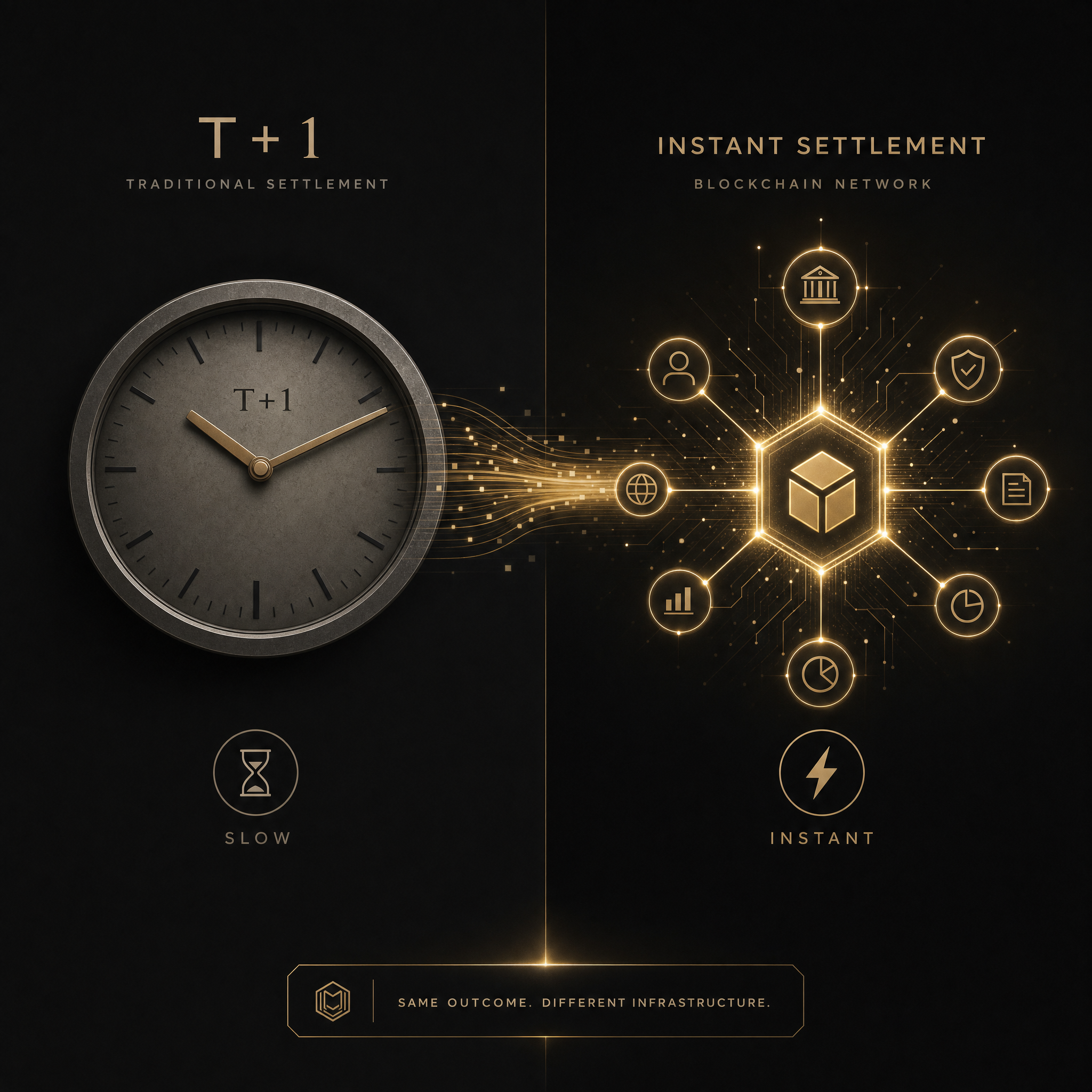
U.S. stock trades settle on a T+1 schedule, one business day after you place the order. That T+1 settlement standard became mandatory on May 28, 2024, halving the old two-day window. During that gap, capital and shares sit locked in transit.
A central securities depository holds shares in book-entry form and updates ownership by ledger entry, not paper certificates. The DTCC has run that plumbing for essentially all U.S. stock trades for decades. On-chain stock settlement puts a blockchain alternative next to that incumbent layer.
What Did the Paxos SEC Approval Actually Change?
The Paxos SEC approval registered Paxos Securities Settlement Company as a clearing agency under Section 17A of the Securities Exchange Act of 1934, the legal category for a central securities depository. It makes Paxos the first blockchain-native firm cleared to settle U.S. equities on-chain alongside the DTCC.
According to CoinDesk on May 29, 2026, the approval lets Paxos settle eligible securities same-day or near-instantly rather than on the T+1 timeline.
Seven years of work, not an overnight win
Paxos says the registration followed roughly seven years of SEC engagement, starting with a 2019 No-Action Letter and a live pilot from February 2020. The SEC order is also a temporary registration, not an open-ended license, so as of June 2026 the rules are still being written.
Settlement is the invisible step where your trade becomes legally final. Moving it on-chain is plumbing, not a product.
Break The Ordinary
Why Does Faster Settlement Matter At All?
Faster settlement frees up capital that would otherwise sit locked during the settlement window. For institutions moving billions, even a one-day delay ties up real money and adds counterparty risk, and near-instant on-chain stock settlement reduces both.
The link to tokenized stocks and 24/7 markets
Paxos already runs white-label settlement infrastructure used by PayPal and Mastercard. Adding regulated stock clearing to those same rails could make tokenized stocks and real-world asset tokenization more feasible at scale over time.
On-chain settlement is also the foundation tokenized equities need. If shares can settle instantly, they can in theory trade around the clock and split into fractional pieces, the wider shift we covered in crypto moving onto Fed payment rails.
What Changes for Ordinary Investors, and What Does Not?
Here is the honest framing headlines skip. On-chain stock settlement is institutional infrastructure, so for now almost nothing about your investing changes. You still buy stocks through your broker exactly as before.
What genuinely does not change
The need for real diligence does not change. Many tokenized stocks today give price exposure without full shareholder rights, and thin liquidity and custody risk can hurt retail traders who rush in. On the custody side, our piece on self-custody with eToro and Zengo covers the trade-offs plainly.
Mistakes to Avoid When Reading This News
The biggest mistake is treating this as a signal to buy something today. There is no new on-chain stock you can trade as a retail investor because of this approval. The change is in the wiring, not the storefront.
A second mistake is assuming on-chain means safer. A blockchain ledger settles faster, but it does not remove the need to verify what a token legally represents. The third mistake is ignoring it entirely, since structural changes matter more over years than weeks.
Old Rails Versus On-Chain Rails
Traditional DTCC Settlement
- Timing: T+1, one business day after the trade
- Ledger: Centralized clearinghouse database
- Capital: Locked during the settlement window
- Maturity: Decades of proven scale and trust
Paxos On-Chain Settlement
- Timing: Same-day or near-instant finality
- Ledger: Blockchain-based book-entry records
- Capital: Freed up sooner after the trade
- Maturity: New, on a temporary SEC registration
Frequently Asked Questions
What is on-chain stock settlement in simple terms?
On-chain stock settlement records the final transfer of shares and payment on a blockchain instead of a clearinghouse database. It is the back-end step that makes a trade legally final, and the blockchain version can complete it faster.
What did the Paxos SEC approval actually do?
It registered Paxos Securities Settlement Company as a clearing agency, the first blockchain-native firm allowed to settle U.S. stocks on-chain. The approval came on May 29, 2026.
Can I buy tokenized stocks on-chain now because of this?
No. This is settlement infrastructure for institutions, not a retail trading product. You still buy stocks through your broker the same way as before.
How is this different from T+1 settlement?
T+1 settlement finalizes a trade one business day after you place it, while on-chain stock settlement can finalize same-day or near-instantly. That speed is the core advantage.
Does on-chain settlement replace the DTCC?
Not currently. Paxos is a blockchain alternative sitting alongside the DTCC, which still clears essentially all U.S. equities. Your broker relationship does not change.
Are tokenized stocks the same as owning real shares?
Often not. Many tokenized stocks sold today give price exposure without full shareholder rights like voting, so read what a token actually grants before buying.
What should an ordinary investor do about this?
For most people, nothing right now. Understand the shift, keep doing real diligence, and stay focused on long-term investing.
When will tokenized equities reach regular investors?
There is no fixed date. June 2026 marks the start of rule-making, not the finish line, so expect a gradual rollout over years rather than a sudden retail launch.
How I Know This
I came to this country with one carry-on and almost nothing in the bank, and my first paycheck went into savings before anywhere else. When you start from zero, the boring mechanics of money matter more than exciting headlines.
Settlement is exactly that kind of boring mechanic. The habit that protected my early investing was never reacting to news I did not fully understand. On-chain stock settlement is a real shift, but it is plumbing, and plumbing rewards patience.
The Bottom Line
The Paxos SEC approval is a real milestone for on-chain stock settlement, pointing toward faster markets and tokenized equities. It is also institutional plumbing, so the practical impact on your money today is near zero.
That is the clarity Break The Ordinary exists to give you. Independence comes from understanding how the system works rather than chasing every blockchain headline. To keep building that foundation, our guide to what Treasury bonds are is a grounded next read.
Randal is the founder of Break The Ordinary, where he documents what actually works for building independence. He reads news like the Paxos approval the way he makes every financial decision, as an immigrant who built from scratch and values mechanics over hype. He writes from real experience, not theory.