Published: June 11, 2026 · Last updated: June 11, 2026
Visa and Mastercard Just Settled a $38 Billion Swipe-Fee Fight. Here’s What Actually Changes for Small Business Owners.
If you run anything that takes a credit card, you have been paying a tax you never voted for. Every time a customer taps or swipes, a small slice of that sale gets skimmed off the top before it ever reaches you. It is called the interchange fee, or “swipe fee,” and for twenty years merchants have been fighting Visa and Mastercard over it in court. This week, a judge moved that fight a big step toward the finish line with a $38 billion settlement. The headline sounds like a windfall. The reality, for a normal small operator, is more complicated.
This article is for informational and educational purposes only and does not constitute financial or legal advice. Always do your own research before making business decisions.
What This Article Covers
- What actually happened in court
- What the settlement actually changes
- The “Honor All Cards” change explained
- Why the relief is smaller than the $38 billion suggests
- What you can actually do about swipe fees
- Frequently asked questions
On June 9, 2026, a Brooklyn federal judge gave preliminary approval to a $38 billion settlement between Visa, Mastercard, and roughly 12 million U.S. merchants, in a swipe-fee fight that began in 2005. The deal cuts interchange fees by 0.1 percentage point for five years and caps standard consumer-credit rates at 1.25% for eight years (the average swipe fee today is about 2.35%). It also weakens the “Honor All Cards” rule, letting merchants refuse entire card tiers. For a small business, the near-term savings are modest, so the real win is understanding the cost levers you already control.

Quick Takeaways
- A Brooklyn judge granted preliminary approval to a $38B Visa/Mastercard swipe-fee settlement on June 9, 2026.
- It replaces an earlier $30B deal that was rejected as too small, in a case dating to 2005.
- Swipe fees drop just 0.1 percentage point for five years; standard consumer-credit rates are capped at 1.25% for eight years.
- The average swipe fee today is around 2.35%, so the headline relief is thin.
- The “Honor All Cards” rule is weakened, so merchants can refuse whole card tiers, but not individual issuers.
- Major retail groups objected that the deal still does not do enough.
What Actually Happened in Court
U.S. District Judge Brian Cogan in Brooklyn granted preliminary approval to the revised settlement, calling it “fair, reasonable, and adequate” and signaling he is likely to grant final approval down the road. Preliminary approval is not the end of the road. Final approval is expected later in 2026, and appeals could still drag things out. But it is the most meaningful movement in this case in years.
Context matters here. This $38 billion deal is the second attempt. Nearly two years ago, a different judge rejected an earlier proposed settlement worth around $30 billion as too small. The dispute itself is genuinely ancient by business standards: it traces back to 2005, which means merchants have been arguing that Visa and Mastercard illegally fixed swipe fees for more than two decades. Roughly 12 million merchants are covered by the class.
What the Settlement Actually Changes
Strip away the big number and the mechanics are surprisingly modest. The networks agreed to cut interchange fees by 0.1 percentage point for five years, and to cap standard U.S. consumer credit-card interchange at 1.25% for eight years. To feel how small that is, anchor it against reality: the average swipe fee a merchant pays today sits around 2.35%. A one-tenth-of-a-point trim does not move that needle much.
So if you are picturing your processing bill suddenly shrinking, temper that. On $200,000 a year in card sales, a 0.1-point reduction is roughly $200 a year. Real money, but not the kind of relief the $38 billion headline implies. The more interesting change is structural, and it has to do with which cards you are forced to accept.
The “Honor All Cards” Change Explained
For years, network rules included something called “Honor All Cards.” In plain English, if you accepted Visa, you had to accept every Visa — including the premium rewards cards that carry the highest swipe fees, the ones that fund all those airline miles and cash-back perks. You could not pick and choose. The settlement weakens that rule. Merchants can now refuse entire tiers of cards (for example, commercial cards, premium-consumer cards, or standard-consumer cards), though they still cannot reject individual issuers within a tier.
The $38 billion headline is the kind of number that wins press releases. The 0.1-point cut is the number that actually hits your bank account.
Break The Ordinary
That sounds powerful: finally, the option to turn away the expensive cards. In practice, most merchants will not use it. Nearly 90% of credit-card spending runs through rewards cards, so refusing that whole tier means turning away your highest-spending customers at the register. Few small businesses can afford to tell their best customers “we don’t take that here.” The right to say no is real; the willingness to use it usually is not.
Why the Relief Is Smaller Than the $38 Billion Suggests
This is the part worth internalizing, because it is a pattern you will see again and again in business news. A giant settlement number gets the headline, but the per-merchant, per-year impact is what touches you. Spread $38 billion across 12 million merchants and many years, and the structural caps that sit only slightly below today’s rates, and the math gets ordinary fast. That is exactly why groups like the National Retail Federation, the Merchants Payments Coalition, and the National Association of Convenience Stores objected — they argue the deal does too little to change the underlying economics.
None of this means the settlement is meaningless. It is a real, court-supervised cap and a real loosening of network control. But for a small operator, treating it as “my costs just dropped” would be a mistake. The smarter move is to treat swipe fees the way you treat any recurring cost — as something you manage, not something you wait on a court to fix. Understanding your own numbers is the foundation of every other decision, which is why we keep coming back to the basics of financial literacy before anything fancier.
What You Can Actually Do About Swipe Fees
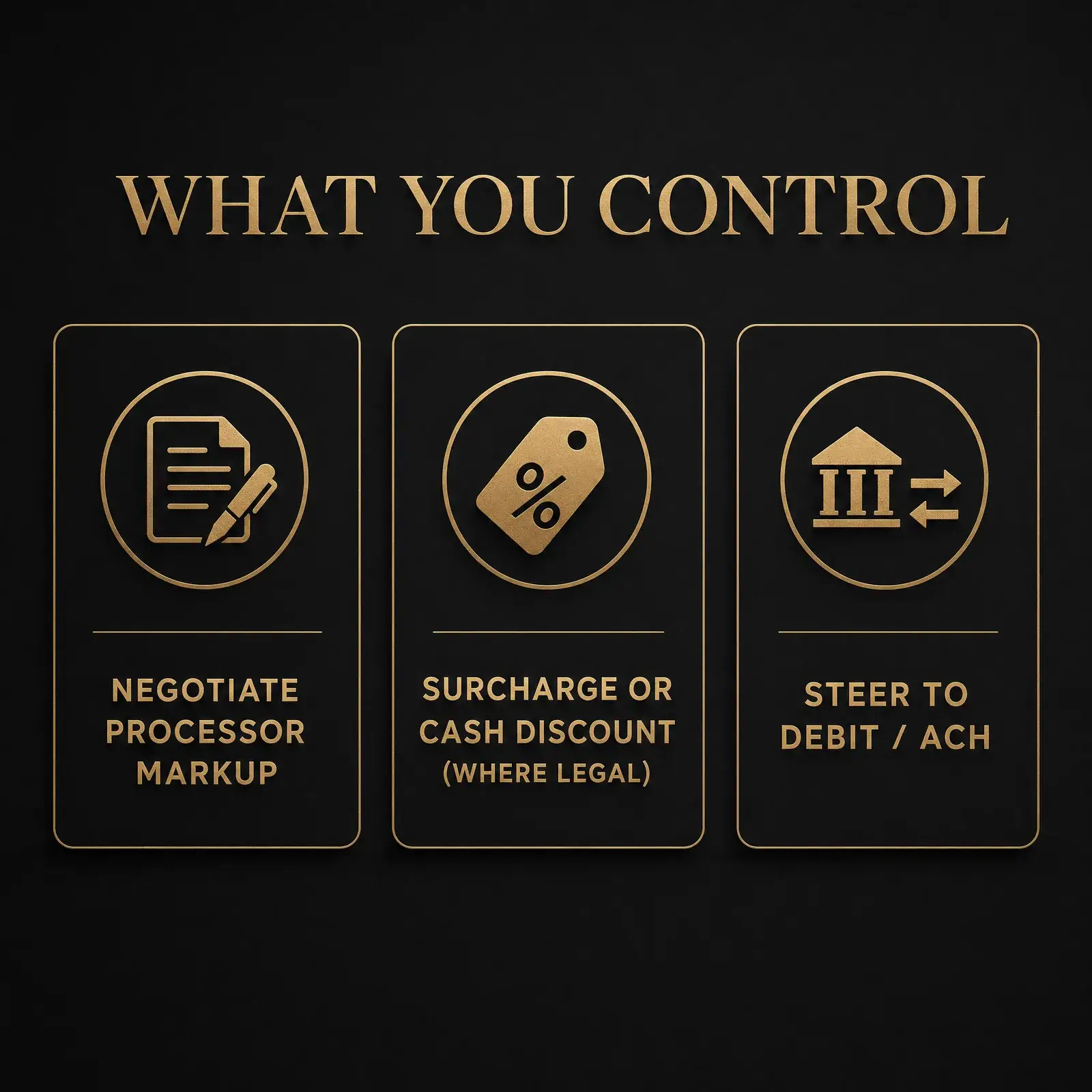
Here is the part you control without waiting for an appeal to clear. First, look at your processor statement and separate the two pieces of what you pay: the interchange fee (set by the networks, the thing this settlement touches) and your processor’s markup (the part your payment company adds on top). The settlement only affects the first. The second is often negotiable, especially if your volume has grown, and many small merchants are on default pricing they have never once questioned.
Second, know your legal options for shifting cost. In most states you can add a surcharge to credit-card transactions as long as you disclose it clearly and follow the rules, or you can offer a cash discount, which steers price-sensitive customers toward cheaper payment methods. Debit cards and ACH transfers generally cost you far less than premium credit cards, so nudging larger or recurring payments toward those rails can quietly protect your margin. Run the numbers before you change anything, the same disciplined way you would validate any business decision — a clumsy surcharge can cost you more in goodwill than it saves in fees.
The meta-lesson is the one Break The Ordinary keeps hammering: the headline event is rarely where your leverage is. Your leverage is in the unglamorous details of your own operation, the line items you actually touch. That mindset is the spine of the one-person business system, and it applies to a $38 billion settlement exactly as much as it applies to a $200 processing bill.
Frequently Asked Questions
How much will the Visa/Mastercard settlement actually lower my swipe fees?
Not much, near-term. The deal cuts interchange by 0.1 percentage point for five years and caps standard consumer-credit rates at 1.25% for eight years. Since average swipe fees are around 2.35%, the per-merchant savings are modest, on the order of a few hundred dollars a year for a small business with moderate card volume.
What is the “Honor All Cards” rule, and why does the change matter?
It required merchants who accept a network’s cards to accept every tier of that network’s cards, including high-fee premium rewards cards. The settlement lets merchants refuse entire tiers (but not individual issuers). In practice, since about 90% of credit spending is on rewards cards, most merchants will not turn those customers away.
Is the settlement final?
No. As of June 9, 2026 it has only preliminary approval. Final approval is expected later in 2026, and appeals could delay or alter implementation.
Can I just charge customers a fee to cover swipe costs?
In most U.S. states you can add a credit-card surcharge if you disclose it clearly and follow the rules, or offer a cash discount instead. Rules vary by state and by card network, so confirm what is allowed where you operate before adding any fee.
What is the single best move for a small merchant right now?
Read your processor statement and separate interchange (network-set) from your processor’s markup (negotiable). Most small merchants have never renegotiated their markup, and that is usually where the fastest, fully-in-your-control savings live.
How I Know This
I have a reflex when a number like “$38 billion” lands in a headline: I divide. Big settlement numbers are built for press releases, and the moment you spread them across twelve million merchants and a decade, the per-person reality usually deflates. That is not cynicism, it is just the habit of reading business news as an operator instead of a spectator.
What I would actually do with this news is almost boring: pull my own processing statement, find the markup, and make one phone call. I have watched too many small operators wait for some external fix — a law, a settlement, a platform policy — to lower a cost they could have trimmed themselves months earlier. The settlement is genuinely good that it exists. But the version of this story that changes your bank balance is the one where you treat swipe fees as your problem to manage, not Visa’s problem to eventually fix.
The Bottom Line
A twenty-year fight just moved toward resolution, and that is worth noting. But do not let a $38 billion headline convince you your costs just fell off a cliff — the actual relief is a 0.1-point trim and a cap that sits just below today’s rates. The real takeaway for anyone building a business is the mindset: the headline is rarely where your leverage lives. Go read your processor statement this week, separate interchange from markup, and make the one call most merchants never make. That is the kind of small, unglamorous move that compounds, the same way the case for entrepreneurship in 2026 is built on doing the boring things other people skip.
Randal is the founder of Break The Ordinary, where he documents what actually works for building independence. He reads big-number business headlines the way an operator should, by asking what it changes for the person actually running the shop, and he is more interested in the costs you control than the ones you wait on. He writes from real experience, not hype.