Published: June 17, 2026 | Last Updated: June 17, 2026
When to Make Your First Hire (and How to Not Get Burned)
Knowing when to make your first hire is one of the most consequential decisions a solo founder will face. Most people get it wrong in one of two directions: they hire too early and drain cash managing someone instead of building, or they wait too long and become the bottleneck on their own growth. The line between those two outcomes is not luck – it is a specific set of readiness conditions that most articles never spell out clearly.
If you are already thinking through the systems side of your business, the work at building a one-person business system applies directly here. The financial logic governing this decision also mirrors the analysis in the side hustle quit-job math: you need consistent, predictable revenue before you add a fixed cost.
Before any hire makes sense, you should have already validated the role itself the same way you would validate a business idea – with a low-cost test before a full commitment. And given where we are in 2026, it is worth checking what agentic AI can handle for solo founders before you write a job description at all.
General Information Notice: The tax, payroll, and worker classification information in this article is general in nature and reflects U.S. conditions as of mid-2026. It is not legal or tax advice. Consult a licensed employment attorney and a CPA before making any hiring or classification decision for your specific situation.
What Is the First Hire Decision? The first hire decision is the point at which a solo business owner determines whether adding a person to their operation will generate more value than it costs. It matters because a bad hire at this stage can set a bootstrapped business back by months and thousands of dollars. This decision is most relevant to solo founders who are consistently at capacity and have identified specific revenue-generating work they cannot currently execute.
Featured Answer: You are ready to make your first hire when you have sustained capacity constraints blocking revenue-generating work you have already identified, consistent monthly revenue of at least 3 to 4 times the cost of the hire, and a clear written scope for what the hire will do in the first 90 days. If any of those three conditions is missing, you are not ready yet.
Quick Takeaways
- Overwhelm is an audit signal, not a hiring signal
- Start with a contractor – validate the role before committing to headcount
- A $50,000 salary employee costs $62,500 – $70,000 after taxes and overhead
- You need 3 to 4 times the hire’s monthly cost in consistent revenue first
- Hire for the task furthest from your highest-value work – not what you hate most
- Document the process before you hand off the task – a hire without a system is a prayer
What Is the Feeling That Actually Sends Founders Searching?
It usually starts with a week like this: you miss a deliverable, a client follows up twice, you are answering emails at midnight, and somewhere in the middle of it you think: I need to hire someone. That feeling is real. It is also not a reliable hiring signal.
Overwhelm is a feeling, not a diagnosis of the actual problem. In most cases, that feeling signals one of three things: a need for better systems, low-value tasks that should be eliminated entirely, or work that should be automated.
Hiring is the right answer only when the problem is genuine capacity – when you have already eliminated, systemized, and automated, and there is still high-value work you cannot get to. The question is not “should I hire?” It is “what is actually blocking my growth, and is a person the right solution to that specific problem?”
Most founders skip that diagnosis. They hire into the symptom instead of the root cause, and then wonder why the new hire did not fix the feeling.
Why Automation Comes Before Headcount
As of June 2026, the AI tools available to solo founders can handle research, content drafting, customer email triage, scheduling, bookkeeping integrations, and basic reporting without a human on payroll. Before you post a role, spend two hours auditing what you are doing repeatedly.
If a task is repetitive and rule-based, it is a candidate for automation, not delegation to a person. According to a 2024 Salesforce survey, small business owners lose an average of 96 minutes of productivity daily – roughly three weeks of lost time per year – to task-switching and inefficiency.
A well-designed workflow fixes that. A hire does not automatically fix it; a hire can actually add to it through the time cost of management.
When to Make Your First Hire: The 5-Signal Readiness Test
Knowing when to make your first hire requires passing a real readiness test, not just feeling stretched. Here are the five signals that together constitute a green light.
Signal 1: Capacity Is Blocking Revenue, Not Just Time
The distinction matters. If you are busy on low-value tasks, you have a prioritization problem. If you have identified specific client work, product development, or sales activity you cannot execute because your hours are full, that is a capacity problem a person can actually solve.
A 2025 Shopify-commissioned Harris Poll survey found that 39% of small business owners cited goals beyond personal capacity as their primary hiring signal. That is the right trigger. Feeling scattered is not.
Signal 2: You Have a Defined Role, Not a List of Problems
If you cannot write down exactly what this hire will own in the first 90 days, you are not ready. “Help me with everything” is not a role. A role is: “This person owns client onboarding emails and project delivery coordination. Success in 90 days means zero missed client follow-ups and turnaround time under 24 hours.”
According to Raines International’s analysis of CBInsights data, the wrong team was a top-three failure factor in 23% of failed startups, with ego-driven or vague hiring identified as a common driver. A hire without a clear scope is a bad hire waiting to happen.
Signal 3: The Work Repeats
One-off tasks do not justify a hire. If a type of work appears weekly, consumes more than four hours per instance, and follows a consistent enough pattern that another person could learn it, that is a candidate for delegation.
If it is irregular and complex, it is a consulting or project engagement – not a hire.
Signal 4: You Have Documented the Process
Michael Gerber’s warning in The E-Myth Revisited holds up: most founders make the fatal assumption that understanding the work means understanding how to hand it off. A hire without a documented process is management by abdication – you delegate, get frustrated, and take the work back.
Write the process before you post the role.
Signal 5: You Have Runway Beyond the Hire
The same 2025 Shopify survey found 38% of business owners required at least three months of cash covering payroll before hiring. That is the minimum, not the target.
The full financial test is in the next section – but the principle is simple: a hire should never put your business one slow month away from not making payroll.

Contractor, Part-Time, or Full-Time Employee: Your First Hire Decision
For most solo founders, the answer to “when to hire your first employee” should actually be reframed as “when to hire your first contractor.” According to Mercury’s 2025 contractor vs. employee framework, 61% of startups are already reliant on contract talent, and 60% plan to increase contractor spending.
The reasoning is sound: employees create continuity; contractors create optionality. At this stage, optionality is what you need. You do not yet know exactly how the role will evolve, whether the person will perform, or how the scope will expand.
A contractor lets you validate all of that before committing to payroll obligations, benefits, and the legal complexity of termination.
The Mercury 5-Question Framework (Adapted for Solo Founders)
Use these five questions to determine whether your first hire should be a contractor or a full-time employee. They are adapted from Mercury’s 2025 guidance on employee vs. independent contractor decisions for startups.
Question 1: Is the work ongoing or time-bound?
- Contractor signal: Time-bound project with clear deliverables and an end date
- Employee signal: Ongoing need that does not have a natural endpoint
- Solo founder verdict: If you are unsure, start with a contractor to find out
Question 2: Execution or decision-making authority?
- Contractor signal: Defined deliverable – they produce output, you make decisions
- Employee signal: The role requires judgment and authority to act on your behalf
- Solo founder verdict: Most first hires are execution roles. Keep authority with yourself.
Question 3: How much company context is required?
- Contractor signal: Specialist skill applied quickly with minimal onboarding
- Employee signal: Deep institutional knowledge required from day one
- Solo founder verdict: Graphic designers, video editors, and bookkeepers rarely need deep context
Question 4: Daily embedded or independent output?
- Contractor signal: They produce work independently and deliver it to you
- Employee signal: Close daily collaboration is required for the role to function
- Solo founder verdict: Most early-stage founders cannot provide the management bandwidth for daily collaboration
Question 5: If the role disappeared in six months, would your business stall or just pause?
- Contractor signal: Business pauses briefly, then recovers – a contained dependency
- Employee signal: Business stalls – the function is load-bearing
- Solo founder verdict: If the answer is “stall,” build toward a full-time hire. If “pause,” a contractor is right.
The Misclassification Risk You Cannot Ignore
One warning that most guides on when to make your first hire skim past: worker misclassification carries real penalties. Intentional misclassification triggers a 20% tax on wages, 100% of FICA taxes owed, and up to $1,000 per worker in fines, according to ABLEMKR’s 2025 analysis of IRS penalties.
The risk is not usually intentional – it is gradual. An early contractor relationship drifts: you give them a company email, include them in recurring meetings, assign ongoing tasks with no defined end. Over time, the relationship looks like employment regardless of what the contract says.
The DOL’s May 2025 reversal of the 2024 independent contractor rule returned classification to traditional economic reality principles: is this worker economically dependent on you, or genuinely operating an independent business? That test is applied to the relationship as it actually functions, not as it was originally structured.
Keep your contractor relationships scoped to deliverables, not hours. Do not direct how they do the work – only what the output should be. And consult an employment attorney when the relationship begins to look ongoing or embedded.
This is general regulatory context; classification rules differ significantly by state, and California’s ABC test is among the strictest in the country.
The Financial Readiness Test: Run This Math Before You Post Any Role
Financial readiness to hire is not about whether you can afford one month’s payment. It is about whether you can sustain the cost through the full ramp period – the six to nine months it typically takes a new hire to become fully productive.
The 3 to 4x Revenue Rule
The standard guidance from business.org is this: your business should generate 3 to 4 times the monthly cost of the hire in consistent revenue before you commit. That buffer accounts for taxes, overhead, the management time cost, and the ramp period before the hire delivers full value.
Here is what that looks like in practice. Say you are bringing on a contractor at $4,000 per month for operations support. You need $12,000 to $16,000 per month in consistent, predictable revenue before that hire is financially sound.
Not gross revenue in a good month – consistent revenue across a trailing three-month average.
The True Cost of a Hire
According to The Fino Partners, a commonly cited rule of thumb puts a $50,000 salary employee at $62,500 to $70,000 per year once you factor in payroll taxes, benefits, equipment, and overhead. That is 1.25 to 1.4 times the stated salary.
Contractors do not carry those costs, but you typically pay a premium on the hourly or project rate to compensate. Either way, the sticker price is not the real price.
The cost of a bad hire makes this even more consequential. According to DistantJob’s compilation of U.S. Department of Labor and CareerBuilder data, the DOL puts the average cost of a bad hire at at least 30% of first-year expected earnings, and CareerBuilder puts the average financial loss at $17,000 per bad hire for entry-to-mid-level roles.
The same data source reports that 74% of small business employers have hired the wrong person at least once. These numbers argue for caution and role validation before commitment.
The Runway Check
Beyond revenue coverage, run a simple runway check. If your business had a slow month at 60% of your normal revenue, could you still cover the hire for three consecutive months?
If the answer is no, you are not ready. A hire that works only in good months is a liability, not an asset.
What to Delegate First – and What to Keep
One of the most common mistakes in a first hire decision is hiring a second version of yourself. You bring on someone who does what you do, compounds your output slightly, and leaves the actual bottlenecks untouched.
The right question is not “who can do what I do?” – it is “what work is furthest from my highest-value activity?”
The Delegation Hierarchy for Solo Founders
Here is a ranked order for what to hand off first, based on what costs the most founder time for the least strategic return.
- Administrative and scheduling: Email management, calendar coordination, follow-up sequences. High volume, low judgment, easy to document.
- Production and delivery work: Content editing, graphic design, video editing, transcription, data entry. Specialist skills that do not require business context.
- Client communication and support: Responding to common questions, processing routine requests, onboarding coordination. High time cost, definable process.
- Bookkeeping and financial admin: Receipt categorization, invoicing, payroll prep. Low strategic value, high accuracy requirement – a contractor with accounting training handles this better than most founders.
- Specialized technical work: Website updates, ad management, SEO execution. Hire a specialist rather than a generalist.
What you do not hand off first: sales, strategy, and relationships. These are where your judgment, your credibility, and your direct knowledge of the business are load-bearing.
A hire who makes promises you cannot verify or builds relationships in your name before you have systems in place creates more problems than they solve.
The Gerber Warning: Document Before You Delegate
Michael Gerber’s framing in The E-Myth Revisited is worth taking seriously here. Most founders hire and then delegate verbally, expecting the new person to figure out the nuance. The result is what Gerber calls management by abdication: you step back, the work degrades, and you reclaim the task in frustration.
That cycle is not the hire’s fault. It is the absence of a system.
Before you hand off any task, write down how you do it. Not a manual – a simple documented process, step by step, with decision points noted. If you cannot write it down, you have not understood it well enough to hand it off cleanly.
That documentation also becomes the foundation for training the next person after this one.
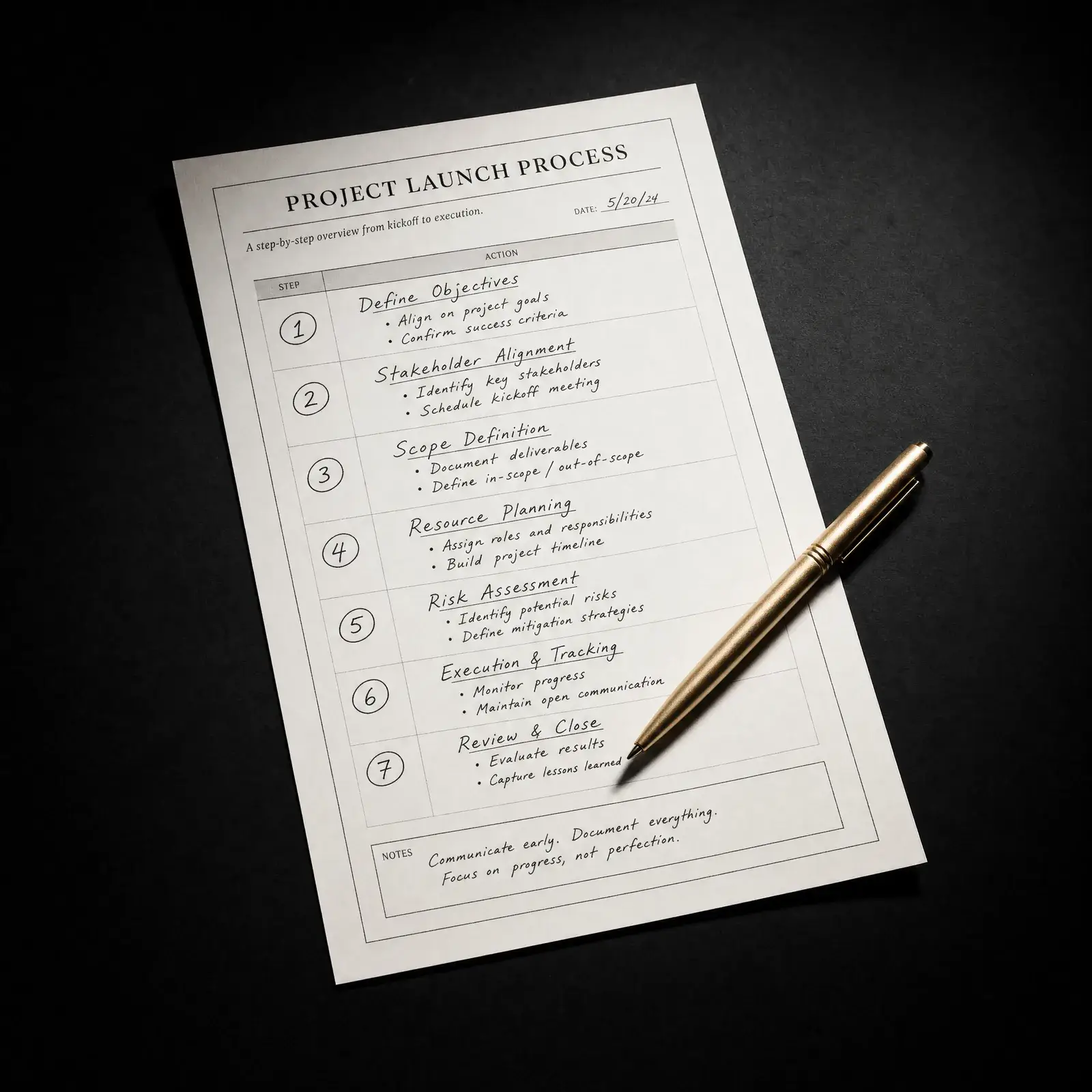
The Mistakes That Burn Solo Founders on Their First Hire
The data on bad hires is sobering: 74% of small business employers have made one. Here are the specific patterns that cause them.
Mistake 1: Hiring Out of Overwhelm, Not Readiness
Overwhelm triggers urgency, and urgency skips the vetting that a good hire requires. Founders who hire in a panic tend to take the first available person rather than the right person, skip the written scope because they are too busy to write it, and hand off tasks without documentation because there is no time.
The hire inherits the chaos instead of solving it.
Mistake 2: The Vanity Hire
Some first hires are about status, not function. A full-time team member before you have the revenue to support one, a senior title before the role has enough scope to fill it, or hiring in a function you admire rather than one your business needs.
According to Raines International’s analysis of CBInsights data, ego-driven hiring showed up as a recurring failure pattern across 23% of failed startups. The test: does this hire make your business more capable, or does it make you feel more like a CEO?
Mistake 3: Urgency Without Clarity
Founders hire urgently when a client escalates or a deadline looms. That urgency compresses the time spent on the single most important input: the role definition.
A hire brought in to solve a specific crisis without a clear ongoing scope becomes purposeless once the crisis passes. You end up managing someone whose job you cannot clearly articulate, and they end up underperforming in a role that was never designed.
Mistake 4: The Technician Trap
Gerber’s warning from The E-Myth Revisited applies directly here. Most founders hire someone to do the technical work the founder does well rather than the work that is actually blocking growth.
You love writing, so you hire a writer. You love the product, so you hire a second person to help with the product. Either way, you compound output in areas you already have covered while the real bottlenecks go untouched.
The result is that you compound your output in areas you already have covered while your bottlenecks – the admin, the delivery coordination, the client follow-up – remain untouched.
Your 5-Question Go/No-Go Framework
Run through these five questions before you post any role or sign any agreement. All five must be true before the answer is yes.
Go/No-Go Checklist for Your First Hire
- Have I documented the process this person will own – step by step?
- Does my trailing three-month revenue average at least 3 to 4 times the monthly cost of this hire?
- Can I write down exactly what success looks like for this hire in the first 90 days?
- Is this role solving a capacity constraint on revenue-generating work, not just clearing things off my plate?
- Have I tested what AI and automation can do in this function before deciding a person is necessary?
If any answer is no, the right move is to fix that condition, not to hire anyway and hope the hire fixes it for you.
“Most small business owners make the fatal assumption that understanding the technical work of a business means understanding how to run a business that does technical work.”
– Michael Gerber, The E-Myth Revisited
BTO framework; data via Mercury – Employee vs. Independent Contractor, 2025, Business.org – Cost to Hire, 2024, and ABLEMKR – IRS Misclassification Penalties, 2025
Frequently Asked Questions
How do I know when to make my first hire?
You are ready when three conditions are all true: capacity constraints are blocking specific revenue-generating work you have identified, your trailing three-month revenue average is at least 3 to 4 times the monthly cost of the hire, and you have a written role definition with a 90-day success measure. If any of those three is missing, fix that condition first.
Should my first hire be a contractor or an employee?
For most solo founders, the answer is a contractor: it lets you validate the role before committing to payroll obligations, benefits, and the legal complexity of termination. According to Mercury’s 2025 data, 61% of startups are already reliant on contract talent for exactly this reason. Move to a full-time employee when the work is ongoing, load-bearing, and the business revenue can sustain it.
How much revenue do I need before hiring someone?
The standard benchmark is 3 to 4 times the monthly cost of the hire in consistent, predictable revenue. For a contractor at $4,000 per month, that means $12,000 to $16,000 in monthly revenue on a reliable trailing average. Waiting for profitability is not required – consistent revenue is.
What is the real cost of a bad first hire?
According to DistantJob’s compilation of U.S. Department of Labor and CareerBuilder data, the DOL puts the average cost of a bad hire at at least 30% of first-year expected earnings, and CareerBuilder puts the average financial loss at $17,000 for entry-to-mid-level roles. The greater cost is time: rebuilding the role, re-hiring, and recovering the momentum you lost.
What tasks should I delegate to my first hire?
Delegate the work that is furthest from your highest-value activity and has the highest process-ability – admin, delivery coordination, client follow-up, and specialist production work like design or bookkeeping. Keep sales, strategy, and key relationships with yourself until you have the systems and people in place to hand those off safely.
What is the worker misclassification risk, and how do I avoid it?
Intentional misclassification carries a 20% tax on wages, 100% of FICA owed, and up to $1,000 per worker in fines. The more common risk is accidental drift: a contractor relationship that gradually looks like employment through shared email, recurring meetings, and ongoing undocumented tasks. Keep the scope written, deliverables-based, and independent – and consult an employment attorney when in doubt.
Can AI replace a human first hire in 2026?
For a growing set of functions, yes. Research, content drafting, email triage, scheduling, and basic reporting are all being handled by AI tools at quality levels that would have required a junior hire three years ago. Audit what AI can do before deciding a person is necessary: most solo founders in 2026 need fewer human hires than they think, and the ones they do need should handle work AI cannot yet reliably execute.
How I Know This
My context for this topic is not theoretical. When I helped launch and manage both the açaí shop and a furniture business, I watched firsthand how early-stage operations either get stuck because of under-resourcing or get burned because of premature or mismanaged hires. The açaí shop was a physical business with real staff needs, delivery timelines, and product quality standards – the kind of operation where a bad hire does not just cost money, it costs you a customer relationship and sometimes a health code compliance problem.
What I saw repeatedly was this: the founders who struggled with hiring almost always skipped the documentation step. They knew how to do the work themselves. They just could not explain it to someone else, because they had never had to write it down.
The result was exactly what Gerber describes: frustration, reclaiming of delegated tasks, and turnover that cost more than just doing it themselves would have.
The second lesson came from the digital marketing years. In agency and brand environments, I saw what happens when a solo operator hires to solve a feeling rather than a defined problem. The headcount would grow, the costs would rise, and the output would not change at the rate anyone expected, because the underlying problem was not capacity – it was unclear prioritization.
More people doing the wrong things does not fix that.
Building Break The Ordinary on an AI-powered pipeline has also sharpened my thinking on the automation question. Before any human hire makes sense for this business, I have had to map exactly what a multi-agent system can already handle and where the genuine human judgment gaps are. That discipline – map the function before you fill it – applies whether you are hiring a person or deploying a tool.
Closing: The Hire That Actually Builds Something
According to SBA’s 2025 Small Business Profile for the United States, 82% of US small businesses are nonemployer firms – solo operations with no payroll. That is not failure. That is the reality of where most business owners are, and there is no shame in staying there until the conditions genuinely call for something different.
The founding idea at Break The Ordinary is that real independence is built on systems and clear decisions – not on how many people are on your roster. A solo founder who has systemized their operations, knows their numbers, and delegates strategically from a position of clarity is more capable than a small team operating in chaos.
The first hire, done right, extends that clarity. Done wrong, it imports chaos into a business that was working.
Your first hire should make your business more capable of serving its customers and generating revenue without you in every loop. If it does not do that, it is the wrong hire at the wrong time. Know the difference before you sign anything.
For more on the systems that make this decision easier, start with how to build a one-person business system – the infrastructure that makes smart delegation possible.