Published: June 9, 2026 | Last Updated: June 9, 2026
AI Coding Agent API Cost Audit: The Real Bill After 30 Days
Every AI coding agent subscription pitch sounds like a bargain until you open the billing dashboard. The ai coding agent api cost audit most developers have never run reveals a gap between the advertised price and the actual monthly spend that can easily reach 10x. An active developer on Claude Code Pro at $20 per month is not spending $20 per month in any meaningful sense of that number.
They are spending whatever the underlying API would charge for their session volume, and the flat subscription is simply a ceiling on that bill, not the bill itself. If you want to understand why your stack costs what it costs, the first step is recognizing that AI tool billing has quietly shifted from predictable subscriptions to token-driven economics.
BTO has covered why AI subscription prices are artificially low and what happens when the pricing subsidy ends. We have also broken down the self-hosted architectural approaches that cut LLM API costs and compared Claude versus ChatGPT across the dimensions that matter for builders. This article takes a different cut: a concrete, tool-by-tool audit framework for the solo developer who wants to know what they are actually paying right now and where to cut it.
This article is for general informational purposes only and reflects pricing and tool details verified as of June 9, 2026. AI tool pricing changes frequently – confirm current rates on each provider’s official billing page. Nothing here constitutes professional, financial, or business advice; evaluate any subscription or spend decision against your own circumstances.
What is an AI coding agent cost audit? An AI coding agent cost audit is a systematic review of what you are actually paying for AI-assisted development tools across subscription fees, API-equivalent token consumption, and subscription overlap. It matters because the pricing page and the real bill are structurally disconnected: agentic sessions consume tokens at 1,000x the rate of chat interactions, and the same task can vary 30x in cost depending on session length and context size. This audit is most valuable for solo developers and technical founders running one or more AI coding tools and noticing that their monthly spend does not match their expectations.
Quick answer: A solo developer running Claude Code, Cursor, and GitHub Copilot can spend $70 to $500 per month depending on session depth and tool overlap. The hidden costs are not mysterious: they live in agentic loop token accumulation, premium model defaults, context window bloat, and redundant subscriptions billing for the same underlying model. A 30-day audit – tracking each tool’s dashboard, comparing API-equivalent cost against your flat subscription, and eliminating overlap – typically reveals 30 to 50 percent of monthly spend that delivers no additional output quality.
Quick Takeaways
- Agentic sessions consume 1,000x more tokens than standard chat interactions.
- Input tokens drive 85% of the bill – not the code the AI writes.
- GitHub Copilot moved to AI credits (token billing) on June 1, 2026.
- Cursor’s June 2025 credit shift cut effective monthly requests by more than half.
- Subscription overlap between Cursor Pro and Claude Pro is a common double-charge.
- Context compaction and fresh sessions can cut costs 50 to 70 percent.
What Is an AI Coding Agent Cost Audit?
An ai coding agent api cost audit is a structured four-week process of measuring, comparing, and optimizing your actual spend on AI development tools. The audit examines subscription fees, API-equivalent token burn, and redundant overlaps – then produces a defensible number you can act on.
Most developers skip this audit entirely. The subscription pricing looks manageable, the tools feel indispensable, and the token-level mechanics are deliberately obscured behind credits, request counts, and rolling windows. By the time the bill is surprising, months of untracked spend have already accumulated.
Why Token Economics Changed the Game
Until 2024, most AI coding tools billed on flat subscriptions or simple request counts. That model has eroded systematically. GitHub Copilot moved to AI credits (usage-based billing) effective June 1, 2026 – each plan now includes a matching credit allotment, with overages billed at per-token API rates.
Cursor made the same shift in June 2025, cutting the effective monthly request count from roughly 500 to roughly 225 at the $20 price point. Multiple developers documented $350 in overages in a single week.
AI model costs scale with token volume, not seat counts. Agentic sessions – where the model reads your file tree, runs tool calls, iterates on edits, and validates results – consume tokens at a rate that flat pricing cannot cover sustainably. Providers either raise prices, move to usage-based billing, or do both.
Who This Audit Is For
This framework addresses the solo developer or technical founder spending between $50 and $500 per month on AI tools. It is not an enterprise FinOps guide. It does not require a dedicated cost management platform or an engineering manager dashboard.
Every step in the four-week framework requires nothing more than the billing dashboards that already exist inside the tools you are paying for.
Why the Bill Is Higher Than the Pricing Page Implies
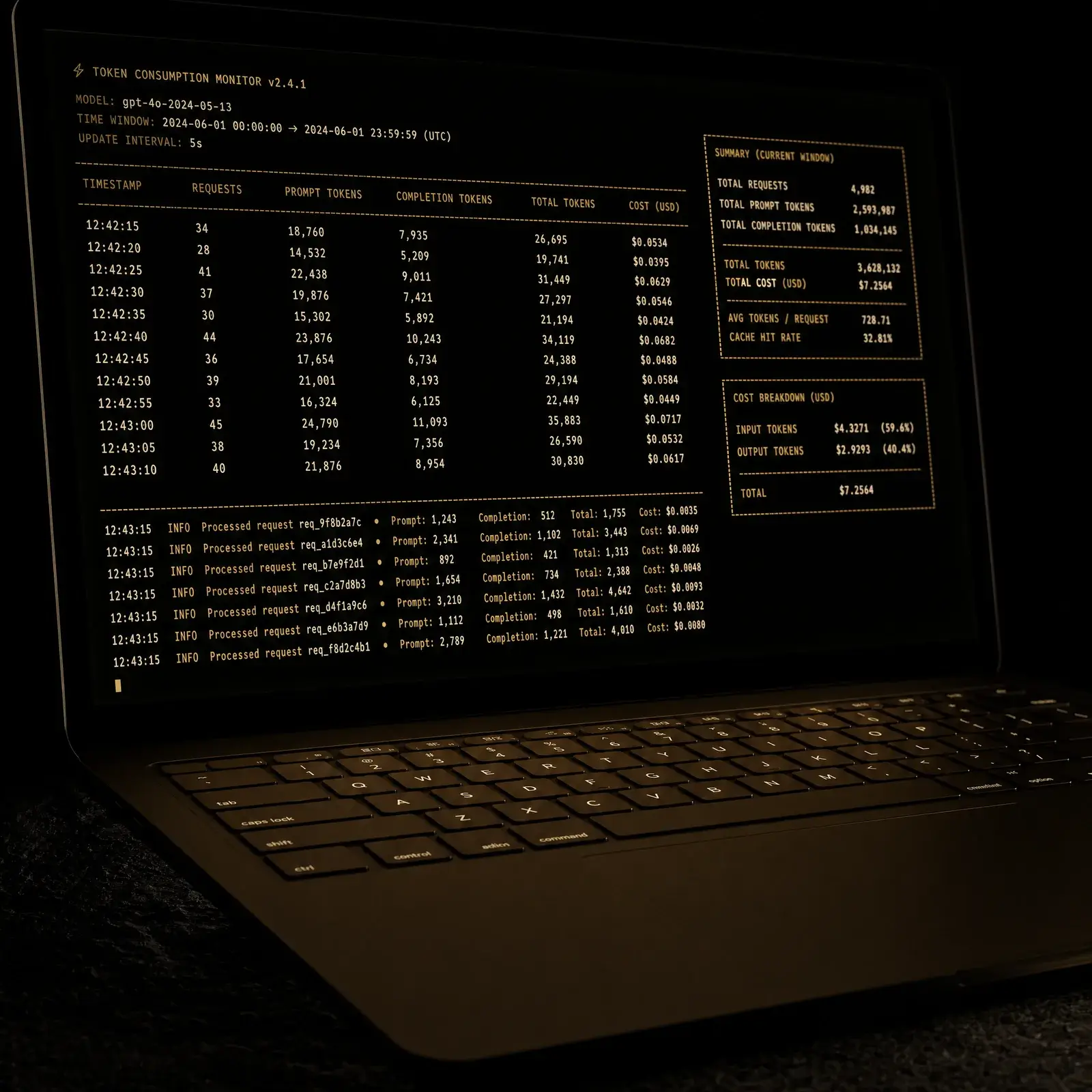
The advertised price and the real cost come apart for a specific reason: AI coding agents operate in agentic loops, not single-turn exchanges. In a standard chatbot interaction, you send a prompt and receive a response. In an agentic session, the model executes a reasoning loop – tool calls, file reads, edits, validations, re-checks – and each step re-sends the entire accumulated conversation history to the API.
A 50-turn session generates roughly one million input tokens versus 40,000 output tokens: a 25-to-1 ratio that inverts most developers’ cost assumptions entirely.
According to peer-reviewed research from the Stanford Digital Economy Lab (2025), agentic coding tasks consume 1,000 times more tokens than code reasoning and chat. Read operations – navigating files, reading code, running searches – account for 76.1 percent of total token consumption. Code generation, the part developers think they are paying for, is a small fraction of the actual bill.
A developer analysis of 42 agent runs on a real FastAPI codebase found that 70 percent of tokens were waste: repeated reads, failed iterations, and verbose tool output.
The Input Token Problem
The common assumption is that you pay for what the model writes. For agentic sessions, that assumption is wrong.
Vantage.sh quantified the split at 85 percent input tokens, 15 percent output across real agentic coding sessions. As a session progresses through phases – initial exploration, active editing, verification – the tokens-per-turn grow from 5,000 to 20,000 to 35,000 and beyond.
The Stanford research also found that the same bug fix can cost $0.05 or $1.50 depending on session length, context size, and retry count. Token usage for identical tasks varies by up to 30x across runs. Frontier models also systematically underestimate their own token consumption – self-prediction correlations measured only 0.39.
In other words, neither you nor the AI can reliably predict what a session will cost before it runs.
The Tokenizer Inflation Nobody Mentions
One concrete cost driver that competitor articles skip entirely: Anthropic documents that Claude Opus 4.7 and later models use a new tokenizer that generates up to 35 percent more tokens for identical text compared to predecessor models. A developer who upgraded from Claude 4.6 to 4.7 without adjusting their spend assumptions faces a roughly 35 percent invisible price increase with no change in the headline pricing number. As of June 2026, this is live on Claude Opus 4.7 and Opus 4.8.
What Does Each Tool Actually Cost in 2026?
Pricing data below is verified as of June 9, 2026. AI tool pricing changes frequently – bookmark the official billing pages for each tool rather than relying on screenshots older than 90 days.
Claude Code (Anthropic)
Claude Code subscription tiers set the access floor. The Pro tier at $20 per month ($17 annual) provides approximately 44,000 tokens per 5-hour rolling window.
The Max 5x tier at $100 per month roughly doubles that to 88,000 tokens per window. The Max 20x tier at $200 per month covers approximately 220,000 tokens per window.
That window is shared across Claude Code, Claude.ai chat, and Claude.ai Cowork – a detail that catches many developers by surprise.
The API-equivalent cost tells a different story. At standard API rates, Claude Sonnet 4.6 runs $3.00 per million input tokens and $15.00 per million output tokens. Claude Opus 4.8 runs $5.00 per million input and $25.00 per million output.
A case study documented by Morph.llm put the gap in stark terms: a team processing 10 billion tokens over eight months paid $15,000 at direct API rates versus $800 on a Claude Max subscription. For heavy users, the Max subscription is the rational choice. For light users, the Pro tier may represent significant overpay if usage stays well below the token window.
Anthropic states that 90 percent of Claude Code users spend under $12 per day in API-equivalent terms – roughly $360 per month as a ceiling. The Max 5x plan at $100 per month is therefore the breakeven point where consistent heavy usage beats direct API billing.
GitHub Copilot
GitHub Copilot moved to AI credits (token-based billing) on June 1, 2026. The Pro plan costs $10 per month and includes $10 in monthly AI credits.
One AI credit equals $0.01, and credits are consumed at per-token API rates when using agent sessions or premium models. Inline code completions and Next Edit Suggestions remain free and do not consume credits.
The Pro+ plan at $39 per month includes $39 in credits and priority model access. Business and Enterprise plans bill at $19 and $39 per seat respectively. GitHub extended a transition bonus through August 2026: Business accounts receive an additional $30 per month in credits, Enterprise accounts receive $70 per month.
If your Copilot usage is primarily inline completions, the billing shift does not affect you materially. If you rely on agent sessions, your credit pool will deplete at token rates – and there is no hard cap preventing overages.
Cursor
Cursor’s Individual (Pro) plan costs $20 per month with extended limits and on-demand overage billing in arrears. The June 2025 pricing shift from request-based to credit-based billing cut the effective monthly request count from roughly 500 to roughly 225 at the $20 price point. Teams Standard runs $40 per user per month.
Teams Premium runs $96 per user per year on an annual commitment with 5x Standard usage volume.
The documented overage risk is real. Multiple Cursor developers reported $350 in overages in a single week following the June 2025 shift.
Cursor issued a public apology on July 4, 2025 and refunded charges – but the billing model has not reverted. Monitor your Cursor billing dashboard weekly, not monthly, during any period of heavy agent use.
Windsurf and Replit Agent
Windsurf’s Pro plan raised from $15 to $20 per month in May 2026, operating on a quota-based system. The Max plan at $200 per month serves power users. Windsurf offers the most generous free tier in the category via its SWE-1.6 model access.
Replit Agent uses an effort-based pricing model. The Core plan charges $25 per month and includes $25 in expiring monthly credits. Real documented bills show the compounding effect clearly: one developer’s billing period produced 632 agent checkpoints at $0.25 each ($158.00) plus 965 assistant interactions at $0.05 each ($48.25), totaling $206.25 in agent charges for a single month on the Core plan.
Source: Anthropic API Pricing, GitHub Blog, Cursor Pricing – verified June 9, 2026
Week 1: Inventory and Baseline
The first week of an ai coding agent api cost audit has one objective: knowing exactly what you are paying for and how each tool bills you. Most developers cannot answer both questions for all their tools without looking it up.
Build Your Subscription Register
List every active AI coding subscription in a simple document: tool name, billing date, tier, monthly price, and billing mode. The billing mode distinction matters more than any other variable.
A flat subscription is predictable. A credit-based or pay-per-token system means the subscription price is a floor, not a ceiling.
For each tool, identify which billing mode applies to your specific workflow. GitHub Copilot inline completions are genuinely free regardless of plan – but agent sessions consume credits at token rates. Cursor inline completions are included in the Pro plan, but heavy agent use depletes the credit pool and triggers overages.
Claude Code subscription tiers cap your token window; exceeding that window does not charge you more, it throttles you. Understanding which mechanism applies to each tool is the prerequisite for any cost calculation.
Find Your Usage Dashboards
Screenshot the last 30 days of usage data from each tool’s billing dashboard before anything else. The dashboards to open are: Claude Code at console.anthropic.com (Usage tab); GitHub Copilot at billing.github.com (AI Credits tab, active from June 2026); Cursor at cursor.com/settings (Billing section); OpenAI / Codex at platform.openai.com/usage; Windsurf at app.windsurf.ai/account; Replit at replit.com/account (Credits tab).
Flag every tool that provides no token-level data. Request counts and credit balances are proxies at best.
If a tool does not show you token consumption directly, you cannot calculate the API-equivalent cost without a third-party monitoring tool. That opacity is a cost risk, not a feature.
Week 2: Measure Actual Consumption
Week 2 converts the usage screenshots into numbers you can act on. The core calculation for each tool is the same: what would this month’s sessions have cost at direct API rates?
The Claude Code Calculation
For Claude Code: pull your average daily token consumption from the Anthropic console. Multiply by 30 to get monthly volume. Apply the model rate – $3.00 per million input tokens for Sonnet 4.6, $5.00 per million for Opus 4.8.
Compare the API-equivalent cost against your flat subscription. If you are on the Pro plan at $20 per month and your API-equivalent cost calculates to $85 per month, the Max 5x plan at $100 per month is the rational upgrade. If your API-equivalent cost is $15 per month, the Pro plan is already overpay relative to direct API access.
Remember the 85/15 input-output split. For most developers running agentic sessions, input token volume is 5 to 25 times higher than output volume. Apply the input rate to the dominant share of your consumption – using only the output rate produces a number that underestimates the real cost by a factor of three to five.
Identifying Subscription Overlap
The quietest cost in most developer stacks is subscription overlap: paying twice for access to the same underlying model. A common stack of Cursor Pro at $20 plus Claude Pro at $20 plus ChatGPT Plus at $20 plus GitHub Copilot at $10 runs $70 per month – $840 per year. The redundancy is structural: Cursor routes requests through Claude and GPT-4 models under the hood.
Paying for both Cursor Pro and a separate Claude Pro subscription means paying twice for Claude model access with no incremental capability gain. During Week 2, map every tool to the underlying model it uses for agent tasks. If two tools in your stack route to the same API backend, you are double-paying for model access.
One tool at the correct tier handles the inference. The second subscription is pure overhead. To understand how Claude and OpenAI models compare at the capability and cost level, the Claude vs. ChatGPT for builders breakdown covers the specific trade-offs that matter for solo developers.
Week 3: Identify the Waste Sources
Week 3 is where the audit earns its value. Three waste sources account for the majority of unnecessary token consumption in solo-developer workflows, and all three are behavioral – meaning they cost nothing to fix.
Context Bloat: The Compounding Tax
Every tool call in an agentic session carries the full prior context back to the model. A session that starts at 5,000 tokens per turn escalates to 20,000 tokens per turn after extended debugging, then to 35,000 tokens per turn when the model begins re-reading prior failed attempts. At $3.00 per million input tokens on Claude Sonnet 4.6, a 30,000-token turn costs $0.09.
Run 50 of those turns in a session and the session costs $4.50 in input tokens alone – before a single line of output.
The Stanford research confirms what most experienced developers already suspect: accuracy peaks at intermediate token usage and then saturates. A stuck agent iterating 20 times does not produce a better result than one that iterated 8 times – it just costs more. If a session has not resolved the problem within 30 turns, terminate it, start fresh, and restate the problem with a clear context boundary.
Context compaction – explicitly summarizing prior session state before restarting – can reduce context size by 50 to 70 percent according to Vantage.sh.
Premium Model Defaults
Most AI coding tools default to the most capable (and expensive) model available. For Claude Code, that means Opus 4.8 at $5.00 per million input tokens.
Claude Sonnet 4.6, at $3.00 per million input tokens, handles the vast majority of standard refactors, documentation tasks, and single-file edits with equivalent quality. Reserve Opus-tier models for genuinely complex multi-file reasoning tasks.
Defaulting to Sonnet for routine work cuts input token costs by 40 percent with no meaningful change in output quality for those task types.
The same logic applies across the stack. GitHub Copilot’s Pro+ plan at $39 per month includes premium model access.
If your Copilot usage is primarily inline completions (which remain free), you are paying $29 extra per month for access you are not using. Match the model tier to the actual task complexity, not to the marketing claim that the best model is always worth the price.
Subscription Redundancy
One agentic coding tool plus one chat assistant covers 95 percent of solo-developer needs. Three overlapping agentic tools do not triple output – they triple cost while competing for the same cognitive budget. During Week 3, identify every subscription in your stack where a cheaper or free alternative within another tool you already own covers the same need.
Cancel the redundant one entirely – not pause, cancel. Pausing keeps the subscription in the mental stack and encourages reactivation before a genuine need exists.
For deeper context on how to structure your session workflow to reduce token waste per interaction, the Claude Projects beginner setup guide covers how to organize sessions and maintain context efficiently.
Week 4: Calculate, Cut, and Optimize
Week 4 converts three weeks of data into a defensible decision for each tool in your stack: keep, downgrade, or cancel. The payback test provides the decision framework.
The Payback Test
For every tool in your stack, calculate: (hours saved per week) multiplied by 4.3, multiplied by your effective hourly rate, compared against the monthly subscription cost. A minimum 2x return is the required bar. If a tool saves you 3 hours per week and your effective hourly rate is $50, the tool generates $645 per month in time value.
A $20 per month subscription easily clears 2x. A $100 per month subscription requires 10 hours saved per week – roughly two hours per working day – to justify at that rate.
If a tool fails the payback test at your current usage level, cancel it. Not downgrade to a free tier, not pause – cancel. A free tier maintains the subscription relationship and encourages gradual drift back to a paid plan.
A cancellation forces a deliberate re-evaluation if the need genuinely re-emerges. The payback test also pairs naturally with BTO’s broader framework for evaluating AI tool ROI; the AI tool stack ROI calculation guide provides the full 30-day value framework to apply alongside the cost audit.
Three Optimizations That Move the Number
For tools that pass the payback test, three behavioral changes produce the largest reductions in token consumption without any change in output quality. First, enable prompt caching on any repeated system prompt or codebase context. A cache hit on an Anthropic model costs 10 percent of the standard input rate – a 90 percent reduction on cached content.
Second, default to the Sonnet tier and escalate to Opus manually only for tasks that demonstrably require it. Third, start a fresh session after each discrete task. Carrying unrelated context across sessions compounds input token costs with no benefit.
Free monitoring options require no additional spend. Token Tracker at tokentracker.cc tracks 13 AI coding CLIs from a single local dashboard. CodeBurn provides GitHub-integrated token observability.
The Anthropic Console Usage tab and GitHub’s billing.github.com AI Credits dashboard are built-in for the tools you already pay for.
If you are spending $100 or more per month on AI coding tools, the 30 minutes required to set up one of these monitoring tools is the highest-leverage hour in the audit.

What Are the Most Costly Mistakes in an AI Coding Agent Cost Audit?
Certain mistakes consistently inflate bills and mislead audits. Knowing them in advance eliminates the most common failure modes.
Mistaking the Subscription for the Total Cost
For flat-rate subscriptions, the subscription is the cost until the tool pivots to usage-based billing – which GitHub Copilot and Cursor have both now done. For API-direct usage, the subscription is irrelevant and the bill is entirely token-driven.
Many developers do not know which billing mode applies to their specific workflow. Audit the billing mechanism first, before you look at any usage numbers.
Calculating Cost Using Output Tokens Only
The output rate is what the AI writes back to you. It is a small fraction of the total bill. For agentic sessions, 85 percent of the cost comes from input tokens: re-sending conversation history, file contents, system prompts, and tool outputs on every API call.
Using only the output rate to estimate cost produces a number that is three to five times too low. Apply the input rate to the dominant token volume.
Treating “Unlimited” as a Real Number
No AI coding tool is unlimited. Claude Pro and Max operate within a 5-hour rolling token window shared across Claude Code, Claude.ai chat, and Cowork.
During weekday peak hours (5 to 11am Pacific Time), that window depletes 1.3 to 1.5 times faster than during off-peak periods. GitHub Copilot inline completions are genuinely free – but agent sessions consume AI credits at token rates with no hard spending cap.
The 30 percent of developers who hit usage limits on paid tools within a given month, documented by The Pragmatic Engineer in April 2026, found out the hard way.
Assuming Model Upgrades Are Cost-Neutral
Upgrading to a new model version is not automatically a neutral cost event. Anthropic documents that Claude Opus 4.7 and later use a tokenizer that generates up to 35 percent more tokens for identical text compared to predecessor models. A developer who upgraded from 4.6 to 4.7 without adjusting their spend assumptions faces a ~35 percent invisible price increase with no change in the headline per-token rate.
Running More Loops on a Stuck Agent
Persistence is not the correct response to a stuck agent. Stanford research shows that accuracy peaks at intermediate token usage and saturates – or declines – at higher costs. A stuck agent iterating 15 or more times, each adding thousands of tokens to accumulated context, compounds the bill without improving the outcome.
Kill the session and restart fresh. A clean restatement of the problem almost always costs less and produces a better result than continuing an extended failed loop.
Tool Comparison: Billing Models and Cost Transparency
Claude Code (Anthropic)
- Billing Mode: Flat subscription with token-window throttling
- Primary Paid Tier: Pro $20/mo, Max 5x $100/mo, Max 20x $200/mo
- Where to Find Usage Data: console.anthropic.com → Usage tab
- Throttle Mechanism: 5-hour rolling window; no overages, just rate limits
- Hidden Cost Risk: Tokenizer inflation on Opus 4.7+ (up to 35% more tokens)
- Best For: Heavy daily agentic sessions; Max 5x is breakeven at ~$80+/mo API-equivalent
GitHub Copilot
- Billing Mode: AI credits (usage-based, from June 1, 2026)
- Primary Paid Tier: Pro $10/mo (+$10 credits), Pro+ $39/mo (+$39 credits)
- Where to Find Usage Data: billing.github.com → AI Credits tab
- Throttle Mechanism: Credit depletion; inline completions remain free
- Hidden Cost Risk: Agent sessions consume credits at token rates; no hard overage cap
- Best For: Inline completions-heavy workflows; agent-heavy use should monitor credits weekly
Cursor
- Billing Mode: Credit-based (shifted June 2025); overages billed in arrears
- Primary Paid Tier: Individual Pro $20/mo, Teams Standard $40/user
- Where to Find Usage Data: cursor.com/settings → Billing section
- Throttle Mechanism: Credit pool; overages trigger at-cost billing
- Hidden Cost Risk: Overage risk is real and documented ($350+ in one week)
- Best For: IDE-integrated agentic work; monitor billing weekly, not monthly
Windsurf
- Billing Mode: Quota-based subscription
- Primary Paid Tier: Pro $20/mo (raised from $15 in May 2026), Max $200/mo
- Where to Find Usage Data: app.windsurf.ai/account
- Throttle Mechanism: Quota exhaustion; most generous free tier in category
- Hidden Cost Risk: Price increase pattern (May 2026 was not the first)
- Best For: Free-tier-first evaluation; upgrade only after validating task fit
Replit Agent
- Billing Mode: Effort-based (checkpoints + interactions)
- Primary Paid Tier: Core $25/mo ($25 in expiring credits), Pro $100/mo
- Where to Find Usage Data: replit.com/account → Credits tab
- Throttle Mechanism: Credits expire monthly; checkpoint cost is $0.25 each
- Hidden Cost Risk: Effort pricing compounds fast; 632 checkpoints = $158
- Best For: Beginners learning agent workflows; monitor checkpoint count closely
Frequently Asked Questions
How much does an AI coding agent cost per month for a solo developer?
A solo developer running one or two AI coding tools typically spends between $70 and $200 per month on subscriptions. Actual API-equivalent spend for an active Claude Code user averages $180 per month according to Morph.llm’s 2026 analysis. The wide range reflects session depth, model tier, and whether the developer has run an ai coding agent api cost audit to eliminate redundant subscriptions.
Why did my GitHub Copilot bill change in June 2026?
GitHub Copilot moved to AI credits (usage-based billing) effective June 1, 2026. Each plan now includes a matching credit allotment – Pro at $10 per month includes $10 in credits. Overages are billed at per-token API rates when credits are exhausted.
Inline code completions remain free and do not consume credits. Agent sessions and premium model access are the primary credit consumers.
What is agentic loop token burn and why does it matter for billing?
Agentic loop token burn is the cumulative input token cost of an AI agent re-sending the full conversation history, file contents, and tool outputs to the model on every reasoning step. Stanford Digital Economy Lab research confirmed that agentic tasks consume 1,000 times more tokens than standard chat interactions. Because input tokens drive 85 percent of the bill in agentic sessions, long loops on a single context become the primary cost driver, not the output the agent produces.
What is the Claude Code Max 5x plan and when does it make sense?
The Claude Code Max 5x plan costs $100 per month and provides approximately 88,000 tokens per 5-hour rolling window. It is the rational tier for developers whose API-equivalent monthly spend exceeds $80 per month – the point at which direct API billing costs more than the flat subscription. The Max 20x plan at $200 per month makes sense for developers whose equivalent spend exceeds $160 per month.
Does paying for Cursor Pro and Claude Pro create a double charge?
Yes, in most workflows. Cursor routes agent requests through Claude and GPT models under the hood. Paying for both Cursor Pro and Claude Pro means you are effectively paying twice for Claude model access.
The correct stack for most solo developers is one agentic coding tool at the appropriate tier, plus one chat assistant. A second agentic tool adds no meaningful capability increase for the majority of solo-developer tasks.
How does context window bloat affect my AI coding agent costs?
Context window bloat is the progressive accumulation of input tokens as an agentic session extends. Each tool call re-sends the entire prior conversation, file reads, and error history.
A session that starts at 5,000 tokens per turn can reach 35,000 tokens per turn after extended debugging. Starting fresh sessions after each discrete task and using context compaction techniques can reduce total session cost by 50 to 70 percent.
What free tools can I use to track my AI coding token spend?
Several free options exist. Token Tracker at tokentracker.cc monitors 13 AI coding CLIs from a single local dashboard.
CodeBurn provides GitHub-integrated token observability with a free tier. The Anthropic Console Usage tab provides built-in token tracking for Claude API billing, and GitHub’s billing.github.com AI Credits dashboard shows real-time credit consumption from June 2026 onward.
Why did Cursor charge me unexpected overages?
Cursor moved from request-based to credit-based billing in June 2025, cutting the effective monthly request count from roughly 500 to roughly 225 at the $20 price point. Agent sessions consume credits faster than inline completions, and overages bill in arrears without a hard cap. The fix is to monitor your Cursor billing dashboard weekly during any period of heavy agent use, not monthly after the overage has already processed.
How does the Claude Opus 4.7 tokenizer inflation affect my costs?
Anthropic documents that Claude Opus 4.7 and later models use a new tokenizer that generates up to 35 percent more tokens for identical text compared to models before version 4.7. A developer who upgraded without adjusting their cost assumptions faces a roughly 35 percent invisible price increase with no change in the headline per-token rate. Recalculate your API-equivalent cost using your current model version, not the version you benchmarked against when you set your budget.
What does a 30-day AI coding agent cost audit actually involve?
A 30-day ai coding agent api cost audit runs across four focused weeks. Week 1 builds a subscription register and collects usage dashboard screenshots.
Week 2 calculates API-equivalent cost for each tool and identifies subscription overlap. Week 3 traces the three primary waste sources: context bloat, premium model defaults, and redundant subscriptions.
Week 4 applies the payback test to each tool and implements the three behavioral optimizations – prompt caching, default model tier, and fresh sessions – that move the cost number most.
Is AI coding tool spend worth the money for a solo founder?
For most solo founders, yes – with the right stack and the right tier. The key is applying the payback test: hours saved per week times your effective hourly rate, compared against monthly subscription cost. A tool that clears 2x return at your usage level is worth keeping.
A tool that fails the test should be cancelled, not managed down to a cheaper tier that keeps you in the billing relationship without delivering the return. For more on building an AI stack that generates a measurable return, the best AI tools in 2026 overview covers the full stack context.
What happened to Microsoft’s Claude Code deployment?
According to TechCrunch reporting from June 5, 2026, Microsoft deployed Claude Code to approximately 5,000 engineers in December 2025. Per-engineer API costs reached $500 to $2,000 per month.
Microsoft subsequently revoked the licenses and migrated those engineers to GitHub Copilot. Uber burned its entire 2026 AI coding budget by April of that year – four months into a twelve-month budget. These enterprise cases illustrate the same token economics that apply to solo developers, at a scale where the consequences became impossible to ignore.
How I Know This
I build Break The Ordinary using Claude Code every day. The multi-agent content pipeline behind this article – researcher, writer, SEO agent, designer, backend validator, affiliate strategist, legal gate, publish script – runs on Claude Code, and I watch the token consumption in real time through the Anthropic Console Usage tab.
When I first set up the pipeline, I was not tracking token spend systematically. I was paying for Claude Pro, assuming the flat subscription covered my usage, and not thinking about whether the sessions I was running justified the tier I was on.
The subscription felt like a known cost. In practice, it was a floor with a usage pattern I had never examined.
Running the same audit I describe in this article changed that. The exercise I documented here – inventory, measure, trace the waste, calculate, cut – is the same process I applied to my own stack. I dropped one redundant subscription, defaulted to Sonnet for the majority of pipeline tasks, and started treating fresh sessions as a discipline rather than a preference.
The behavior changes are not complicated. The discipline is in actually doing the audit instead of assuming your subscription is your cost.
Closing
AI coding agent billing in 2026 is a gap between the marketing page and the operational reality. The headline number – $20 per month, $100 per month, “unlimited” – is the entry ticket. The actual cost is set by session depth, model defaults, subscription overlap, and whether you have ever looked at the token-level data behind the credit balance.
Running a real ai coding agent api cost audit is not complicated. It requires four weeks of consistent tracking against dashboards that already exist. The developers who skip it are not saving time – they are spending money without the information required to decide whether that spending is rational.
Financial control over your tool stack is the same discipline as financial control over any other operating expense: you measure it, you evaluate it, and you cut what does not return at least twice its cost.
That discipline is what Break The Ordinary is built on. Not the cheapest stack, not the most expensive one – the most deliberate one. Understanding the real cost of your tools is how you keep your options open, stay profitable as a solo operator, and make decisions based on numbers instead of assumptions.
If you are ready to go deeper on the architectural side of cutting AI API costs, the companion article on how to reduce LLM API costs with a self-hosted stack covers the infrastructure layer that sits beneath the subscription decisions.
Randal | Break The Ordinary
I am Randal, the founder of Break The Ordinary – a multi-niche media brand covering business, tech, health, and finance for people who want to build wealth, freedom, and a life worth living. I built the AI-powered content pipeline that runs this site using Claude Code, and I track the token-level costs of that stack every week – so the audit framework in this article is one I run on my own tools, not one I reverse-engineered from a billing invoice. I share what actually works, what does not, and what most people get wrong. My approach is direct, research-backed, and built on real experience – not theory.