Published: June 10, 2026 · Last updated: June 10, 2026
AI Is the New Front Page: How to Get ChatGPT and Claude to Recommend Your Business
Think about the last time you needed a tool, an app, or a service. There is a decent chance you did not open Google and scroll. You asked an AI. “What’s the best invoicing app for a freelancer?” “Which CRM should a small agency use?” And then you probably did what most people now do: you trusted the answer and acted on it. That shift, from scrolling a page of blue links to accepting a single named recommendation, is quietly rewriting how businesses get found. The brand the model names wins. Everyone else is invisible.
What This Article Covers
- The proof this is already happening
- Why being named beats being ranked
- The Answer Engine Optimization playbook
- How to actually track it
- Old SEO vs. new AEO, side by side
- The honest caveat
- Frequently asked questions
Answer Engine Optimization (AEO) is the practice of making AI assistants like ChatGPT, Claude, and Perplexity recommend your business when someone asks them a question. Analytics company PostHog reported its traffic from LLMs grew 41x in two years and now converts better than almost any other channel it runs. The tactics are surprisingly old-fashioned: answer the question directly, use real numbers and named specifics, write headings as the questions people actually ask, and track which AI prompts are sending you customers. You do not need a marketing team. You need to be the clearest, most concrete answer on the internet.

Quick Takeaways
- People increasingly ask an AI assistant for recommendations instead of searching and scrolling.
- PostHog’s LLM-referred traffic grew 41x in two years and converts better than almost any other channel.
- In three months, 9,214 of PostHog’s users told it the exact AI prompt that led them to the product.
- The winning tactics are clarity-based: direct answers, real numbers, named specifics, question-shaped headings.
- Track it by asking new customers “how did you find us?” and watching which prompts convert.
- This is a solo-operator advantage: clear, specific writing beats big-budget vagueness.
The Proof This Is Already Happening
This is not a prediction. It is already measurable. PostHog, a developer analytics company, published a breakdown titled “LLMs Are Picking Winners. Here’s How to Become One,” and the numbers are hard to ignore. Its traffic referred from large language models, the engines behind ChatGPT, Claude, and Perplexity, grew 41 times over the past two years, with each quarter setting a new record. More importantly, that traffic converted into paying users better than almost any other channel the company runs.
The most striking detail is how they know. PostHog added a single question to its onboarding flow asking new users which prompt led them to the product. In just three months, 9,214 people answered, handing the company a live list of the exact questions buyers were typing into AI tools before they showed up ready to pay. That is not a vanity metric. That is a map of demand most businesses cannot see at all.
Why Being Named Beats Being Ranked
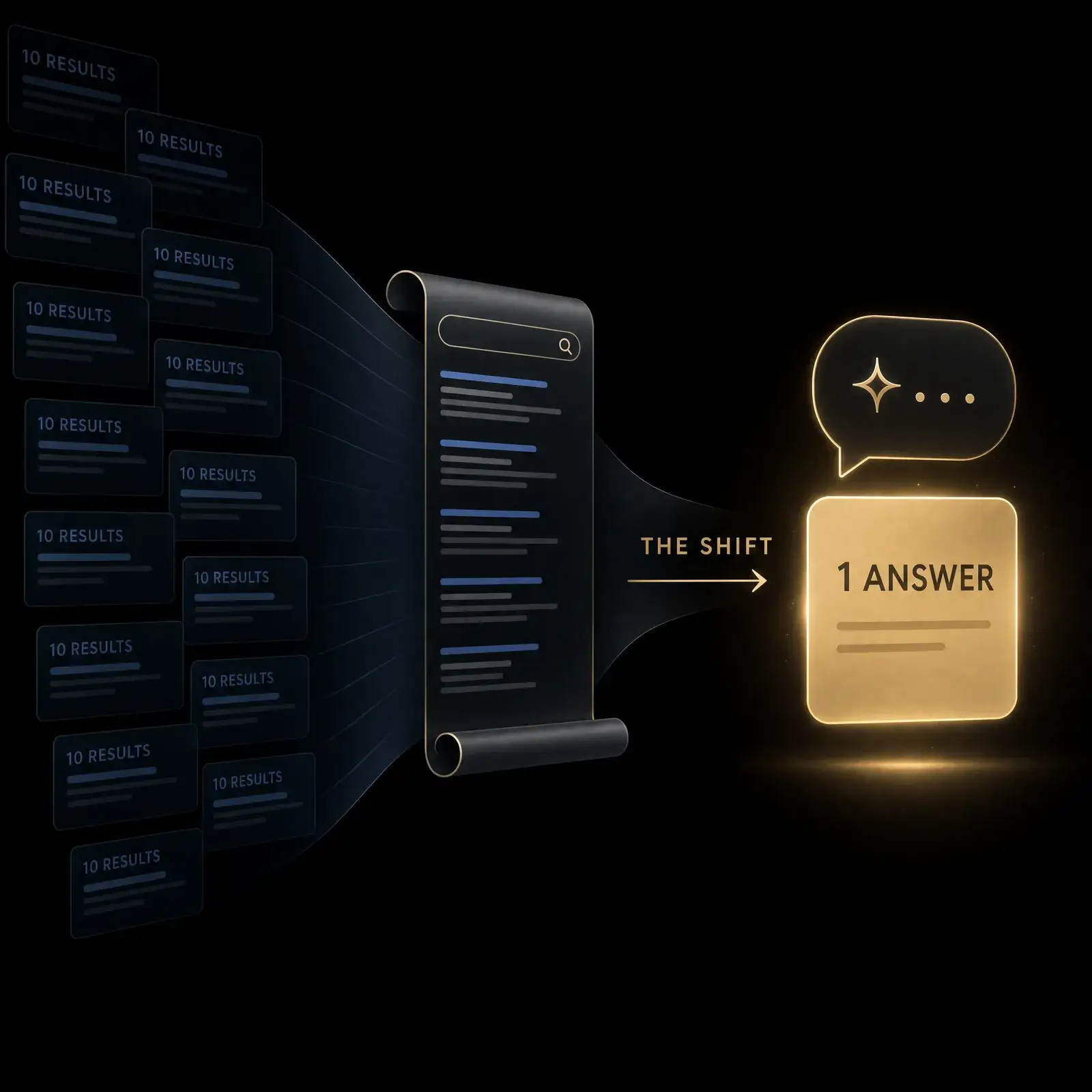
For twenty years, the game was ranking on Google’s first page. You optimized to be one of ten options a searcher might click. The AI era changes the math in a brutal way: the assistant usually names one, two, or three answers, and the person rarely looks further. There is no page two. If the model does not mention you, you do not exist for that buyer, and you will never even see the missed opportunity in your analytics because there was no click to miss.
That is the threat and the opportunity in one sentence. The businesses that learn to be the named answer capture demand that their competitors cannot even detect. It is the same lesson we keep coming back to in why every business is now a media company: attention has moved, and you go where the attention is, not where it used to be.
On Google you fought to be one of ten links. With AI, you fight to be the one name the model says out loud. There is no page two.
Break The Ordinary
The Answer Engine Optimization Playbook
Here is the genuinely good news for a normal builder: the tactics PostHog credits are not technical wizardry, and they do not require a budget. They reward clarity, which is something you control completely. These are the moves that work.
Answer the question in the first sentence. Models pull clean, quotable answers from the top of a page. If your article opens with a paragraph of throat-clearing, there is nothing crisp to lift. Lead with the direct answer, then explain.
Write your headings as real questions. People prompt AI in plain questions (“how do I lower my electric bill?”), so pages structured around those exact questions map cleanly onto what the model is trying to answer. Use H2 subheadings phrased the way a customer would actually ask.
Be concrete. Name real numbers, tools, and scenarios. PostHog’s blunt finding is that models favor content with concrete details over vague gesturing. “Affordable, scalable solution” is invisible. “$29 a month, handles up to 5,000 contacts, integrates with Stripe” is quotable. Specificity is what gets you cited.
Make it scannable. Short paragraphs, lists, and summary tables are easier for both models and people to extract. Dense walls of text bury the answer.
If you have never built a content engine before, this pairs naturally with the fundamentals in how to build an audience from zero and building a personal brand. The AI does not invent recommendations from nothing. It surfaces the clearest, most credible, most specific source it can find. Your job is to be that source.
How to Actually Track It
The hardest part of AEO is that the “click” often disappears. Someone asks Claude for a recommendation, hears your name, and types your URL directly. Your analytics may log that as “direct traffic” with no clue an AI sent them. PostHog’s fix is the most copyable idea in the whole piece, and it costs nothing: just ask.
Add one question to your signup, checkout, or contact form: “How did you hear about us?” with an option for “AI assistant (ChatGPT, Claude, etc.)” and a free-text box for the prompt. Within weeks you will have your own version of PostHog’s dashboard, telling you which questions lead to paying customers. Then you write more of the content that answers those exact questions. It is a tight, cheap feedback loop, and the same plain-AI tooling we cover in using AI to work smarter can help you sort and read the responses.
Old SEO vs. New AEO, Side by Side
Classic SEO (Google)
- Goal: Rank in the top 10 links
- Win condition: Get the click
- Reward: Keywords and backlinks
- You can see: Referral traffic in analytics
Answer Engine Optimization (AI)
- Goal: Be the named recommendation
- Win condition: Get mentioned out loud
- Reward: Clarity, specifics, and credibility
- You must ask: “How did you find us?”
The Honest Caveat
It would be easy to oversell this, so here is the part most “AEO gurus” leave out, taken straight from PostHog itself: the discipline is young and, in their words, “mostly propped up on assumptions and operating on vibes.” Nobody has a perfect formula for how a given model decides what to recommend, and it is dangerously easy to confuse correlation with causation when your AI traffic happens to rise.
So treat this as a high-upside experiment, not a guaranteed system. The good news is that the core moves, being clearer, more specific, and more genuinely useful than your competitors, make your business better even if the AI numbers never materialize. That is the rare kind of bet where you win either way. It is the same posture we recommend on AI spending generally in getting real ROI from AI: define what good looks like, measure it, and do not pay for hype.
Frequently Asked Questions
What is Answer Engine Optimization (AEO)?
AEO is the practice of structuring your content and online presence so that AI assistants like ChatGPT, Claude, and Perplexity recommend your business when users ask them questions. It is the AI-era successor to search engine optimization, sometimes also called Generative Engine Optimization (GEO).
Is AEO different from SEO?
They overlap but differ in the win condition. SEO aims to rank your page among clickable search results. AEO aims to make you the answer an AI names directly, often without a click. Both reward useful, well-structured content, but AEO puts a premium on concrete specifics and direct answers the model can quote.
How do I know if AI is sending me customers?
The simplest method, used by PostHog, is to add a question to your signup or contact form asking how the person found you, with an option for “AI assistant” and a box for the prompt they used. AI referrals often show up as “direct traffic” otherwise, so asking is the most reliable signal.
Do I need special software or a big budget for AEO?
No. The highest-leverage tactics, answering questions directly, using real numbers and named specifics, writing question-shaped headings, and asking customers how they found you, cost nothing but effort. Paid prompt-tracking tools exist, but they are optional, not essential to start.
Which AI assistants matter most for this?
The main consumer-facing ones today are ChatGPT, Claude, Perplexity, and Google’s AI answers. Rather than chasing each one separately, focus on being the clearest and most specific source on your topic, since they all tend to surface credible, concrete content.
How I Know This
I run Break The Ordinary as a one-person operation, so I cannot out-spend anyone. I have to out-clarify them. When I read PostHog’s breakdown, what struck me was not the 41x number, it was that the winning tactics were things I could do at my kitchen table this week: answer the question first, use the real figure instead of the fuzzy one, write the heading the way a reader would actually ask it.
I have started adding the “how did you find us” question to my own forms, and I will be honest that the data is still thin and I am not pretending otherwise. But the underlying move, becoming the most useful and specific answer on a topic, is something I would chase regardless of which AI happens to be popular. That is the test I apply to any new tactic: would I do it even if the hype turned out to be wrong? Here, the answer is yes.
The Bottom Line
The front page of the internet is no longer a page. It is a sentence an AI says back to a person who asked for help. PostHog has shown, with real numbers, that being the business named in that sentence is worth more than almost any other channel. The work to get there is not glamorous and it is not expensive. It is the discipline of being clear, specific, and genuinely useful, then asking your customers how they found you and doubling down on what works.
That is exactly the kind of unglamorous edge Break The Ordinary exists to hand you before everyone else catches on. Start by rewriting one page on your site to answer its core question in the first sentence, with one real number in it. Then build from there, the same way you would validate any business idea: small, concrete, and measured.
Randal is the founder of Break The Ordinary, where he documents what actually works for building independence. As a one-person operator, he tests tactics like Answer Engine Optimization on his own business first and reports the honest version, including the parts that are still uncertain. He writes from real experience, not hype.