What Does “Bitcoin Implied Volatility” Actually Measure?
Bitcoin implied volatility is the market’s forward-looking expectation of how much BTC will move over the next 30 days. The Bitcoin Volatility Index (BVIV) calculates this from options prices, just like the VIX does for the S&P 500. A higher BVIV means traders are paying up for protection. A lower BVIV means they are not.
On May 22, 2026, the BVIV closed at 38% – its lowest level since October 2025, while Bitcoin traded near $77,167. That number matters because it signals a structural change in who is holding BTC and why.

Quick Takeaways
- The Bitcoin Volatility Index (BVIV) hit 38% on May 22, 2026 – its lowest level since October 2025.
- Bitcoin was trading at roughly $77,167 during the same window.
- MicroStrategy alone absorbed 171,238 BTC in 2026 – about 2.7 times the ~63,450 BTC mined during the same period.
- Yield-focused funds suppressed price swings by aggressively selling call options for income.
- For a small individual holder, the playbook from the 60–80% volatility era of 2021–2023 is no longer the right one.
- Self-custody is the operational decision that matters most when the market regime gets quiet.
Bitcoin Is the Calmest It Has Been in Seven Months – And That Should Get Your Attention
On the surface, the May 22 CoinDesk report by James Van Straten reads like a non-event. Bitcoin’s 30-day implied volatility – the BVIV index – fell to 38%. That is the lowest reading since October 2025. The price barely moved. Retail headlines would call this boring.
It is the opposite of boring. Bitcoin reaching a multi-month low in expected price swings while macro risks remain elevated tells you something about who is buying and how they are holding. The institutional bid has reshaped how Bitcoin behaves as an asset. The old volatility playbook does not work in the new regime.
If you own BTC, are thinking about owning some, or you watch the crypto market as a leading indicator, this matters. Position sizing, entry timing, and custody all change when the underlying volatility profile changes.
Why the BVIV at 38% Is a Structural Story, Not a Sentiment One
Shiliang Tang, Managing Partner at Monarq Asset Management, gave CoinDesk a clear breakdown of what is suppressing Bitcoin volatility right now. He named three forces.
“First, the geopolitical risk from the Iran conflict is finally moving into the later stages,” Tang said. The fear premium tied to that conflict has been a recurring volatility driver in 2026. As tensions de-escalate, that premium leaks out of options markets.
“Second, the continued BTC buying from Strategy (MSTR) is dampening downside BTC volatility by acting as a structural floor.” This is the part most retail traders are missing. MicroStrategy bought 171,238 BTC in 2026 – about 2.7 times the roughly 63,450 BTC that miners produced in the same window. When a single corporate buyer absorbs more than two-and-a-half times new supply, there is a hard floor under price.
Tang also identified the yield trade. “Systematic overwriters are aggressively selling options for yield, keeping a heavy lid on the entire volatility complex.” Yield-focused funds are selling Bitcoin call options to collect premium, which mechanically suppresses upside volatility. That is a different kind of buyer behavior than late-cycle FOMO.
What This Means If You Hold BTC With Real Money on the Line
Three practical things change when volatility structurally compresses.
Position sizing built for the old regime overshoots. If your sizing logic assumes 60–80% annualized volatility, you are sized too small for a 38% world. Stop losses calibrated for 2021–2023 will fire on what is now market noise. Revisit how much of your portfolio you actually want allocated to Bitcoin if its real-world behavior is closer to a high-beta tech stock than a casino chip.
“Buy the dip” needs an upgrade. When 2.7 times more BTC is being absorbed than mined, the dips are shallower and shorter. Sitting in cash waiting for a 30% drawdown may mean sitting in cash forever. Dollar-cost averaging into a smaller, consistent position has a higher expected return in this regime than holding out for a crash that the structural bid is actively preventing.
The narrative will lag the price. Crypto media is calibrated for big swings. When BTC trades in a narrow range for weeks, the coverage gets thin and traders assume nothing is happening. That is exactly when the next leg gets built. Pay attention to flows – institutional accumulation, ETF inflows or outflows, corporate treasury announcements – not to price ticks.
The Custody Decision Matters More When the Market Is Quiet
There is a counterintuitive pattern in crypto. Most retail security mistakes – keys lost, accounts drained, coins left on exchanges that later collapse – happen during quiet markets. When prices are not moving, people stop paying attention. They leave Bitcoin on an exchange “for now,” reuse passwords, skip the firmware update, ignore the seed phrase that lives in a drawer somewhere.
Institutional holders do not behave that way. SpaceX disclosed 18,712 BTC in its S-1 filing – held in cold storage, not on Coinbase. MicroStrategy’s 800,000-plus BTC sits in custody arrangements designed to survive both market crashes and operational disasters. The structural buyers shaping today’s volatility regime treat their Bitcoin like a serious treasury asset, not a casino chip.
That is the operational lesson for an individual holder. If institutional buying is making the market calmer, the question worth asking is no longer “when do I buy more?” but “where exactly are the coins I already own?” Coins on an exchange are an IOU from the platform. Coins on a hot wallet connected to your phone are one phishing click away from gone.
Disclosure: This article contains affiliate links. If you purchase a Trezor hardware wallet through the links below, Break The Ordinary earns a commission at no extra cost to you. We only recommend products we have independently evaluated as useful for the topic at hand.
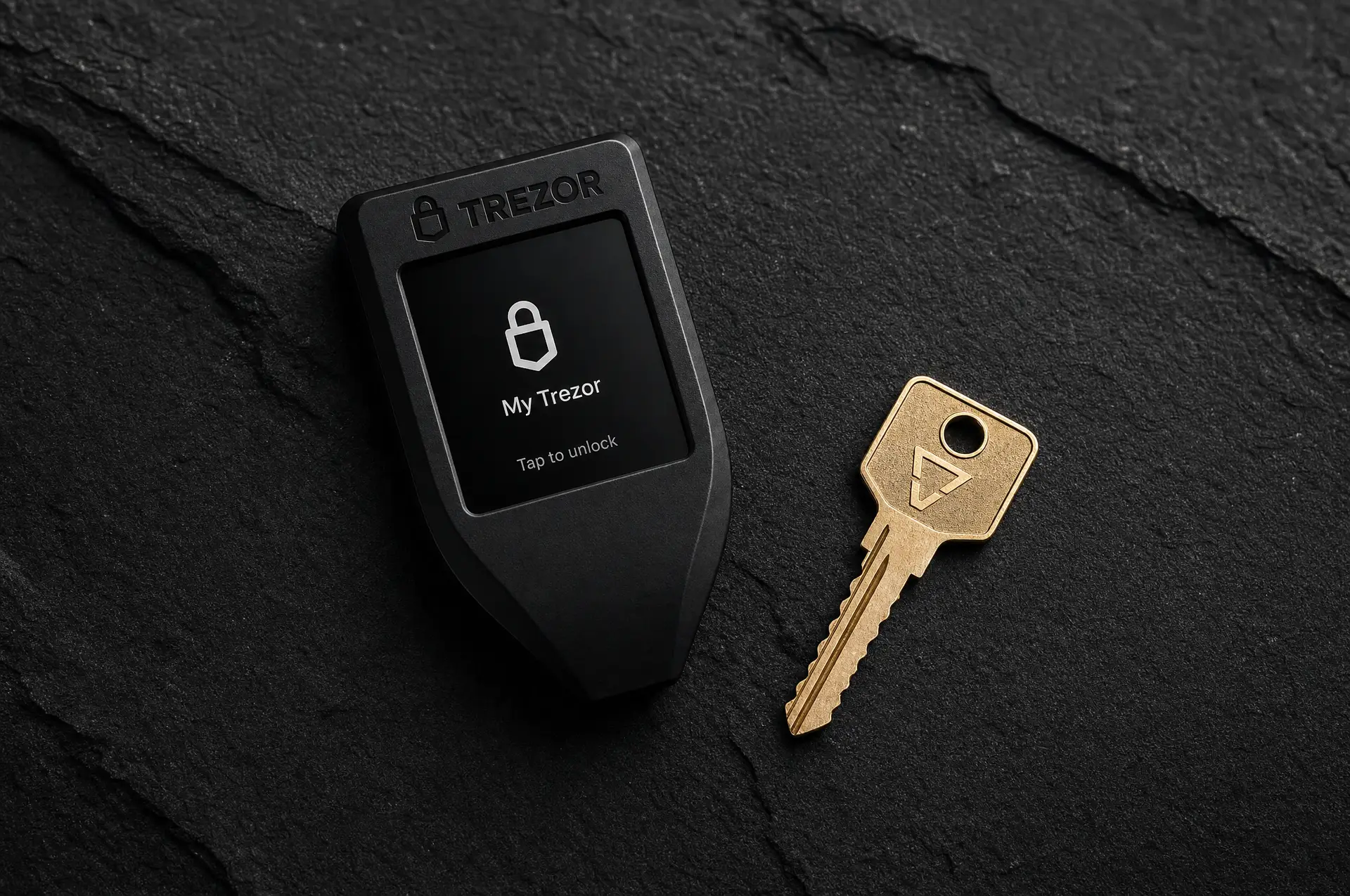
A hardware wallet like the Trezor Safe 5 keeps your private keys completely offline. Your BTC never touches an internet-connected device during signing, which is the threat model that matters in a regime where exchanges and custodians become the convenient default. For holders getting started or building toward larger positions, the Trezor Safe 3 covers the same core security at a lower price point. Both are built by SatoshiLabs, the team behind the original Trezor in 2013.
Frequently Asked Questions
What is the BVIV index?
The Bitcoin Volatility Index (BVIV) is the implied volatility of Bitcoin over the next 30 days, calculated from options prices on major exchanges. It is the Bitcoin equivalent of the VIX for the S&P 500. A reading of 38% means options markets are pricing in roughly 38% annualized price movement over the next month.
Why is Bitcoin volatility falling if Treasury yields are still elevated?
Structural buying. Even with elevated long-end yields competing for institutional capital, MicroStrategy and other corporate treasuries have absorbed more BTC than miners produced in 2026. That demand has anchored the price range. Yield-focused funds selling call options for income have separately suppressed upside volatility. The result is a market that is calmer than the macro backdrop would suggest.
Does low Bitcoin volatility mean the bull market is over?
Not necessarily. Volatility compression in Bitcoin has historically preceded both major moves up and significant corrections. What it does signal is that the marginal buyer is no longer a leveraged retail trader. The marginal buyer is a corporate treasury or a yield-focused fund with a multi-year horizon. That changes the rhythm of the asset, not the direction.
How does this connect to the recent Bitcoin ETF outflows?
ETF flows and corporate treasury buying are two different signals. ETFs saw $649 million in single-day outflows on May 18 – the largest since January. That measures short-term institutional positioning. The volatility compression measures something deeper: the structural accumulation by long-horizon corporate holders that continues regardless of weekly ETF flow swings. Both can be true at once.
Should I change my Bitcoin strategy because of this?
Look at your sizing, your dollar-cost-averaging cadence, and your custody. Sizing built for 60–80% volatility may be too small for the current regime. DCA into a 38% volatility asset behaves differently than DCA into a 70% volatility asset. And your custody setup is what determines whether any of this analysis actually applies to coins you control – versus coins that exist as an IOU from a platform. This article is for informational purposes only and does not constitute financial advice.
How I Know This
I have been tracking corporate Bitcoin treasury accumulation since MicroStrategy made its first purchase in 2020, and I read the CoinDesk derivatives coverage as part of how I think about position sizing for my own portfolio. I am not an options trader. What I have learned is that the moves that matter for someone building wealth from scratch are not the daily price swings – they are the slow structural shifts in who is holding the asset and why. This piece of data is one of those shifts.
I built Break The Ordinary as a structured content system because reading 30 crypto articles a week is not how a 25–35 year old actually gets smarter about money. Pulling the signal out of the noise is. That is what this article tries to do.
What You Should Take From This
Bitcoin’s volatility profile has structurally changed because the marginal buyer has changed. Corporate treasuries, yield-focused funds, and long-horizon institutional holders now set the floor – and a meaningful part of the ceiling – on the price.
For a small individual holder, that means three things. Position sizing built for the old regime overshoots. “Buy the dip” needs to be a smaller, more consistent plan instead of a wait-for-a-crash plan. And custody is the part of your Bitcoin strategy that you fully control – which makes it the part that deserves the most attention while the market is quiet.
Calm markets are when the disciplined operators win. Use this period to fix the parts of your setup that have been “good enough” for too long.
Build the rest of your foundation
Bitcoin is one allocation inside a portfolio that needs to make sense. If you are still figuring out how the pieces fit, start with our breakdown of how to build your first investment portfolio, then read why most people never build wealth – the patterns that hold a 25-year-old back are the same ones that hold a 50-year-old back, just compounded.
This article is for informational purposes only and does not constitute financial advice. Bitcoin and cryptocurrencies are volatile assets. Always do your own research and consult a qualified financial professional before making investment decisions.