Published: July 2026 | Last Updated: July 1, 2026
Protein Intake for Men 25–35: How Much You Actually Need
The protein intake for men debate has been running for decades, and most men are stuck somewhere between two bad numbers: the government’s RDA (which was built to prevent deficiency in sedentary people, not to build muscle) and the gym-floor rule of 1 gram per pound (which sits at the very top of the evidence range, not the sweet spot). The real number lives in between, and in January 2026, the US Dietary Guidelines acknowledged it for the first time in over 70 years – raising their protein recommendation from 0.8 g/kg to 1.2–1.6 g/kg. The research has known this for over a decade; the government just caught up.
For men 25–35 who train – or who are building the habit – the stakes are higher than they realize. Testosterone starts declining around 1% per year after age 30, and research estimates suggest muscle mass can decrease 3–8% per decade starting in the thirties without resistance training. Protein is the most controllable nutritional lever you have against both.
If you’re already tracking your strength training for men and your sleep, then getting your protein number right completes the foundation. This article covers how much you actually need for your specific bodyweight, why per-meal distribution matters more than you think, and which widely repeated fears about kidney damage and fat gain are simply not supported by the science.
The three most closely related BTO articles to read alongside this one: our deep guide on testosterone optimization for men 25–35, the training partner to this piece on strength training for men over 30, and the recovery side of the equation in sleep and recovery for men. Creatine – the supplement that pairs most naturally with an elevated protein intake – gets its own dedicated breakdown in what is creatine monohydrate.
Protein intake for men refers to the total grams of dietary protein consumed daily, calibrated to bodyweight and training status, to support muscle protein synthesis, body composition, and recovery. For sedentary adults, the RDA sets a minimum floor of 0.8 g/kg – enough to prevent deficiency, not enough to build or preserve muscle under load. For men who train, the evidence-based optimal range is 1.6–2.2 g/kg per day, depending on training intensity and caloric context.
This matters to any man in his twenties or thirties who wants to build muscle, stay lean, or protect the lean mass he already has as testosterone and anabolic sensitivity begin their gradual decline. Who it’s for: active men 25–35 navigating conflicting advice between the government RDA and gym-floor bro science.
Health & Wellness note: This article is educational and informational only. It is not medical advice and does not substitute for the guidance of a qualified physician or registered dietitian. If you have existing kidney disease or a renal condition, consult your doctor before significantly changing your protein intake.
The direct answer: Men 25–35 who train with resistance exercise need approximately 1.6–2.2 g of protein per kilogram of bodyweight per day. A 2018 meta-analysis of 49 randomized controlled trials by Morton et al., published in the British Journal of Sports Medicine, found the evidence-based breakpoint at 1.62 g/kg per day – with the 95% confidence interval running from 1.03 to 2.20 g/kg. The International Society of Sports Nutrition recommends 1.4–2.0 g/kg for exercising adults.
For most men in this demographic, the practical daily target is 130–165 g depending on bodyweight, distributed across 3–4 meals throughout the day.
How Much Protein Do Men 25–35 Actually Need for Muscle Growth?
The most reliable evidence we have comes from Morton et al. 2018, a meta-analysis of 49 randomized controlled trials involving 1,863 participants, with Dr. Stuart Phillips of McMaster University as senior author. The study found that protein supplementation produced a mean increase in fat-free mass of +0.30 kg versus training alone, with 1RM strength increasing approximately +2.49 kg (around 9%). More importantly for setting a daily target, the benefits plateaued at a breakpoint of 1.62 g/kg per day.
The 95% confidence interval of that breakpoint ran from 1.03 to 2.20 g/kg – which tells you two things. First, there is real individual variation in where each person hits their ceiling. Second, the bro-science “1 gram per pound” rule (which equals exactly 2.20 g/kg) sits at the very top of that confidence interval – not the sweet spot.
It is not harmful for healthy men, but controlled trials do not show meaningfully better muscle outcomes at 2.2 g/kg versus 1.6–1.8 g/kg.
The updated 2025–2030 US Dietary Guidelines, released January 7, 2026, now officially recommend 1.2–1.6 g/kg – the first upward revision from the 0.8 g/kg floor in over 70 years. For men who train seriously, 1.6 g/kg is the floor, not the ceiling. The practical working range is 1.6–2.2 g/kg, calibrated by where you fall on the training intensity spectrum.
Why the RDA Is the Wrong Number to Follow
The 0.8 g/kg Recommended Dietary Allowance was designed to prevent negative nitrogen balance in sedentary adults – it covers the minimum need of roughly 97.5% of that population, according to USDA Dietary Reference Intakes. It was never a performance target. At 75 kg, the RDA gives you 60 g of protein per day – while the evidence-based low end for a training man at the same weight is 120 g, exactly double.
The January 2026 DGA update acknowledged this gap, but the new government recommendation of 1.2–1.6 g/kg still describes what the general healthy population needs, not what a resistance-trained man needs to build and maintain muscle. The ISSN’s position stand (Jager et al. 2017, JISSN, PMC5477153) places the exercising-adult target at 1.4–2.0 g/kg – a range that doesn’t require a PhD to operationalize, just a bodyweight calculation and a bit of meal planning.
How Age Factors In for the 25–35 Window
Morton et al. 2018 found that protein’s effect on fat-free mass declined with age: each additional year was associated with a decrease of approximately 0.01 kg FFM (p = 0.002). This means the 25–35 window is genuinely the high-yield period for protein-driven muscle building, before anabolic sensitivity begins its gradual erosion. Testosterone declines approximately 1% per year after age 30, according to the HSS Health Library, and research estimates of sarcopenia literature suggest muscle mass decreases 3–8% per decade in untrained adults starting in the thirties.
If you’re 28 and building the habit now, the investment compounds far more efficiently than starting at 40. The combination of adequate protein intake for men in this age bracket, consistent resistance training, and adequate sleep is the foundation – not a supplement or a shortcut. Each pillar has to be in place for the others to work.
Your Daily Protein Target: The Bodyweight Table
Use the table below to find your daily target. The three columns represent the evidence-based range: 1.6 g/kg is the Morton et al. mean breakpoint and the practical floor for training men; 1.8 g/kg is the comfortable midpoint used in most ISSN-aligned protocols; 2.2 g/kg is the practical ceiling and the upper confidence interval of the Morton meta-analysis.
DAILY PROTEIN TARGETS BY BODYWEIGHTBody Weight1.6 g/kgFloor1.8 g/kgMidpoint2.2 g/kgCeiling68 kg (150 lb)109 g122 g150 g75 kg (165 lb)120 g135 g165 g82 kg (181 lb)131 g148 g180 g90 kg (198 lb)144 g162 g198 gSource: Morton et al. 2018 (British Journal of Sports Medicine) – figures verified
Source: Morton et al. 2018 – British Journal of Sports Medicine (PMC5867436)
Most men who train consistently will land between the floor and midpoint columns. The ceiling is appropriate if you’re deep in a strength cycle, training five or more days a week, or if you simply find it easier to track to a round number. Dr. Layne Norton (PhD, Nutritional Sciences), in his August 2024 Huberman Lab episode, recommends the 1 g per pound practical ceiling specifically because it is easy to remember and covers individual variation – not because controlled trials prove it superior to 1.6–1.8 g/kg.
Quick Takeaways
- The evidence-based daily target for training men is 1.6–2.2 g/kg of bodyweight
- At 75 kg, that means 120–165 g per day – double the standard RDA
- The 1 g/lb bro-science rule equals 2.2 g/kg – the top of the range, not the sweet spot
- The January 2026 Dietary Guidelines raised protein recommendations for the first time in 70+ years
- Benefits of higher protein declined with age in the Morton 2018 meta-analysis – act now
- Distribute across 3–4 meals at 30–50 g each; the per-meal ceiling is higher than you think
How Should You Distribute Protein Intake for Men Across the Day?
The ISSN 2017 position stand recommends 0.25 g/kg of protein per meal, distributed every 3–4 hours, with each dose containing 700–3,000 mg of leucine. For a 75 kg man, that is a minimum of 19 g per meal – but to hit the daily 120–165 g target across three or four meals, you’re realistically aiming for 30–50 g per sitting. The leucine threshold matters because leucine is the primary amino acid trigger for muscle protein synthesis (MPS) activation; falling below it in any given meal blunts the anabolic response regardless of daily totals.
The Per-Meal Ceiling Has Been Overturned
The old rule that the body can only use 20–25 g of protein per meal came from MPS studies that measured only the first 3–4 hours after eating. A 2023 randomized controlled trial by Trommelen et al. from Dr. Luc van Loon’s lab at Maastricht University, published in Cell Reports Medicine (PMC10772463), showed that 100 g of protein produced 40% higher MPS from hours 4–12 versus 25 g. Whole-body protein net balance continued rising with dose, with no upper limit found for the magnitude or duration of the anabolic response.
In practice, this means 60–80 g at a single high-protein meal is not wasted protein. The older “anything over 25 g is excreted” claim was based on incomplete measurement windows. That said, 3–4 meals of 30–50 g each remains the most efficient framework for hitting daily targets – not because larger boluses don’t work, but because spreading intake gives you more MPS activation events across the day.
Pre-Sleep Protein Is an Underused Lever
Research by Res et al. (2012) found that 40 g of casein consumed before sleep increased overnight MPS rates approximately 22% versus placebo. Snijders et al. (2015), published in the Journal of Nutrition, confirmed that pre-sleep casein translates to greater muscle mass and strength gains over a 12-week resistance training program – not just an acute MPS spike. The ISSN 2017 position stand endorses 30–40 g of casein before bed as an evidence-backed practice, and van Loon’s foundational casein research underpins the recommendation.
This is the lever most men in this demographic are not using. If you are already hitting 120–165 g per day but struggling to keep a training surplus overnight, a 40 g casein shake before sleep adds a genuine stimulus during the 7–9 hour fasting window. Pair this with a quality sleep quality routine – the anabolic signal from pre-sleep protein is only as effective as the sleep itself.
Does Timing Actually Matter?
Post-workout protein timing has an outsized reputation relative to its effect size. The ISSN 2017 position stand is direct: total daily protein intake, rather than the timing of protein ingestion, is the primary driver of resistance exercise-induced gains in muscle mass and strength. Missing the post-workout window by two hours does not meaningfully impair gains when daily totals are met – the anabolic window is far wider than the 30-minute rule suggests, probably 4–6 hours around a session.
The practical implication: do not skip a meal or eat a suboptimal protein source just to hit a specific post-workout window. Hitting your daily total is the priority. If post-workout is a convenient trigger for a high-protein meal, use it – but do not let timing anxiety override the more important variable of daily total.
PROTEIN DISTRIBUTION – 4-MEAL DAY (75 KG MAN, 135 G TARGET)Breakfast35 gLunch30 gPost-Workout35 gPre-Sleep35 g (casein)Daily total: 135 g – 3–4 hour spacing – leucine threshold met each meal
Source: Jager et al. 2017 – ISSN Position Stand: Protein and Exercise (JISSN, PMC5477153)
Protein Intake for Men While Cutting: Different Target, Same Logic
In a caloric deficit, protein needs rise – not fall. When your body is in an energy deficit, it is more likely to break down muscle tissue for fuel via gluconeogenesis.
The ISSN 2017 position stand raises the recommendation to 2.3–3.1 g/kg during severe caloric restriction, supported by Helms, Aragon, and Fitschen 2014. At 75 kg, that means 172–232 g per day during an aggressive cut.
For men in a moderate deficit (300–500 kcal below maintenance), the practical target sits between the regular training range and the ISSN cutting range: approximately 1.8–2.2 g/kg is reasonable. The higher figure serves as insurance against lean mass loss during the deficit phase. This is the nutritional logic behind body recomposition: protein high enough to protect muscle while the caloric deficit burns fat.
This also means the “eat less protein when you’re cutting to save calories” approach works in the exact opposite direction of the goal. Protein has the highest thermic effect of feeding at 25–30% of calories burned in digestion – far higher than fat or carbohydrate. Higher protein during a cut supports lean mass retention, keeps satiety high, and burns more calories in digestion than equivalent caloric volumes of other macros.
How to Hit Your Protein Number: Real Food Sources
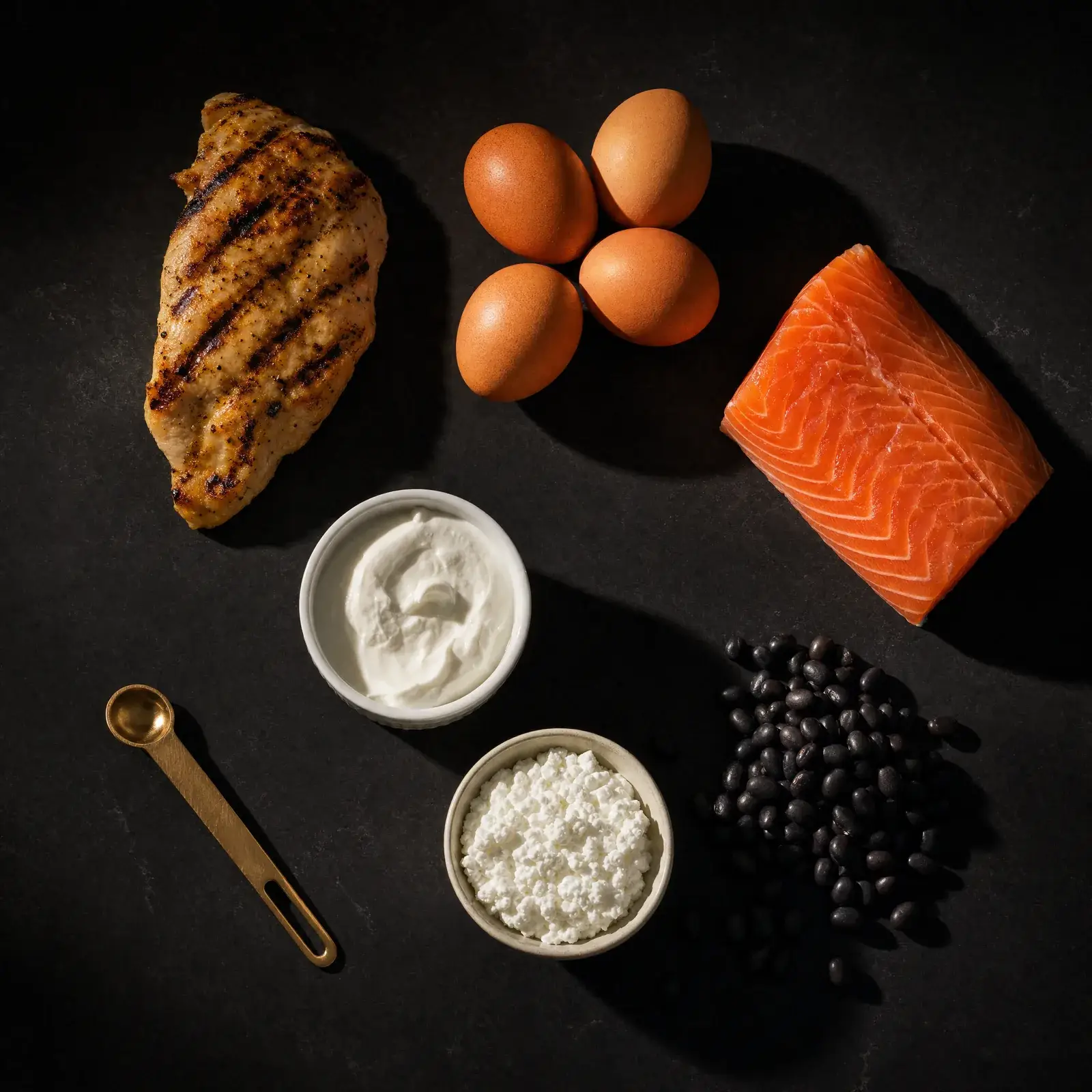
Abstract g/kg targets are useful; knowing which foods actually get you there is more useful. The highest-quality protein sources – those with a complete amino acid profile and high leucine content – are animal proteins: chicken breast (~31 g per 100 g cooked), eggs (~6 g each, with a highly bioavailable profile), Greek yogurt (~17–20 g per 200 g serving), cottage cheese (~14 g per 100 g), salmon (~25 g per 100 g), and lean beef (~26 g per 100 g). A 75 kg man hitting 135 g per day can get there with roughly 200 g chicken, 200 g salmon, two eggs, and 200 g Greek yogurt – leaving room for incidental protein from other foods.
Where Whey Protein Fits
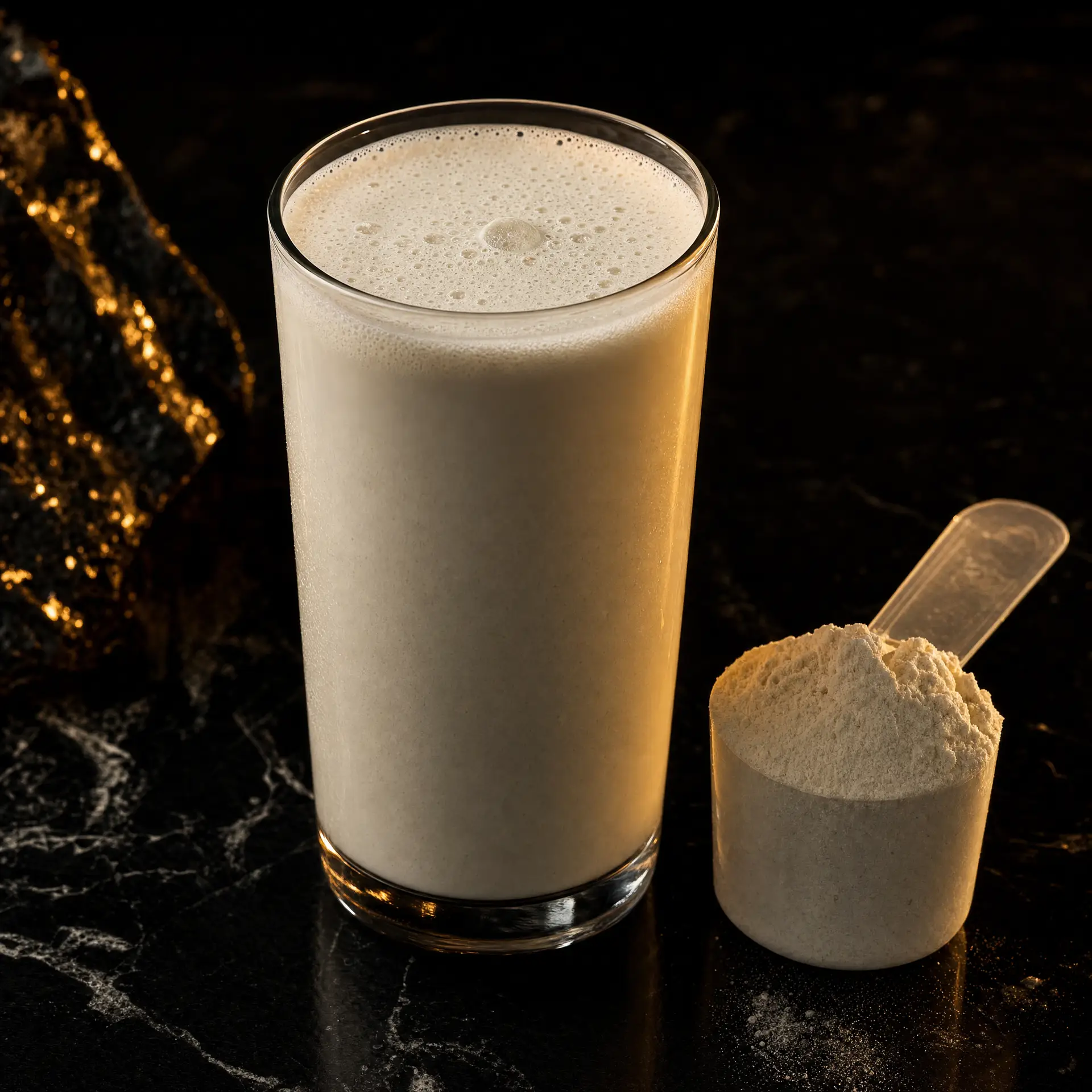
Whole food sources should form the bulk of daily protein intake. Whey protein supplements fill the gap when whole food sources are inconvenient, when post-workout timing matters, or when total daily intake is falling short. Whey is a complete protein with a high leucine content and approximately 97% bioavailability – it triggers MPS as effectively as equivalent quantities of whole food protein when consumed in the same leucine range.
Disclosure: This article contains affiliate links. If you purchase through them, I may earn a commission at no extra cost to you. I only recommend products I believe in.
A standard serving of a quality whey protein concentrate or isolate delivers 20–25 g of protein per scoop with minimal caloric overhead. For men who struggle to hit 130–165 g daily from food alone, one scoop in the morning and one post-workout adds 40–50 g without adding significant meal volume. If you are looking for a reliable starting point, Optimum Nutrition Gold Standard Whey is where most people start – 24 g of protein per scoop, widely available, and consistently third-party tested.
Practical Sample Day at 75 kg
- Breakfast: 4 eggs + 200 g Greek yogurt = approximately 45 g protein
- Lunch: 200 g grilled chicken breast + side = approximately 60 g protein
- Post-workout: whey protein shake = approximately 25 g protein
- Pre-sleep: 200 g cottage cheese or 40 g casein shake = approximately 28–40 g protein
- Daily total: approximately 135–170 g – comfortably in the 1.8–2.2 g/kg range
Endurance athletes and men who combine significant cardio volume with resistance training should note that protein needs may differ from this framework. Our full breakdown of how much cardio you need addresses the caloric equation on the aerobic side, which affects the protein math during hybrid training weeks.
The Myths About Protein Intake for Men That Won’t Die
Two claims about high-protein eating have persisted for decades in spite of clear evidence to the contrary. Both are worth addressing directly, because they function as real barriers for men trying to eat more protein.
Myth 1: High Protein Damages Your Kidneys
This claim originated from legitimate clinical research in populations with pre-existing chronic kidney disease (CKD), where protein restriction is genuinely indicated – the error was generalizing that finding to healthy adults. A McMaster University meta-analysis of 28 studies covering 1,300+ participants – including obese, diabetic, and hypertensive individuals, but none with pre-existing CKD – found no evidence that high protein intake harms kidney function in healthy adults. Dr. Stuart Phillips, the lead researcher, was direct: “There is just no evidence to support this hypothesis – the evidence shows the contrary is true.” Source: McMaster University (2018).
The one place this concern is legitimate: men with diagnosed kidney disease or compromised renal function should consult a physician before significantly increasing protein intake. For healthy men without a prior kidney diagnosis, this fear has no scientific basis.
Myth 2: Extra Protein Turns Into Body Fat
Bray et al. 2012 (JAMA) tested this directly by randomizing participants to low (5%), normal (15%), or high (25%) protein diets at 140% of caloric maintenance for 8 weeks. All groups gained similar amounts of body fat – the high-protein group gained more lean mass, not more fat.
The authors concluded: “Calories alone contributed to the increase in body fat. In contrast, protein contributed to changes in lean body mass, but not to the increase in body fat.”
Protein also has the highest thermic effect of feeding at 25–30% of calories burned in digestion, compared to roughly 5–10% for carbohydrates and 0–3% for dietary fat. A 200-calorie serving of protein effectively delivers about 140–150 net calories. The notion that eating more protein is a fat-gain risk is not only unsupported by the evidence – it works against the actual metabolic reality.
Myth 3: You Need Perfect Post-Workout Timing
The 30-minute anabolic window is a product of supplement marketing more than science. As noted above, the ISSN 2017 position stand is explicit that total daily protein is the primary driver of muscle adaptation. Post-workout protein consumption is beneficial when convenient, not critical to the point of causing anxiety or forcing inferior food choices.
Hit your daily total first; optimize timing second.
A Note on Plant Protein and Protein Intake for Men
Plant proteins are viable for hitting protein targets, but require dose adjustment. Legumes have lower bioavailability than animal protein – roughly 52–70% absorption compared to approximately 97% for animal protein isolates – and most plant sources are lower in leucine per gram, which matters for MPS activation. According to van Loon’s 2021 GSSI review, plant-based eaters should target approximately 10–15% higher total daily protein to compensate, or supplement with an isolated plant protein or leucine addition.
The key finding from the research: when leucine content is matched to whey protein on a gram-for-gram basis, plant protein produces similar MPS outcomes. This means the gap is closable – it just requires either higher total intake or strategic leucine supplementation, not a categorical switch to animal products. Men eating a plant-dominant diet can hit the 1.6–2.2 g/kg range; it takes more intentional planning than omnivorous eating does.
Mistakes to Avoid With Protein Intake for Men
Mistake 1 – Following the RDA as an Optimization Target
The 0.8 g/kg RDA was built to prevent protein deficiency, not to build muscle or support body composition in men who train. Using it as your daily goal leaves roughly half the protein your body needs for muscle protein synthesis on the table. Treat the RDA as the absolute floor for sedentary living – and as the wrong number entirely for a man who lifts.
Mistake 2 – Front-Loading Protein Into One or Two Meals
Eating 80 g at dinner and 60 g at lunch while skipping protein at breakfast means missing 2–3 MPS stimulation windows across the day. Per the ISSN 2017 position stand, protein distributed every 3–4 hours across 3–4 meals maximizes the number of MPS events you trigger daily. Two large protein meals produce fewer total anabolic signals than four moderate ones, even at the same daily total.
Mistake 3 – Reducing Protein During a Cut
Cutting calories is the lever for fat loss; cutting protein is how you lose muscle alongside the fat. The ISSN raises protein recommendations to 2.3–3.1 g/kg specifically during caloric restriction. If you are in a deficit, protein intake should go up or at minimum stay constant – never down.
Mistake 4 – Ignoring Pre-Sleep Protein
The 7–9 hour overnight fast is the longest period your muscles go without a protein signal. Research by Res et al. (2012) and Snijders et al. (2015) established that 30–40 g of casein before sleep increases overnight MPS approximately 22% and translates to greater muscle and strength gains across a 12-week training block. This is the most consistently underused lever in the toolkit for men 25–35.
The connection between pre-sleep protein and quality sleep and recovery for men makes both protocols mutually reinforcing.
Mistake 5 – Using Plant Protein at Animal Protein Targets
If you eat primarily plant protein, matching your total intake to the 1.6 g/kg floor for animal protein eaters underestimates your actual need. Lower bioavailability and leucine content mean you need 10–15% more total protein from plant sources to get the same MPS stimulus. Adjust the table accordingly, or supplement with isolated plant protein that has been fortified to match whey’s leucine profile.
RDA Approach (0.8 g/kg)
- Daily target at 75 kg: 60 g/day
- Designed for: Preventing protein deficiency in sedentary adults
- Muscle building potential: Suboptimal – insufficient leucine trigger per meal at realistic meal sizes
- Verdict: The floor for survival, not the target for performance
Evidence-Based Range (1.6–2.2 g/kg)
- Daily target at 75 kg: 120–165 g/day
- Designed for: Men who resistance train – supported by Morton 2018 (49 RCTs) and ISSN 2017
- Muscle building potential: Optimal for most men – MPS fully activated per meal, daily ceiling reached
- Verdict: The range the research supports for men 25–35 who train
Bro-Science Rule (1 g/lb = 2.2 g/kg)
- Daily target at 75 kg: 165 g/day
- Designed for: Simplicity – a single memorable number that covers individual variation
- Muscle building potential: Same as 1.8–2.0 g/kg in controlled trials – no meaningfully better outcomes
- Verdict: Safe and convenient ceiling; not the sweet spot – but not wrong either
Frequently Asked Questions About Protein Intake for Men
How much protein per day for a 75 kg man who lifts 4 times a week?
The evidence-based range is 120–165 g per day, based on the 1.6–2.2 g/kg framework from Morton et al. 2018 and the ISSN 2017 position stand. A practical daily target is 135 g (1.8 g/kg), distributed across 3–4 meals of 30–45 g each. At four training days per week, the midpoint of the range is appropriate – you would only push toward 2.2 g/kg in an aggressive strength cycle or during a cut.
Is 1 gram of protein per pound too much?
At 2.2 g/kg, it sits at the top of the 95% confidence interval from Morton et al. 2018 – not the evidence-based sweet spot, which is closer to 1.62 g/kg. It is not harmful for healthy men with no kidney issues. Whether it is “too much” depends on your goal: it adds unnecessary caloric overhead if you’re already recovering and building at 1.6–1.8 g/kg.
Does protein damage your kidneys?
Not in healthy adults. A McMaster University meta-analysis of 28 studies and 1,300+ participants found no evidence that high protein harms kidney function in healthy individuals. Dr. Stuart Phillips, the senior author, stated there is simply no scientific basis for this claim in healthy populations.
Men with pre-existing kidney disease should consult a physician before increasing protein intake significantly.
When is the best time to eat protein for muscle growth?
Total daily protein is the primary driver – not timing. The ISSN 2017 position stand is explicit on this. Spreading intake across 3–4 meals every 3–4 hours maximizes MPS events.
Pre-sleep casein (30–40 g) is the timing variable with the strongest evidence base outside of daily totals.
How much protein should I eat while cutting?
More, not less. The ISSN recommends 2.3–3.1 g/kg during severe caloric restriction to prevent gluconeogenesis from burning lean mass. At a moderate deficit (300–500 kcal below maintenance), staying at the upper end of the regular range – around 2.0–2.2 g/kg – provides meaningful protection for muscle retention.
Can I get enough protein from plant sources?
Yes, with adjustment. Plant proteins have lower bioavailability (52–70% versus approximately 97% for animal isolates) and lower leucine content per gram. Target 10–15% more total protein than animal-eating peers, or use isolated plant protein fortified to match whey’s leucine profile.
When leucine content is matched, plant and animal proteins produce similar MPS outcomes according to van Loon 2021.
Is the 20–25 g per-meal ceiling real?
No. That figure came from MPS studies measuring only the first 3–4 hours post-meal. Trommelen et al. 2023 (Cell Reports Medicine) showed that 100 g of protein produced 40% higher MPS from hours 4–12 versus 25 g, with no upper ceiling found.
Practically, 3–4 meals of 30–50 g remains efficient – but larger boluses are not wasted.
Does protein make you fat if you eat too much?
Fat gain is driven by total caloric surplus, not protein intake specifically. Bray et al. 2012 (JAMA) found all caloric groups gained similar fat at 140% of maintenance; the high-protein group gained more lean mass, not more fat. Protein has the highest thermic effect of any macronutrient at 25–30%, so it burns more calories in digestion than equivalent caloric volumes of fat or carbohydrate.
How does protein intake connect to testosterone in men 25–35?
Adequate protein supports the anabolic environment that testosterone depends on – it is not a direct testosterone booster. However, testosterone declines approximately 1% per year after age 30, and protein is the primary nutritional input that preserves muscle mass as that decline begins. The full hormonal picture is covered in our guide to testosterone optimization for men 25–35.
Should I take creatine alongside a high-protein diet?
Creatine and protein serve complementary but distinct functions. Creatine increases phosphocreatine availability for high-intensity efforts; protein provides the amino acid building blocks for muscle repair and growth. Using both together is supported by the ISSN.
The complete breakdown of what creatine does and who it’s for is in our article on creatine monohydrate.
How I Know This
Three years of training six days a week, under the guidance of my best friend – a marine veteran – gave me a working education in what protein actually does in practice. My training partner is someone who has spent years studying training protocols and nutrition mechanics from the ground up, and he was not interested in gym mythology. We worked through the numbers together: what the research said, what our own logs showed, and where the bro-science ceiling rule was genuinely useful versus where it was just marketing convenience.
During that period I went from a baseline build to 190 lbs at 6’1″ with sub-10% body fat. Protein intake was the variable we tracked most carefully – not just the daily total but the per-meal distribution, the pre-sleep window, and how the numbers shifted during periods of caloric restriction. That practical experience is what I bring alongside the literature cited here.
I am not a registered dietitian. What I can offer is three years of applied trial against the same research – plus a production pipeline that cross-checks every claim against primary sources before anything reaches the page.
The BTO Health & Wellness articles are not written from theory. They are written from the intersection of real training experience and peer-reviewed research – with the primary sources linked so you can verify the evidence yourself.
The Bottom Line on Protein Intake for Men 25–35
The argument between the RDA and bro-science has a clear resolution: both numbers are wrong for different reasons. The 0.8 g/kg RDA prevents deficiency; the January 2026 DGA update to 1.2–1.6 g/kg is closer but still just the floor for men who train. The practical working target is 1.6–2.2 g/kg, calibrated to your bodyweight and training intensity, distributed across 3–4 meals, with pre-sleep casein as an underused fourth lever.
Men 25–35 are in the high-yield window for protein-driven muscle building. Anabolic sensitivity declines with age, and testosterone begins its gradual annual erosion around age 30. Getting the protein number right now – while the hormonal environment still favors adaptation – is one of the highest-return decisions in a training man’s toolkit.
It costs nothing extra, requires no equipment, and the evidence is unambiguous.
The kidney and fat-gain fears do not hold up to scrutiny in healthy men. The per-meal ceiling is far higher than the old gym rule suggested. The only thing left is to calculate your number from the table, build a meal structure that distributes it, and commit to the daily total.
The rest follows from that foundation.
If you want the full picture on the training side of this equation, read the guide to strength training for men over 30. Protein without the training stimulus is incomplete; training without adequate protein is inefficient. The two protocols belong together.
“Calories alone contributed to the increase in body fat. In contrast, protein contributed to changes in lean body mass, but not to the increase in body fat.”
– Bray et al. 2012, JAMA
About the Author: Randal is the founder of Break The Ordinary, a content brand built for men 25–35 who want financial independence, physical capability, and a life built on their own terms. He trained for three years under the guidance of a marine veteran, reaching 190 lbs at 6’1″ with sub-10% body fat – and the lessons from that period inform everything written here on health and fitness. His goal is to cut through the noise and give you the research-backed frameworks that actually work.